An accurate wearable hydration sensor: real-world evaluation of practical use (SpectroPhon DBM)
Activity counts measure attention, not model quality. Missing counts are unknown. Publication status follows the linked source; a listed venue alone does not confirm peer review.
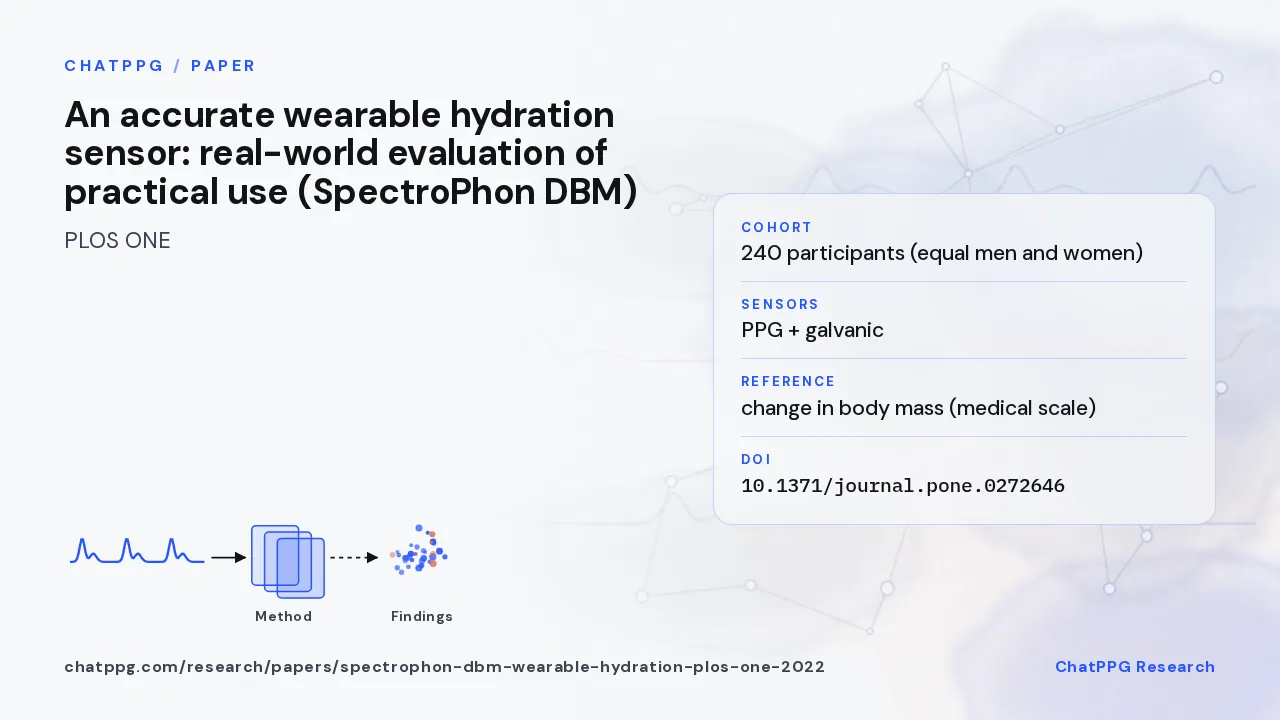
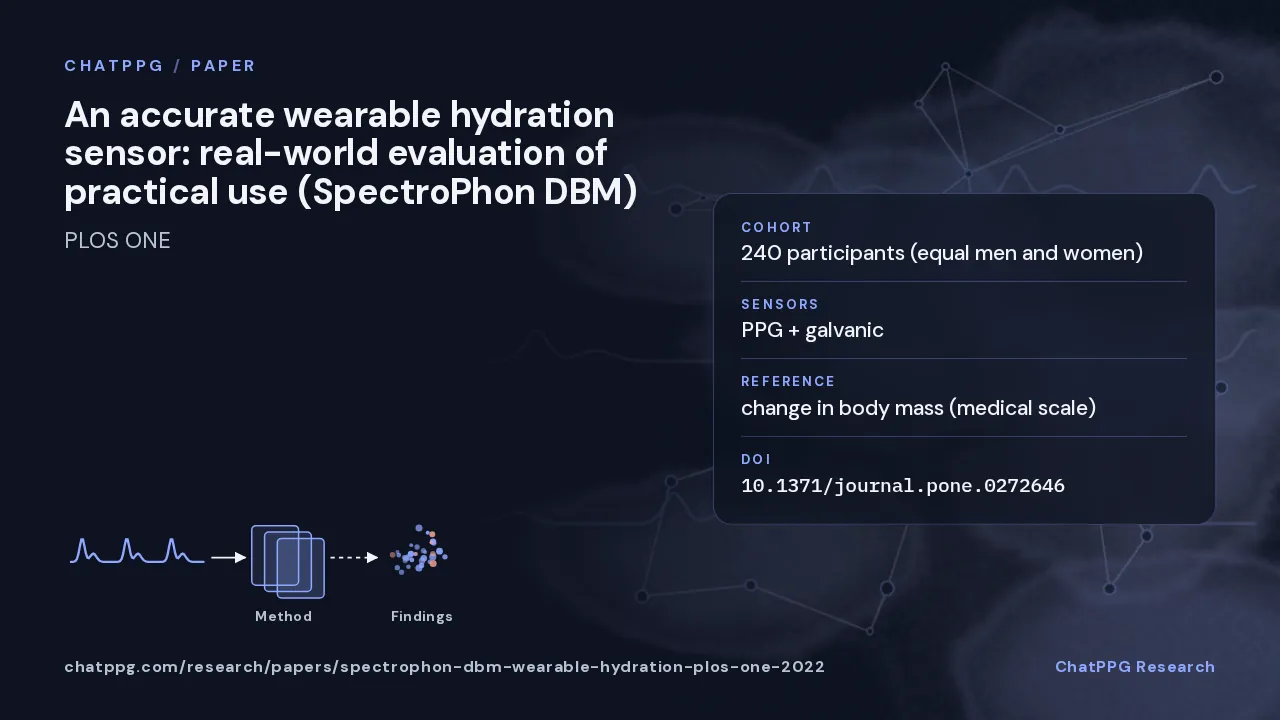
This study tested a wearable hydration sensor that combines PPG and galvanic sensors in a field trial with 240 participants, half men and half women. Device readings went to a phone over Bluetooth every 20 seconds and were compared with change in body mass on a medical scale. Agreement was close, with an average normalized error of about 2%, and fewer than 5% of values fell outside the Bland-Altman limits.
- Sensors: PPG + galvanic
- Reference: change in body mass (medical scale)
- Result: ~2% normalized RMS error
- Venue
- PLOS ONE
- Published
- 2022
- arXiv
- Not reported
- PMID
- Not reported
- Signals
- Not reported
- Form factor
- Not reported
- Subjects
- 240 participants (equal men and women)
- Code
- Not reported
- Added
- Oct 13, 2026
Abstract
A wearable body hydration sensor employing photoplethysmographic and galvanic biosensors was field evaluated using 240 human participants with equal numbers of men and women volunteers. Monitoring of water mass loss due to perspiration was performed by medical balance measurements following one of two different treadmill physical exercise regimens over 90 minutes in 15-minute intervals with intervening 10-minute rest periods. Participants wore two different models of the dehydration body monitor device mated to commercially-available smartwatches (Samsung Gear S2 and Samsung Gear Fit2). Device output was recorded by Bluetooth wireless link to a standard smartphone in 20-second blocks. Comparison of the devices with the standard measurement method (change in body mass measured by medical balance) indicated very close agreement between changes in body water mass and device output (percent normalized mean root square error averaged approximately 2% for all participants). Bland-Altman analyses of method agreement indicated that <5% of participant values fell outside of the 95% confidence interval limits of agreement and all measured value differences were normally distributed around the line of equality. The results of this first-ever field trial of a practical, wearable hydration monitor suggests that this device will be a reliable tool to aid in geriatric hydration monitoring and physical training scenarios.
Verbatim fromthe publisher's DOI record· Publisher licence: http://creativecommons.org/licenses/by/4.0/
How it works
- Cohort
- 240 participants (equal men and women)
Cite
@article{spectrophondbmwearablehy2022,
  title = {{An accurate wearable hydration sensor: real-world evaluation of practical use (SpectroPhon DBM)}},
  author = {Dmitry Rodin and Yair Shapiro and Albert Pinhasov and Anatoly Kreinin and Michael Kirby},
  year = {2022},
  journal = {PLOS ONE},
  doi = {10.1371/journal.pone.0272646}
}History
Added to the ChatPPG research hub