You can monitor your hydration level using your smartphone camera
Activity counts measure attention, not model quality. Missing counts are unknown. Publication status follows the linked source; a listed venue alone does not confirm peer review.
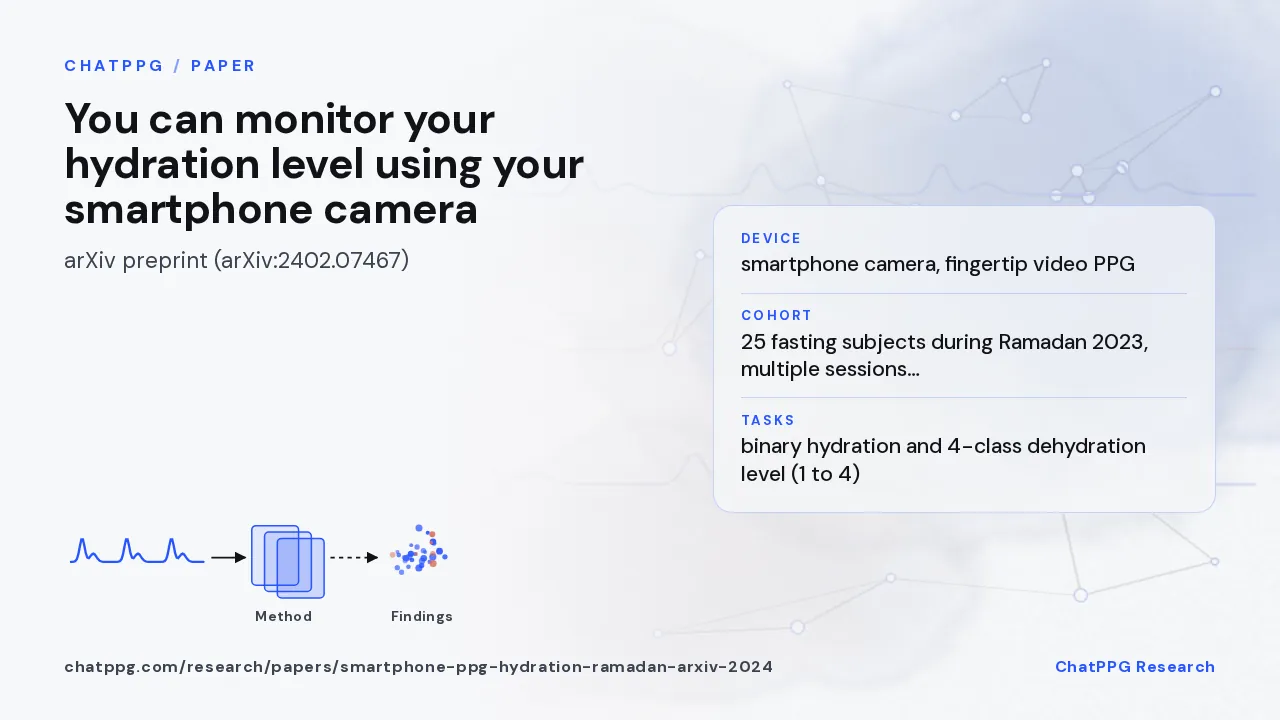
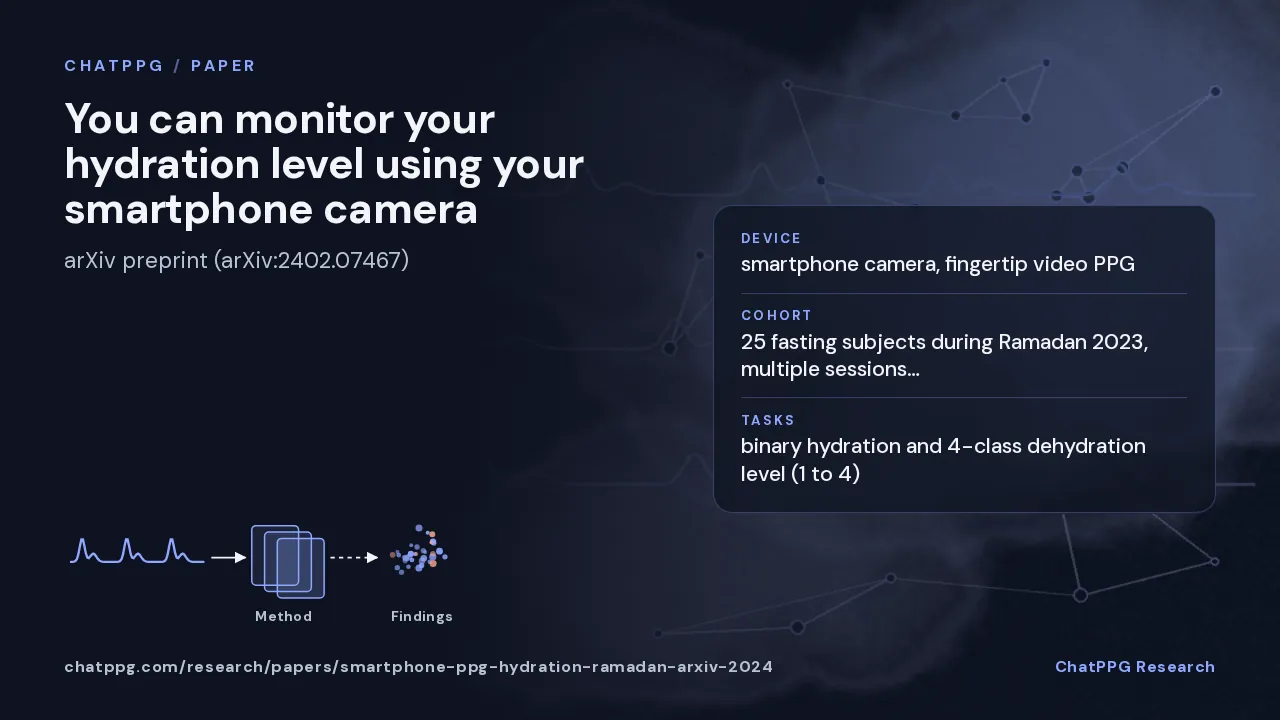
This preprint proposes checking hydration with an ordinary smartphone: the user records a short fingertip video, and a PPG signal extracted from it is classified into hydration levels. The authors built a multi-session dataset from 25 people fasting during Ramadan 2023 and trained machine learning, deep learning and transformer models for a hydrated / not hydrated task and a four-level task (fully hydrated to extremely dehydrated). They report accuracies of 95% to 99%, and explain the deep model's decisions with SHAP. The cohort is small and the dataset is not public.
- Tasks: binary hydration and 4-class dehydration level (1 to 4)
- Result: reported accuracy 95%–99% across ML, deep learning and transformer models
- Venue
- arXiv preprint (arXiv:2402.07467)
- Published
- 2024
- DOI
- Not reported
- arXiv
- Not reported
- PMID
- Not reported
- Licence
- Not reported
- Signals
- Not reported
- Form factor
- Not reported
- Subjects
- 25 fasting subjects during Ramadan 2023, multiple sessions each
- Code
- Not reported
- Added
- Oct 13, 2026
Abstract
This study presents the first demonstration of a smartphone-based, non-invasive method for dehydration monitoring, effectively transforming a regular mobile device into a virtual medical instrument. The proposed technique requires users to record a short video of their fingertip using the smartphone camera while covering the lens with the index finger. This enables the extraction of a photoplethysmography (PPG) signal, which captures peripheral blood volume fluctuations that correlate with changes in hydration status. A key challenge in non-clinical dehydration assessment is the absence of biochemical ground truth. To address this, we conducted a controlled study with 50 fasting individuals over a 13-hour period. Fingertip videos were recorded four times at regular intervals during fasting, leveraging the monotonic decline in hydration to label data as fully hydrated, mildly dehydrated, moderately dehydrated, and severely dehydrated. We pre-processed the collected PPG signals and used them to train a range of artificial intelligence (AI) models for classifying hydration status on a 1 to 4 scale. Additionally, we employed SHapley Additive exPlanations (SHAP) to interpret model decisions. This method, being a non-biochemistry-based approach, does not intend to replace clinical dehydration diagnostic procedures. Rather, it is proposed as a complementary, first-aid screening tool for use in non-hospital environments. Our findings indicate that smartphones can offer rapid, cost-effective, and user-friendly hydration monitoring, paving the way for scalable, patient-centric health solutions. This proposed method is anticipated to be an essential ingredient of smart homes, wearable health ecosystems, and the broader vision of intelligent cities.
Verbatim fromOpenAlex· Abstract via OpenAlex (publisher-deposited); © the authors/publisher
How it works
- Device
- smartphone camera, fingertip video PPG
- Cohort
- 25 fasting subjects during Ramadan 2023, multiple sessions each
Cite
@article{smartphoneppghydrationra2024,
  title = {{You can monitor your hydration level using your smartphone camera}},
  author = {Rose Alaslani and Levina Perzhilla and Muhammad Mahboob Ur Rahman and Taous-Meriem Laleg-Kirati and Tareq Y. Al-Naffouri},
  year = {2024},
  journal = {arXiv preprint (arXiv:2402.07467)}
}History
Added to the ChatPPG research hub