PaperarXiv:2608.09204
Effect of Photoplethysmogram Artifacts on Uncertainty in Atrial Fibrillation Detection
arXiv preprint
TL;DR
This study measured how different PPG artifacts affect the uncertainty of atrial fibrillation detectors. Two detectors, one on raw 25-second PPG and one on rhythm-irregularity features, were trained on wrist PPG from cardiac rehabilitation and tested on 260,000 signals with controlled artifacts. On clean signals the feature-based detector did better (0.94/0.94 sensitivity/specificity vs 0.92/0.86), and device displacement hurt the raw-signal detector most.
- Result: Using artifact-free PPG signals, $\mathit{D}f$ outperforms $\mathit{D}r$ with sensitivity/specificity of 0.94/0.94 versus 0.92/0.86.
- Result: Relative to artifact-free performance, sensitivity/specificity drops by 0.52/0.03, 0.25/0.03, 0.16/0.02, and 0.07/0.02 using $\mathit{D}r$ for 12-s artifacts of device displacement, forearm motion, hand motion, and poor contact respectively.
Abstract
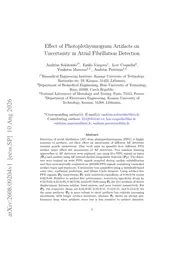
Detection of atrial fibrillation (AF) from photoplethysmogram (PPG) is highly sensitive to artifacts, yet their effect on uncertainty of different AF detectors remains poorly understood. This work aims to quantify how different PPG artifact types affect the uncertainty of AF detectors. Two machine learning approaches to AF detection were explored: one using 25-s PPG signals as input (D_r) and another using AF-related rhythm irregularity features (D_f). The detectors were trained on wrist PPG signals acquired during cardiac rehabilitation and then systematically evaluated on 260,000 PPG signals containing controlled artifact types and durations. Uncertainty was quantified using a threshold-based error rate, conformal prediction, and Monte Carlo dropout. Using artifact-free PPG signals, D_f outperforms D_r with sensitivity/specificity of 0.94/0.94 versus 0.92/0.86. Relative to artifact-free performance, sensitivity/specificity drops by 0.52/0.03, 0.25/0.03, 0.16/0.02, and 0.07/0.02 using D_r for 12-s artifacts of device displacement, forearm motion, hand motion, and poor contact respectively. For D_f, the respective drops are 0.31/0.07, 0.19/0.11, 0.14/0.15, and 0.13/0.21 for the same artifacts. D_f is more robust to short artifacts but exhibits increasing uncertainty with longer artifact durations, whereas D_r shows an abrupt performance drop when artifacts occur but is less sensitive to artifact duration. Applying conformal prediction with 90% coverage reduces the false-positive rate by up to 12% for D_r and up to 64% for D_f. Artifact type and duration have detector-specific effects on AF detection uncertainty. Device displacement causes the largest increase in uncertainty.
Verbatim from arXiv (opens in a new tab) · arXiv metadata (abstracts are released under CC0)
Results on ChatPPG leaderboards
All leaderboardsNo results from this paper on ChatPPG leaderboards yet. Browse the leaderboards.
Tasks & signals
Tasks
Signals
Keywords
How it works
Cite this paper
Sološenko, A., Vargova, E., Coquelin, L., Marozas, V., & Petrėnas, A. (2026). Effect of Photoplethysmogram Artifacts on Uncertainty in Atrial Fibrillation Detection. arXiv preprint. https://arxiv.org/abs/2608.09204
Sološenko, Andrius, Enikö Vargova, Loïc Coquelin, Vaidotas Marozas, and Andrius Petrėnas. 2026. "Effect of Photoplethysmogram Artifacts on Uncertainty in Atrial Fibrillation Detection." arXiv preprint. https://arxiv.org/abs/2608.09204.
Sološenko, A., Vargova, E., Coquelin, L., Marozas, V. and Petrėnas, A. (2026) 'Effect of Photoplethysmogram Artifacts on Uncertainty in Atrial Fibrillation Detection', arXiv preprint. Available at: https://arxiv.org/abs/2608.09204
Sološenko, Andrius, et al. "Effect of Photoplethysmogram Artifacts on Uncertainty in Atrial Fibrillation Detection." arXiv preprint, 2026. https://arxiv.org/abs/2608.09204.
A. Sološenko, E. Vargova, L. Coquelin, V. Marozas, and A. Petrėnas, "Effect of Photoplethysmogram Artifacts on Uncertainty in Atrial Fibrillation Detection," arXiv preprint, 2026, [Online]. Available: https://arxiv.org/abs/2608.09204.
@misc{solosenko2026effect,
  title         = {{Effect of Photoplethysmogram Artifacts on Uncertainty in Atrial Fibrillation Detection}},
  author        = {Sološenko, Andrius and Vargova, Enikö and Coquelin, Loïc and Marozas, Vaidotas and Petrėnas, Andrius},
  year          = {2026},
  howpublished  = {arXiv preprint},
  eprint        = {2608.09204},
  archivePrefix = {arXiv}
}