PaperarXiv:2604.27500
From Elastic to Viscoelastic: An EEMD-Enhanced Pulse Transit Time Model for Robust Blood Pressure Estimation
arXiv preprint (cs.HC, eess.SP) · 4 pages, 5 figures
 (opens in a new tab)
Gu, Boyuan et al., "From Elastic to Viscoelastic: An EEMD-Enhanced Pulse Transit Time Model for Robust Blood Pressure Estimation", arXiv:2604.27500, CC BY-SA 4.0
TL;DR
Cuffless blood pressure (BP) estimation based on Pulse Transit Time (PTT) has emerged as a promising solution for continuous health monitoring. However, conventional models relying on the Moens-Korteweg equation often fail during rapid hemodynamic fluctuations, as they assume arterial walls are purely elastic and neglect inherent viscoelasticity. First, raw photoplethysmogram (PPG) signals undergo high-fidelity reconstruction using Modified Akima (Makima) interpolation.
- Form factor: other
Abstract
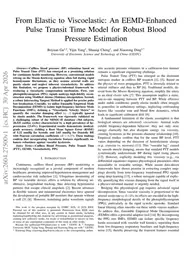
Cuffless blood pressure (BP) estimation based on Pulse Transit Time (PTT) has emerged as a promising solution for continuous health monitoring. However, conventional models relying on the Moens-Korteweg equation often fail during rapid hemodynamic fluctuations, as they assume arterial walls are purely elastic and neglect inherent viscoelasticity. To address this limitation, we propose a physics-informed framework introducing a viscoelastic compensation mechanism. First, raw photoplethysmogram (PPG) signals undergo high-fidelity reconstruction using Modified Akima (Makima) interpolation. Second, a robust Intersecting Tangent Method is applied for precise pulse foot localization. Crucially, we utilize Ensemble Empirical Mode Decomposition (EEMD) to isolate high-frequency Intrinsic Mode Functions (IMFs), defining a ``Viscoelastic Velocity Metric'' to quantify the vascular damping effect ( ) typically ignored by elastic models. The framework was rigorously validated on a challenging subset of the MIMIC-II database (364 subjects, 28,525 cardiac cycles) characterized by a high prevalence of hypertension (23.4%). Experimental results demonstrate medical-grade accuracy, yielding a Root Mean Square Error (RMSE) of 5.22 mmHg for Systolic and 3.65 mmHg for Diastolic BP, with Pearson correlation coefficients (R > 0.97). These findings confirm that incorporating viscoelastic features significantly enhances robustness against vascular hysteresis.
Verbatim from arXiv (opens in a new tab) · arXiv metadata (abstracts are released under CC0)
Results on ChatPPG leaderboards
All leaderboardsNo results from this paper on ChatPPG leaderboards yet. Browse the leaderboards.
Tasks & signals
Tasks
Signals
Keywords
How it works
Cite this paper
APA
Gu, B., Yang, Y., Cheng, S., & Ding, X. (2026). From Elastic to Viscoelastic: An EEMD-Enhanced Pulse Transit Time Model for Robust Blood Pressure Estimation. arXiv preprint · 4 pages, 5 figures. https://doi.org/10.48550/arXiv.2604.27500
BibTeX
@misc{gu2026from,
  title         = {{From Elastic to Viscoelastic: An EEMD-Enhanced Pulse Transit Time Model for Robust Blood Pressure Estimation}},
  author        = {Gu, Boyuan and Yang, Yijin and Cheng, Shuaiqi and Ding, Xiaorong},
  year          = {2026},
  howpublished  = {arXiv preprint · 4 pages, 5 figures},
  doi           = {10.48550/arXiv.2604.27500},
  eprint        = {2604.27500},
  archivePrefix = {arXiv}
}
Built from the hub record. Check it against the publisher before submitting.
Added to the ChatPPG research hub