Paperdoi:10.3389/fbioe.2026.1941539
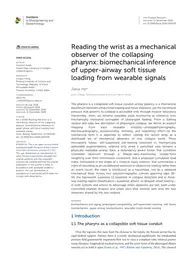
Reading the wrist as a mechanical observer of the collapsing pharynx: biomechanical inference of upper-airway soft tissue loading from wearable signals
Frontiers in Bioengineering and Biotechnology 14:1941539 (2026)
 (opens in a new tab)
Jiarui He, "Reading the wrist as a mechanical observer of the collapsing pharynx: biomechanical inference of upper-airway soft tissue loading from wearable signals", doi:10.3389/fbioe.2026.1941539, CC BY 4.0
TL;DR
Physics-motivated multimodal sleep-apnea model that maps each sensor to a term in a collapsible-airway model and pre-trains only on physically realizable augmentations. On MESA (1,824 subjects, 365 test) it reports apnea AUROC 0.937 vs 0.929 for SleepFM. On CinC 2018 obstructive/central/mixed typing it reports macro-F1 0.755 vs 0.731.
Abstract
The pharynx is a collapsible soft-tissue conduit whose patency is a mechanical equilibrium between intraluminal loading and tissue elastance, yet the transmural pressure that governs its collapse is accessible only through invasive laboratory manometry. Here, we reframe wearable sleep monitoring as inference over mechanically motivated surrogates of pharyngeal loading. From a Starling resistor and tube law description of pharyngeal collapse, we derive an explicit mapping from each wearable modality—photoplethysmography, electrocardiography, accelerometry, oximetry, and respiratory effort—to the mechanical term it is expected to reflect, casting the sensor array as a distributed set of mechanical observers of one collapse event. Three innovations follow: self-supervised pre-training restricted to mechanically admissible augmentations, retained only when a perturbed view remains a physically realizable airway state; a redundancy-aware fusion that combines correlated observers through a Sharpe-ratio-maximizing, closed-form weighting over their information covariance; and a proposed cumulative load index, formulated in the shape of a classical injury criterion, that summarizes a night of recording as an uncalibrated exposure to obstructive loading rather than an event count; the index is introduced as a hypothesis, not as a validated mechanical dose. Across two polysomnographic cohorts spanning ages 18–94, the framework surpasses 13 baselines in collapse detection and in three-way loading regime classification—sustained, absent, or delayed-onset loading—in both cohorts and retains its advantage when observers are lost, both under controlled channel dropout and under zero-shot transfer with only the two observers shared by the two corpora.
Verbatim from the publisher's DOI record (opens in a new tab) · Publisher licence: https://creativecommons.org/licenses/by/4.0/
Results on ChatPPG leaderboards
All leaderboardsNo results from this paper on ChatPPG leaderboards yet. Browse the leaderboards.
Tasks & signals
Tasks
Signals
Keywords
Datasets used
How it works
Cite this paper
He, J. (2026). Reading the wrist as a mechanical observer of the collapsing pharynx: biomechanical inference of upper-airway soft tissue loading from wearable signals. Frontiers in Bioengineering and Biotechnology, 14, 1941539. https://doi.org/10.3389/fbioe.2026.1941539
He, Jiarui. 2026. "Reading the wrist as a mechanical observer of the collapsing pharynx: biomechanical inference of upper-airway soft tissue loading from wearable signals." Frontiers in Bioengineering and Biotechnology 14: 1941539. https://doi.org/10.3389/fbioe.2026.1941539.
He, J. (2026) 'Reading the wrist as a mechanical observer of the collapsing pharynx: biomechanical inference of upper-airway soft tissue loading from wearable signals', Frontiers in Bioengineering and Biotechnology, 14, p. 1941539. doi: 10.3389/fbioe.2026.1941539.
He, Jiarui "Reading the wrist as a mechanical observer of the collapsing pharynx: biomechanical inference of upper-airway soft tissue loading from wearable signals." Frontiers in Bioengineering and Biotechnology, vol. 14, 2026, p. 1941539. https://doi.org/10.3389/fbioe.2026.1941539.
J. He, "Reading the wrist as a mechanical observer of the collapsing pharynx: biomechanical inference of upper-airway soft tissue loading from wearable signals," Frontiers in Bioengineering and Biotechnology, vol. 14, p. 1941539, 2026, doi: 10.3389/fbioe.2026.1941539.
@article{he2026reading,
  title         = {{Reading the wrist as a mechanical observer of the collapsing pharynx: biomechanical inference of upper-airway soft tissue loading from wearable signals}},
  author        = {He, Jiarui},
  year          = {2026},
  journal       = {Frontiers in Bioengineering and Biotechnology},
  volume        = {14},
  pages         = {1941539},
  doi           = {10.3389/fbioe.2026.1941539}
}Added to the ChatPPG research hub