Model

Tiny-PPG

Cite
Venue listedCatalog paper date: 2024Added to atlas: Nov 6, 2026Source

Activity counts measure attention, not model quality. Missing counts are unknown. Publication status follows the linked source; a listed venue alone does not confirm peer review.

Point-wise wrist-PPG artifact segmenter. Table 1 DICE 87.4% (85.9k params) / pruned 87.2% (19.7k). 30 s @ 64 Hz.

Parameters
0.019726M
Signals
PPG
Form factor
Wrist
Year
2023
Architecture

depth-wise separable CNN + ASPP; optional prune to ~19.7k params

At a glance
Type
Task model
Modalities
PPG
Form factor
Wrist
Parameters
0.019726M
Architecture
depth-wise separable CNN + ASPP; optional prune to ~19.7k params
Venue
Not reported
Year
2023
Code
Open
Weights
Not released
Licence
Not reported
Caveats
Not reported
Datasets
Added
Nov 6, 2026
Updated
Nov 6, 2026

Abstract

Photoplethysmogram (PPG) signals are easily contaminated by motion artifacts in real-world settings, despite their widespread use in Internet-of-Things (IoT) based wearable and smart health devices for cardiovascular health monitoring. This study proposed a lightweight deep neural network, called Tiny-PPG, for accurate and real-time PPG artifact segmentation on IoT edge devices. The model was trained and tested on a public dataset, PPG DaLiA, which featured complex artifacts with diverse lengths and morphologies during various daily activities of 15 subjects using a watch-type device (Empatica E4). The model structure, training method and loss function were specifically designed to balance detection accuracy and speed for real-time PPG artifact detection in resource-constrained embedded devices. To optimize the model size and capability in multi-scale feature representation, the model employed depth-wise separable convolution and atrous spatial pyramid pooling modules, respectively. Additionally, the contrastive loss was also utilized to further optimize the feature embeddings. With additional model pruning, Tiny-PPG achieved state-of-the-art detection accuracy of 87.4% while only having 19,726 model parameters (0.15 megabytes), and was successfully deployed on an STM32 embedded system for real-time PPG artifact detection. Therefore, this study provides an effective solution for resource-constraint IoT smart health devices in PPG artifact detection.
Verbatim fromarXiv· arXiv metadata (abstracts are released under CC0)

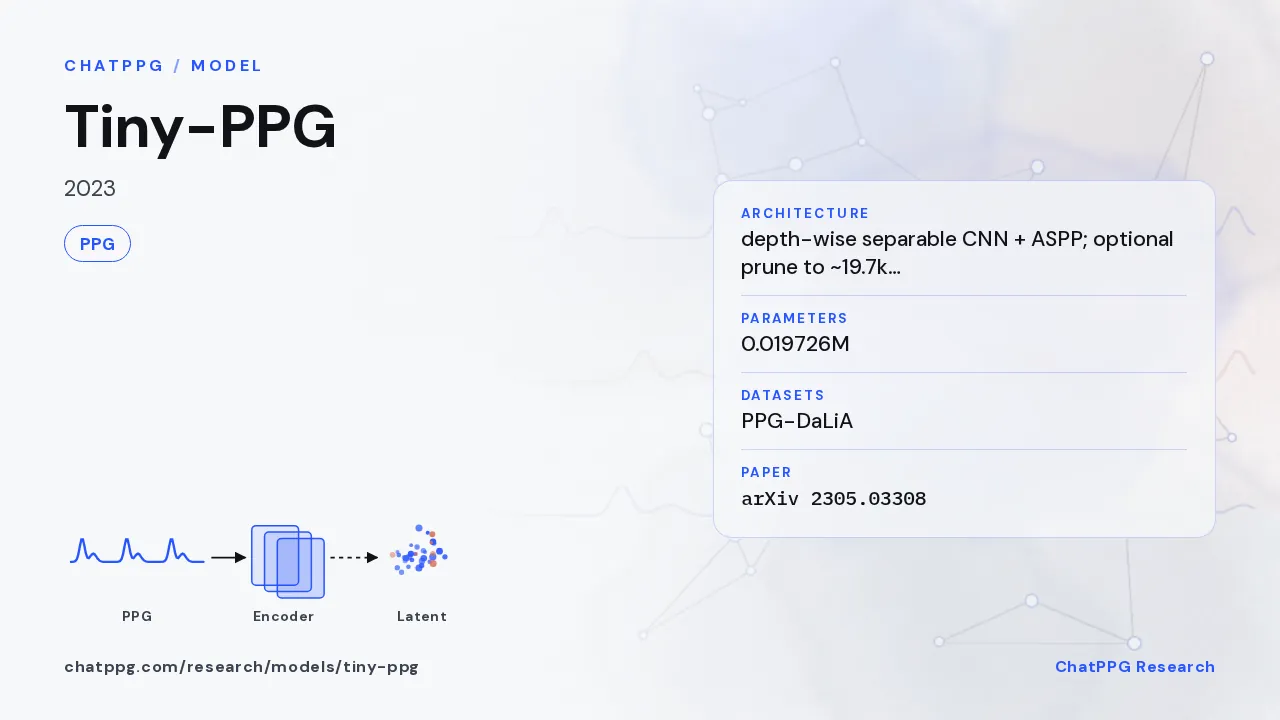
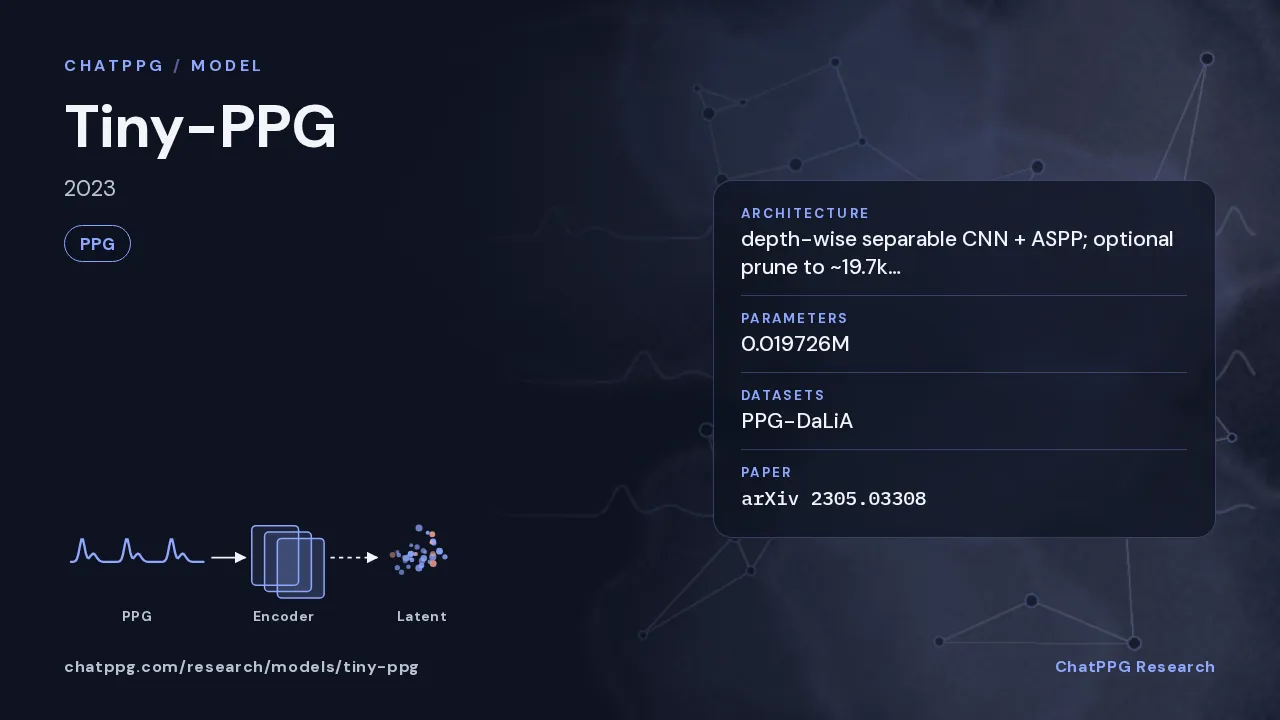
Tiny-PPG: ChatPPG research summary card

How it works

How Tiny-PPG works: Input signals → Model → Downstream tasksInput signals: PPG (Photoplethysmogram). Dataset: PPG-DaLiA. Model: Tiny-PPG, 0.019726M parameters (Convolutional network · Contrastive learning). Downstream tasks: Signal quality; Signal denoising.Input signalsPPG: PhotoplethysmogramPPGPhotoplethysmogramDataset: PPG-DaLiADatasetPPG-DaLiAModelTiny-PPG0.019726M parametersConvolutional network · Contrastive…Downstream tasksSignal qualitySignal qualitySignal denoisingSignal denoising

Datasets linked in the hub; pretraining vs evaluation roles follow the paper.

Architecture
depth-wise separable CNN + ASPP; optional prune to ~19.7k params
Inputs
PPG
Approach
sqi · motion artifact · edge · ppg only · comparison only until licence · dice

Devices· 2

Full photo credits and licences are on each device page. An icon means we have no openly licensed or manufacturer-cleared photo of that exact device yet.

Datasets used· 1

Cite this model

Cite the publication recorded for this model. Check it against the publisher before submitting.

Tiny-PPG: A Lightweight Deep Neural Network for Real-Time Detection of Motion Artifacts in Photoplethysmogram Signals on Edge Devices. (2023). Internet of Things. https://doi.org/10.1016/j.iot.2023.101007
@article{tinyppg2023tinyppg,
  title         = {{Tiny-PPG: A Lightweight Deep Neural Network for Real-Time Detection of Motion Artifacts in Photoplethysmogram Signals on Edge Devices}},
  year          = {2023},
  journal       = {Internet of Things},
  doi           = {10.1016/j.iot.2023.101007},
  eprint        = {2305.03308},
  archivePrefix = {arXiv}
}

History

  1. Added to the ChatPPG research hub