Activity counts measure attention, not model quality. Missing counts are unknown. Publication status follows the linked source; a listed venue alone does not confirm peer review.
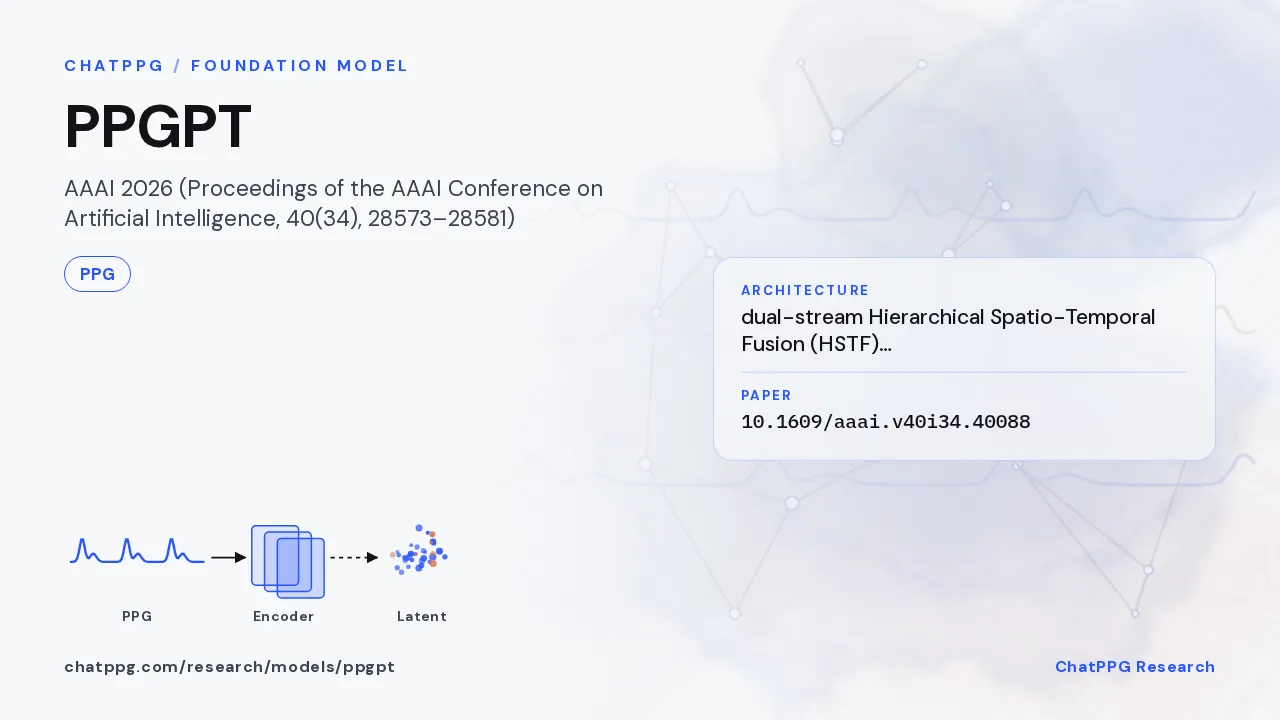
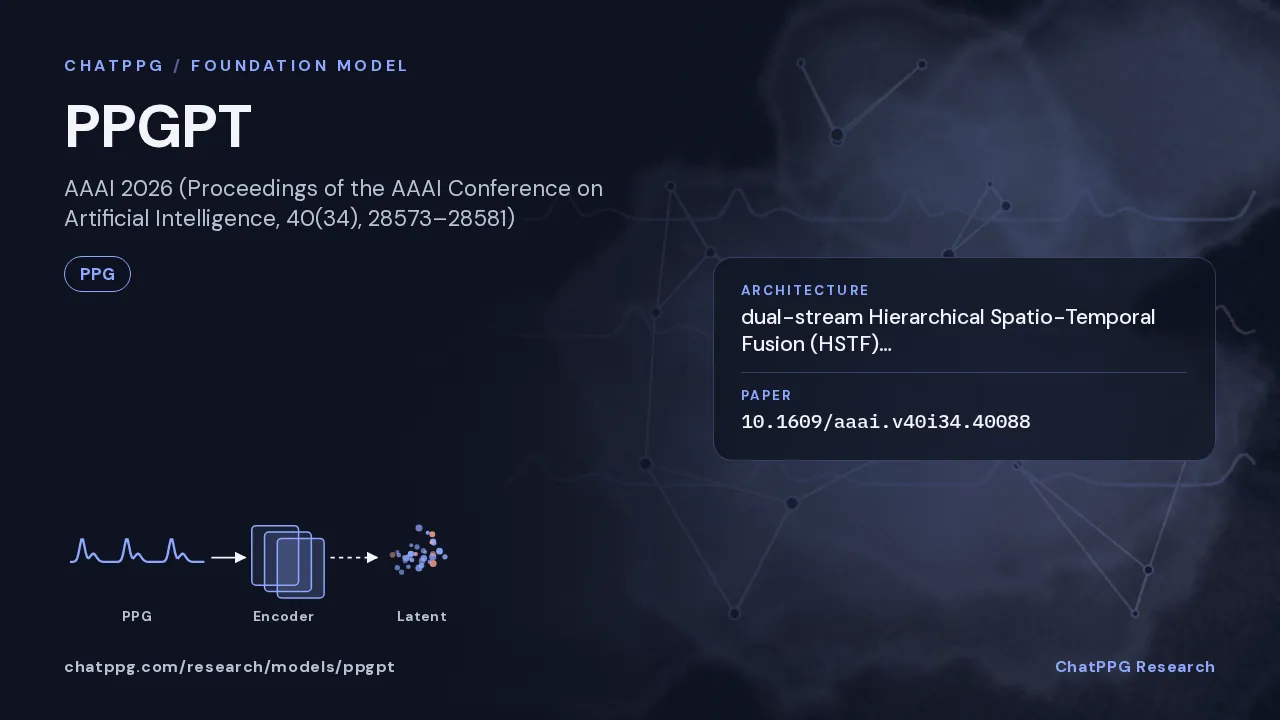
PPGPT is a photoplethysmography foundation model described in AAAI 2026. The authors reformulate next-token prediction as next-feature token prediction (NFTP) and use a dual-stream encoder that jointly models temporal dynamics and local-global morphological patterns. The official repository names that encoder Hierarchical Spatio-Temporal Fusion (HSTF) and pairs it with a DeepSeekMoE decoder. The paper says the model was pre-trained on a mixed dataset of 1.6 billion data points and evaluated on the authors' BioMTL benchmark: 172 subjects over 285 days, seven tasks. The official README specifies 1,808 four-second fingertip-PPG windows at 1000 Hz, with regression labels for SBP, DBP, blood glucose, heart rate and BMI, and classification labels for mental stress, hypertension and type-2 diabetes. The authors report a 16.5% improvement in F1-score and a 25.9% reduction in MAE versus competing methods, plus few-shot results. Code is on GitHub under MIT; the repository has no trained weights, and BioMTL is released under a data-use agreement.
Signals
PPG
Year
2026
Published
AAAI 2026 (Proceedings of the AAAI Conference on Artificial Intelligence, 40(34), 28573–28581, doi:10.1609/aaai.v40i34.40088), 14 March 2026
Authors
Zexing Zhang, Huimin Lu, Qingxin Zhao (Changchun University of Technology)
Architecture
dual-stream Hierarchical Spatio-Temporal Fusion (HSTF) encoder with a DeepSeekMoE decoder; pre-training objective is next-feature token prediction (NFTP). Official code at https://github.com/PPGPT/AAAI2026 (MIT).
Pretraining data
a mixed dataset of 1.6 billion data points (composition not itemized on the publisher abstract or the official repository README).
Evaluation
authors’ BioMTL benchmark, 1,808 four-second fingertip-PPG windows (1000 Hz) from 172 subjects over 285 days, seven tasks (SBP, DBP, blood glucose, heart rate, BMI; mental stress, hypertension, type-2 diabetes). Dataset access is by data-use agreement. The repository does not include trained weights.
Result
the authors report a 16.5% improvement in F1-score and a 25.9% reduction in MAE versus competing methods on BioMTL, plus few-shot results. Baselines and per-task scores are in the paper.
Cite the publication recorded for this model. Check it against the publisher before submitting.
Zhang, Z., Lu, H., & Zhao, Q. (2026). PPGPT: Transferring Next-Token Modeling from Language to PPG Signals. AAAI 2026. https://doi.org/10.1609/aaai.v40i34.40088
Zhang, Zexing, Huimin Lu, and Qingxin Zhao. 2026. "PPGPT: Transferring Next-Token Modeling from Language to PPG Signals." AAAI 2026. https://doi.org/10.1609/aaai.v40i34.40088.
Zhang, Z., Lu, H. and Zhao, Q. (2026) 'PPGPT: Transferring Next-Token Modeling from Language to PPG Signals', AAAI 2026. doi: 10.1609/aaai.v40i34.40088.
Zhang, Zexing, et al. "PPGPT: Transferring Next-Token Modeling from Language to PPG Signals." AAAI 2026, 2026. https://doi.org/10.1609/aaai.v40i34.40088.
Z. Zhang, H. Lu, and Q. Zhao, "PPGPT: Transferring Next-Token Modeling from Language to PPG Signals," AAAI 2026, 2026, doi: 10.1609/aaai.v40i34.40088.
@inproceedings{zhang2026ppgpt,
  title         = {{PPGPT: Transferring Next-Token Modeling from Language to PPG Signals}},
  author        = {Zhang, Zexing and Lu, Huimin and Zhao, Qingxin},
  year          = {2026},
  booktitle     = {AAAI 2026},
  doi           = {10.1609/aaai.v40i34.40088}
}
History
Added to the ChatPPG research hub
Newsletter
Get new PPG datasets, papers and models
Get alerts when PPGPT is benchmarked on new datasets, plus the weekly digest.
New datasets, papers and models
Practical guides from the hub
Unsubscribe anytime
The waveform is an illustration of a PPG pulse, not a recording.