Model

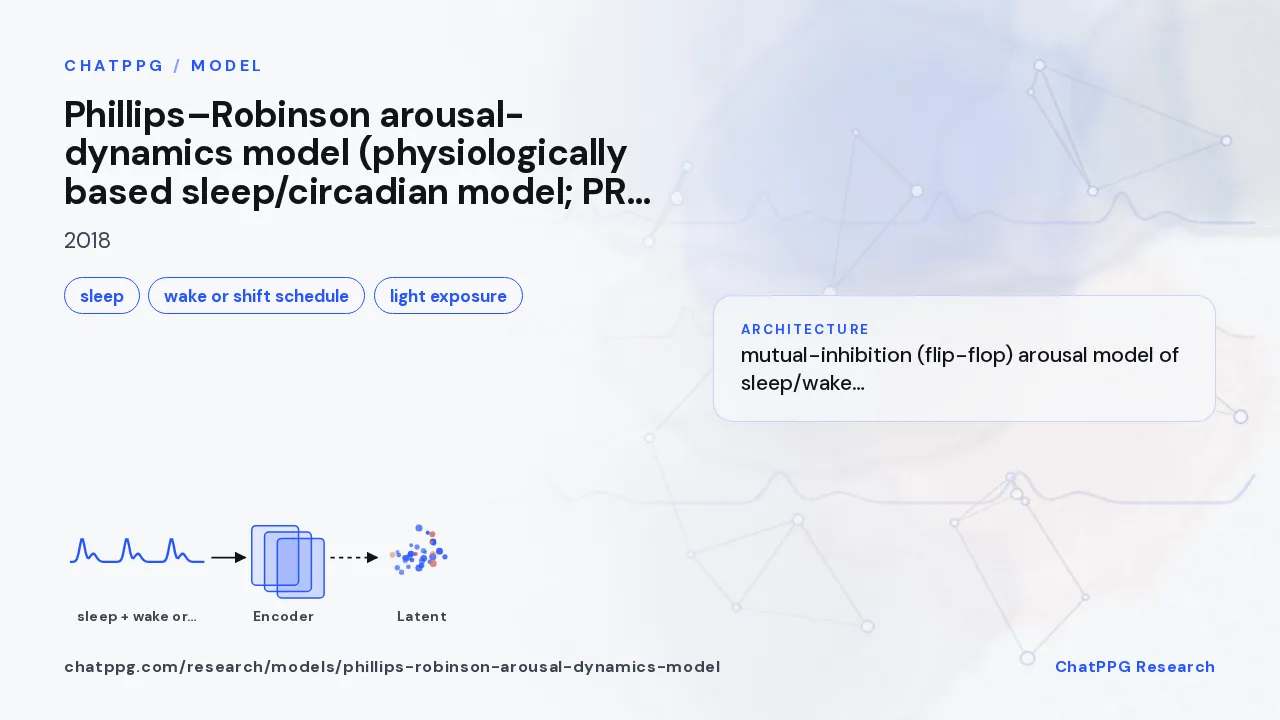
Phillips–Robinson arousal-dynamics model (physiologically based sleep/circadian model; PR model)

Cite
UnconfirmedCatalog paper date: 2018Added to atlas: Nov 9, 2026

Activity counts measure attention, not model quality. Missing counts are unknown. Publication status follows the linked source; a listed venue alone does not confirm peer review.

The Phillips–Robinson arousal-dynamics model is a physiologically based model of sleep and circadian arousal-state dynamics, taking sleep/wake history and light as inputs to predict sleep propensity and alertness. It is the modeling family used in later shift-work and forced-desynchrony studies cited from this entry.

Signals
light exposure, sleep/wake or shift schedule
Form factor
software (schedule/sleep/light input)
License
academic papers
Year
2018
Architecture

mutual-inhibition (flip-flop) arousal model of sleep/wake neuronal populations + light-driven circadian oscillator; PVT/KSS read-outs

At a glance
Type
Task model
Form factor
Software (schedule/sleep/light input)
Parameters
Not reported
Architecture
mutual-inhibition (flip-flop) arousal model of sleep/wake neuronal populations + light-driven circadian oscillator; PVT/KSS read-outs
Venue
Not reported
Year
2018
arXiv
Not reported
DOI
Not reported
Code
Not released
Weights
Not released
Licence
academic papers
Caveats
Not reported
Datasets
Not reported
Added
Nov 9, 2026
Updated
Nov 9, 2026
Phillips–Robinson arousal-dynamics model (physiologically based sleep/circadian model; PR model): ChatPPG research summary card

How it works

How Phillips–Robinson arousal-dynamics model (physiologically based sleep/circadian model; PR model) works: Input signals → Model → Downstream tasksInput signals: light exposure; sleep/wake or shift schedule. Model: Phillips–Robinson arousal-dynamics model (physiologically based sleep/circadian model; PR model). Downstream tasks: Stress.Input signalslight exposurelight exposuresleep/wake or shift schedulesleep/wake or shift scheduleModelPhillips–Robinson arousal-dyna…Downstream tasksStressStress
Architecture
mutual-inhibition (flip-flop) arousal model of sleep/wake neuronal populations + light-driven circadian oscillator; PVT/KSS read-outs
Inputs
light exposure, sleep/wake or shift schedule
Approach
fatigue · biomathematical · physiological · light

Datasets used

No public datasets linked yet.

Papers· 4

Cite this model

Cite the publication recorded for this model. Check it against the publisher before submitting.

Phillips–Robinson arousal-dynamics model (physiologically based sleep/circadian model; PR model). (2018).
@misc{phillipsrobinson2018phillipsrobinson,
  title         = {{Phillips–Robinson arousal-dynamics model (physiologically based sleep/circadian model; PR model)}},
  year          = {2018}
}

Source metadata: 2018

Record updated Nov 9, 2026

History

  1. Added to the ChatPPG research hub