Cite this model
UMP. (2016).
@misc{unifiedmodelofpe2016,
  title         = {{UMP}},
  year          = {2016}
}Unified Model of Performance (WRAIR/BHSAI, Reifman group)
Activity counts measure attention, not model quality. Missing counts are unknown. Publication status follows the linked source; a listed venue alone does not confirm peer review.
The Unified Model of Performance (WRAIR/BHSAI, Reifman group) predicts group-average neurobehavioral performance from sleep loss and caffeine by multiplying a dose-dependent caffeine factor onto caffeine-free performance. It was assessed in 14 laboratory and field conditions, covering seven sleep-loss schedules (from 5 h sleep each night to 85 h continuous wake) and six caffeine doses (placebo to repeated 200 mg or a single 600 mg dose), and predicted group-average PVT performance across those conditions (10.5665/sleep.6164).
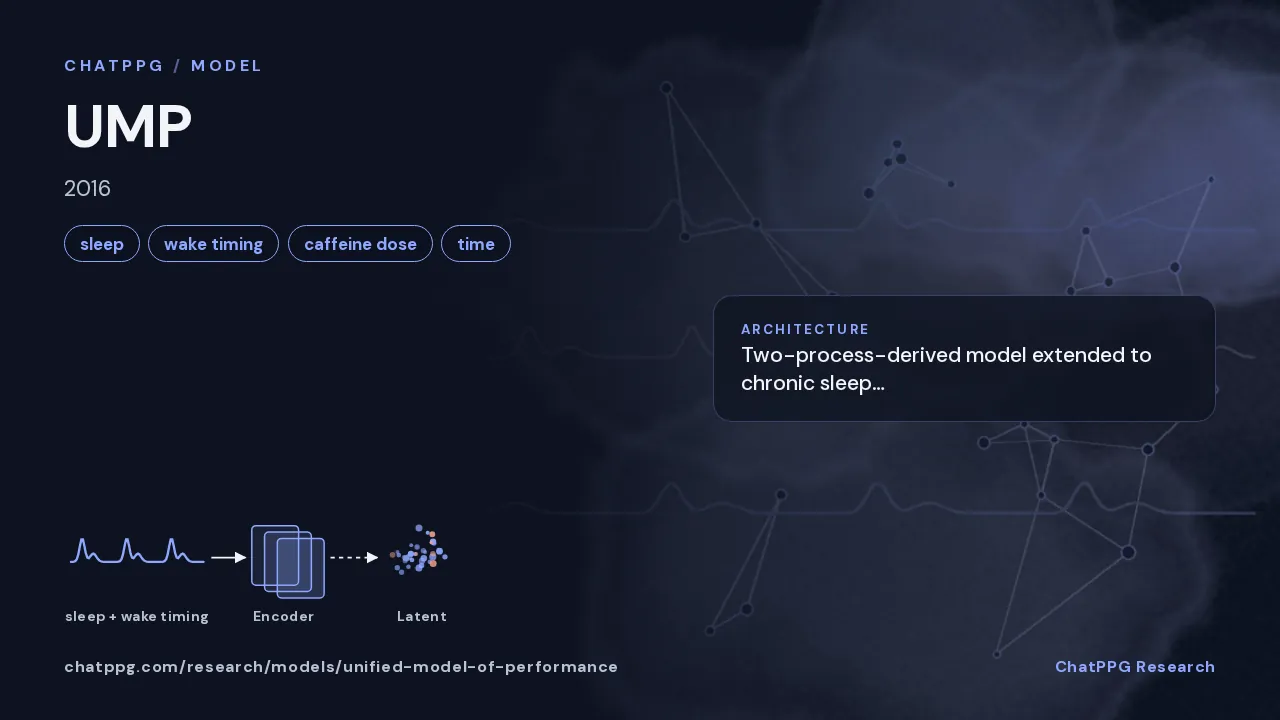
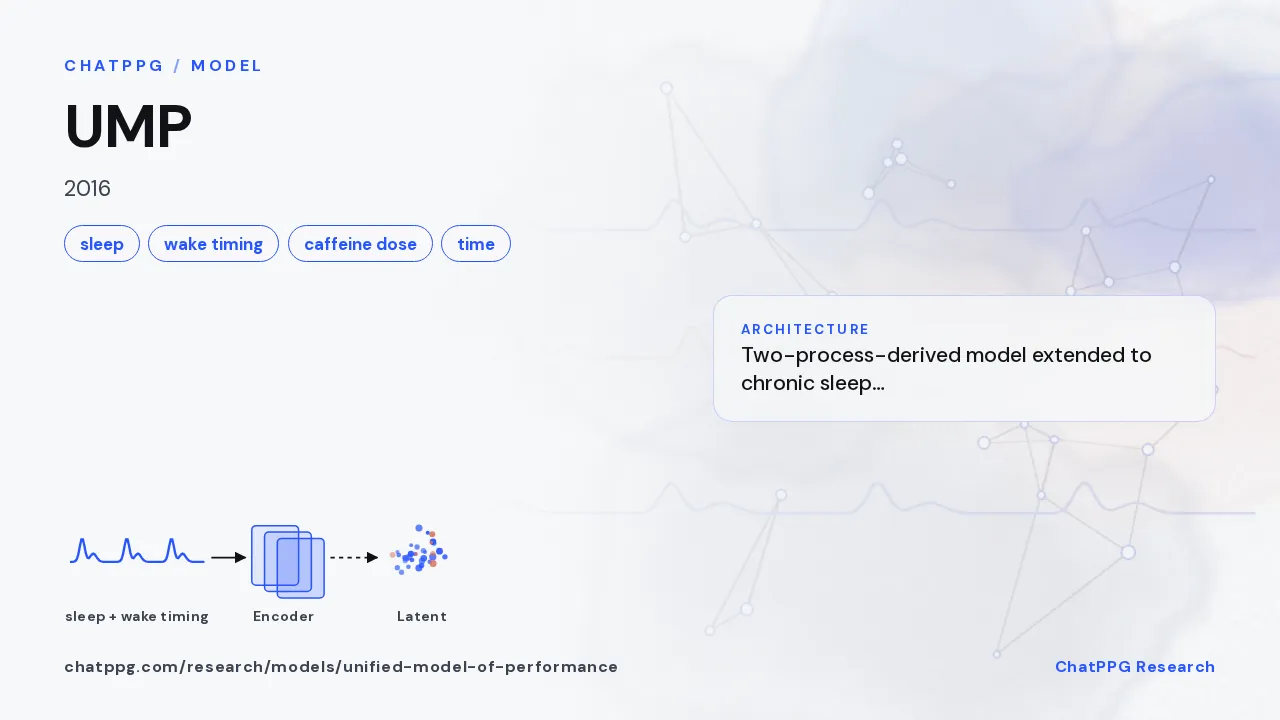
Two-process-derived model extended to chronic sleep restriction, with a multiplicative dose-dependent caffeine factor (2016); Bayesian individualisation in 2B-Alert
UMP. (2016).
@misc{unifiedmodelofpe2016,
title = {{UMP}},
year = {2016}
}Added to the ChatPPG research hub