Foundation model

LIMU-BERT

From “LIMU-BERT: Unleashing the Potential of Unlabeled Data for IMU Sensing Applications”
Published articlePublication date: Nov 15, 2021Added to atlas: Sep 26, 2026Source

Activity counts measure attention, not model quality. Missing counts are unknown. Publication status follows the linked source; a listed venue alone does not confirm peer review.

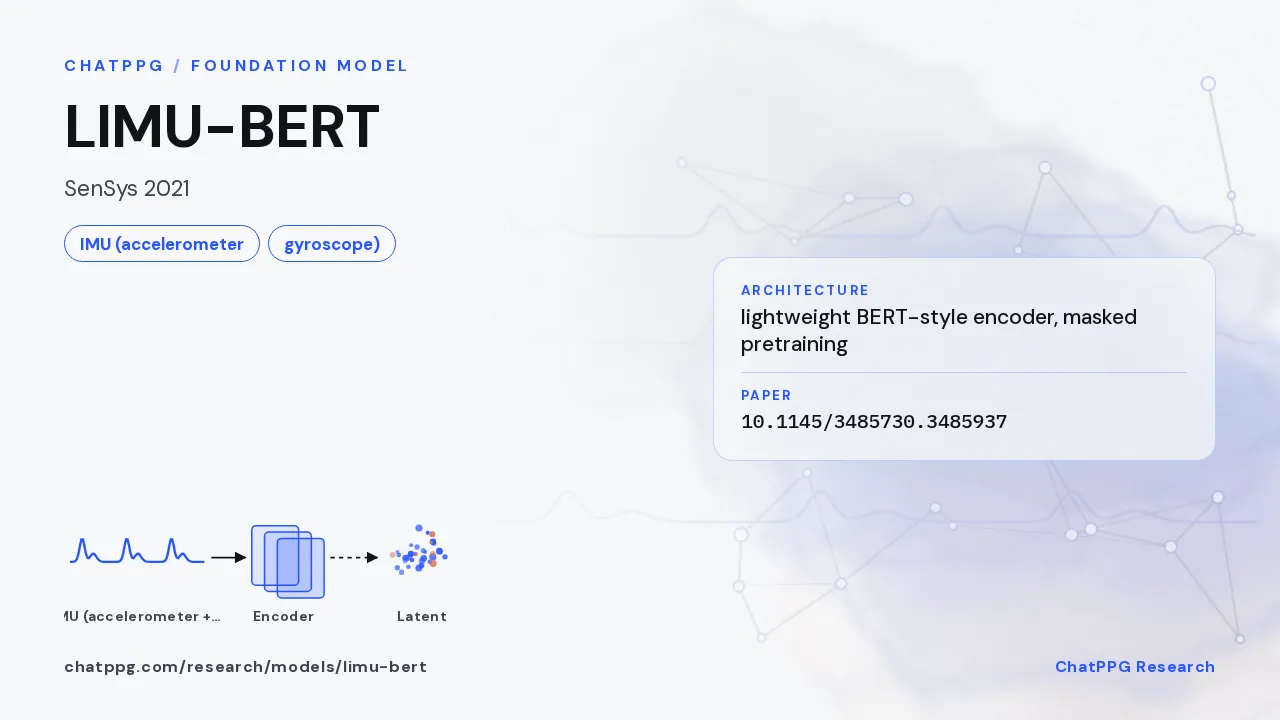
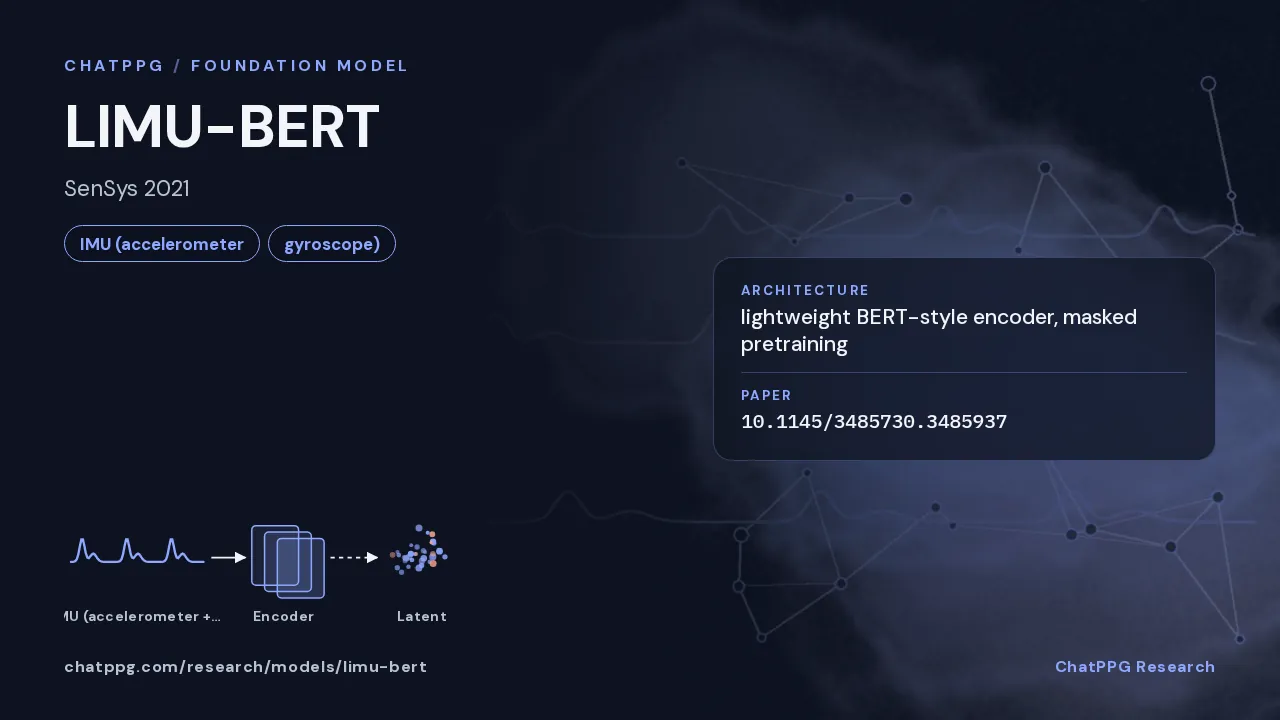
LIMU-BERT is a self-supervised model for IMU data that adapts BERT-style masked training to the properties of inertial sensors. The models are lightweight enough for mobile devices, and features learned from unlabelled data let task models trained on few labels beat earlier approaches. It was evaluated on four open datasets across two typical IMU sensing applications.

Published
ACM SenSys 2021
Signals
IMU
Evaluation
4 open datasets
Form factor
mobile-deployable
Year
2021
Architecture

lightweight BERT-style encoder, masked pretraining

At a glance
Type
Foundation model
Modalities
IMU
Form factor
Wearable IMU
Parameters
Not reported
Architecture
BERT-style transformer encoder, masked reconstruction
Venue
SenSys 2021
Year
2021
arXiv
Not reported
Code
Open
Weights
Open
Caveats
Not reported
Datasets
Not reported
Added
Sep 26, 2026
Updated
Oct 17, 2026

Abstract

Deep learning greatly empowers Inertial Measurement Unit (IMU) sensors for various mobile sensing applications, including human activity recognition, human-computer interaction, localization and tracking, and many more. Most existing works require substantial amounts of well-curated labeled data to train IMU-based sensing models, which incurs high annotation and training costs. Compared with labeled data, unlabeled IMU data are abundant and easily accessible. In this work, we present LIMU-BERT, a novel representation learning model that can make use of unlabeled IMU data and extract generalized rather than task-specific features. LIMU-BERT adopts the principle of self-supervised training of the natural language model BERT to effectively capture temporal relations and feature distributions in IMU sensor measurements. However, the original BERT is not adaptive to mobile IMU data. By meticulously observing the characteristics of IMU sensors, we propose a series of techniques and accordingly adapt LIMU-BERT to IMU sensing tasks. The designed models are lightweight and easily deployable on mobile devices. With the representations learned via LIMU-BERT, task-specific models trained with limited labeled samples can achieve superior performances. We extensively evaluate LIMU-BERT with four open datasets. The results show that the LIMU-BERT enhanced models significantly outperform existing approaches in two typical IMU sensing applications.
Verbatim fromSemantic Scholar· Abstract via Semantic Scholar; © the authors/publisher

LIMU-BERT: ChatPPG research summary card

How it works

How LIMU-BERT works: Input signals → Foundation model → Downstream tasksInput signals: IMU (Accelerometer, 3-axis). Foundation model: LIMU-BERT (Transformer · Language-aligned).Input signalsIMU: Accelerometer, 3-axisxyzIMUAccelerometer, 3-axisFoundation model×NLIMU-BERTTransformer · Language-aligned
Architecture
BERT-style transformer encoder, masked reconstruction
Inputs
IMU
Approach
IMU · BERT · SenSys · classic baseline

Datasets used

No public datasets linked yet.

Papers· 1

Authors· 5

Cite this model

Cite the publication recorded for this model. Check it against the publisher before submitting.

LIMU-BERT: Unleashing the Potential of Unlabeled Data for IMU Sensing Applications. (2021). SenSys 2021. https://doi.org/10.1145/3485730.3485937
@article{limubert2021limubert,
  title         = {{LIMU-BERT: Unleashing the Potential of Unlabeled Data for IMU Sensing Applications}},
  year          = {2021},
  journal       = {SenSys 2021},
  doi           = {10.1145/3485730.3485937}
}

History

  1. Record updated

  2. Added to the ChatPPG research hub