Published articlePublication date: May 13, 2024Added to atlas: Sep 26, 2026Source

Activity counts measure attention, not model quality. Missing counts are unknown. Publication status follows the linked source; a listed venue alone does not confirm peer review.

CrossHAR is an activity recognition model built to work on new datasets without seeing them during training. It augments sensor data and then uses hierarchical self-supervised pretraining to learn general representations. Across several real-world datasets it beat previous methods by 10.83% in accuracy on unseen targets.

Published
Proceedings of the ACM IMWUT, 2024
Signals
IMU
Result
+10.83% accuracy on unseen target datasets
Year
2024
Method

data augmentation + hierarchical self-supervised pretraining

At a glance
Type
Foundation model
Modalities
IMU
Parameters
Not reported
Architecture
Hierarchical self-supervised pretraining method for cross-dataset HAR (CNN + Transformer).
Venue
Proceedings of the ACM on Interactive, Mobile, Wearable and Ubiquitous Technologies
Year
2024
arXiv
Not reported
Code
Not reported
Weights
Not reported
Licence
Not reported
Caveats
Not reported
Datasets
Not reported
Added
Sep 26, 2026
Updated
Sep 26, 2026

Abstract

The increasing availability of low-cost wearable devices and smartphones has significantly advanced the field of sensor-based human activity recognition (HAR), attracting considerable research interest. One of the major challenges in HAR is the domain shift problem in cross-dataset activity recognition, which occurs due to variations in users, device types, and sensor placements between the source dataset and the target dataset. Although domain adaptation methods have shown promise, they typically require access to the target dataset during the training process, which might not be practical in some scenarios. To address these issues, we introduce CrossHAR, a new HAR model designed to improve model performance on unseen target datasets. CrossHAR involves three main steps: (i) CrossHAR explores the sensor data generation principle to diversify the data distribution and augment the raw sensor data. (ii) CrossHAR then employs a hierarchical self-supervised pretraining approach with the augmented data to develop a generalizable representation. (iii) Finally, CrossHAR fine-tunes the pretrained model with a small set of labeled data in the source dataset, enhancing its performance in cross-dataset HAR. Our extensive experiments across multiple real-world HAR datasets demonstrate that CrossHAR outperforms current state-of-the-art methods by 10.83% in accuracy, demonstrating its effectiveness in generalizing to unseen target datasets.
Verbatim fromthe publisher's DOI record· Publisher licence: https://www.acm.org/publications/policies/copyright_policy#Background

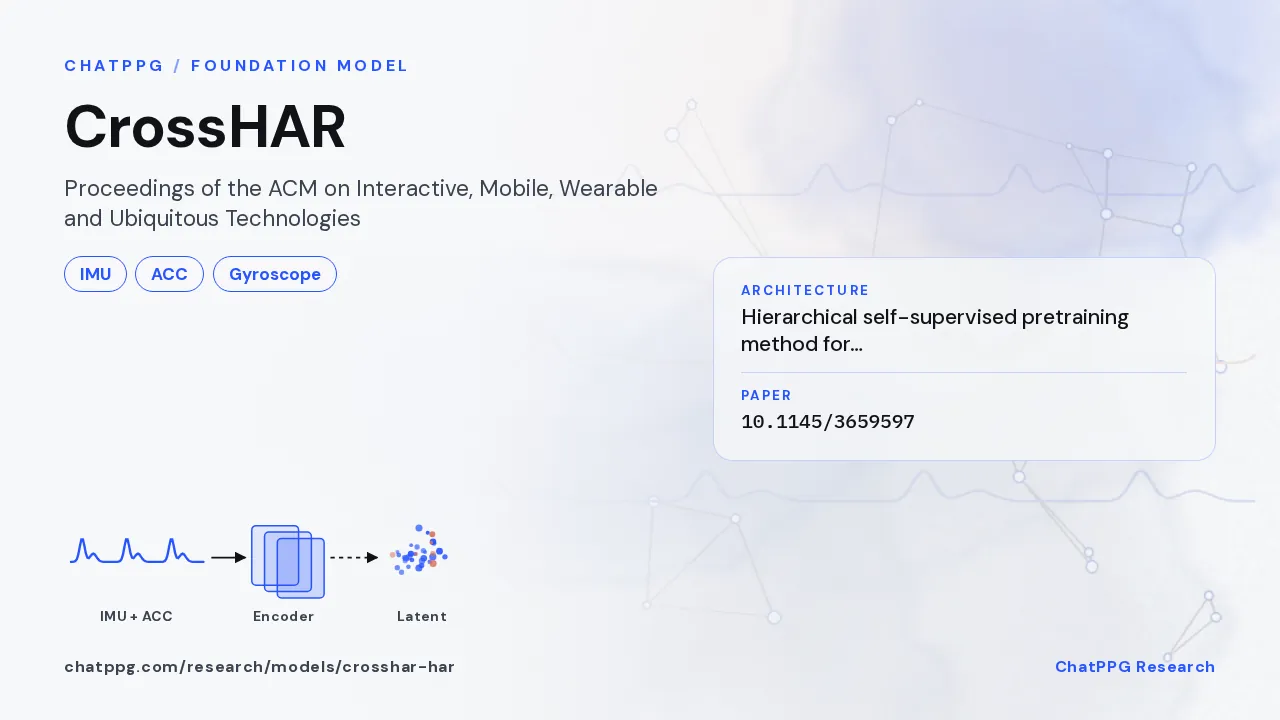
CrossHAR: ChatPPG research summary card

How it works

How CrossHAR works: Input signals → Foundation model → Downstream tasksInput signals: IMU (Accelerometer, 3-axis). Foundation model: CrossHAR (Transformer · Convolutional network).Input signalsIMU: Accelerometer, 3-axisxyzIMUAccelerometer, 3-axisFoundation model×NCrossHARTransformer · Convolutional network
Architecture
Hierarchical self-supervised pretraining method for cross-dataset HAR (CNN + Transformer).
Inputs
IMU

Datasets used

No public datasets linked yet.

Papers· 1

Authors· 8

Cite this model

Cite the publication recorded for this model. Check it against the publisher before submitting.

CrossHAR. (2024). Proceedings of the ACM on Interactive, Mobile, Wearable and Ubiquitous Technologies. https://doi.org/10.1145/3659597
@inproceedings{crossharhar2024crosshar,
  title         = {{CrossHAR}},
  year          = {2024},
  booktitle     = {Proceedings of the ACM on Interactive, Mobile, Wearable and Ubiquitous Technologies},
  doi           = {10.1145/3659597}
}

History

  1. Added to the ChatPPG research hub