PreprintCatalog paper date: Nov 17, 2026Added to atlas: Nov 20, 2026Source
Activity counts measure attention, not model quality. Missing counts are unknown. Publication status follows the linked source; a listed venue alone does not confirm peer review.
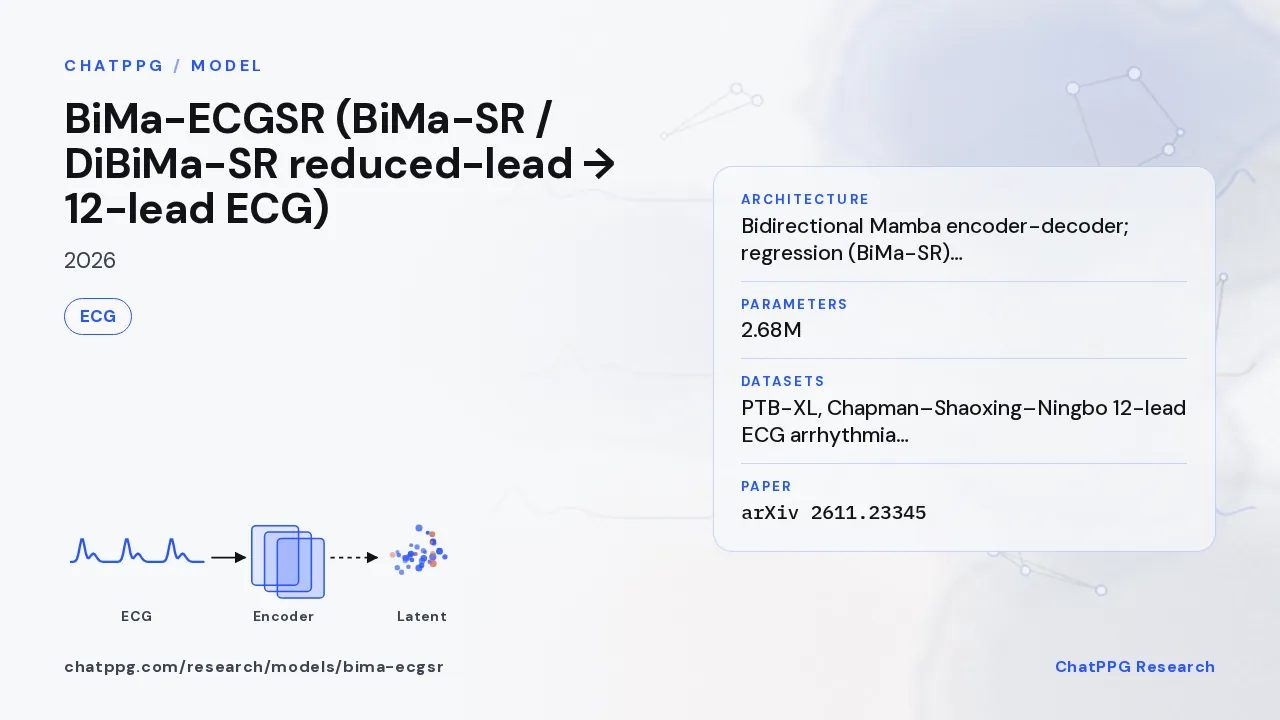
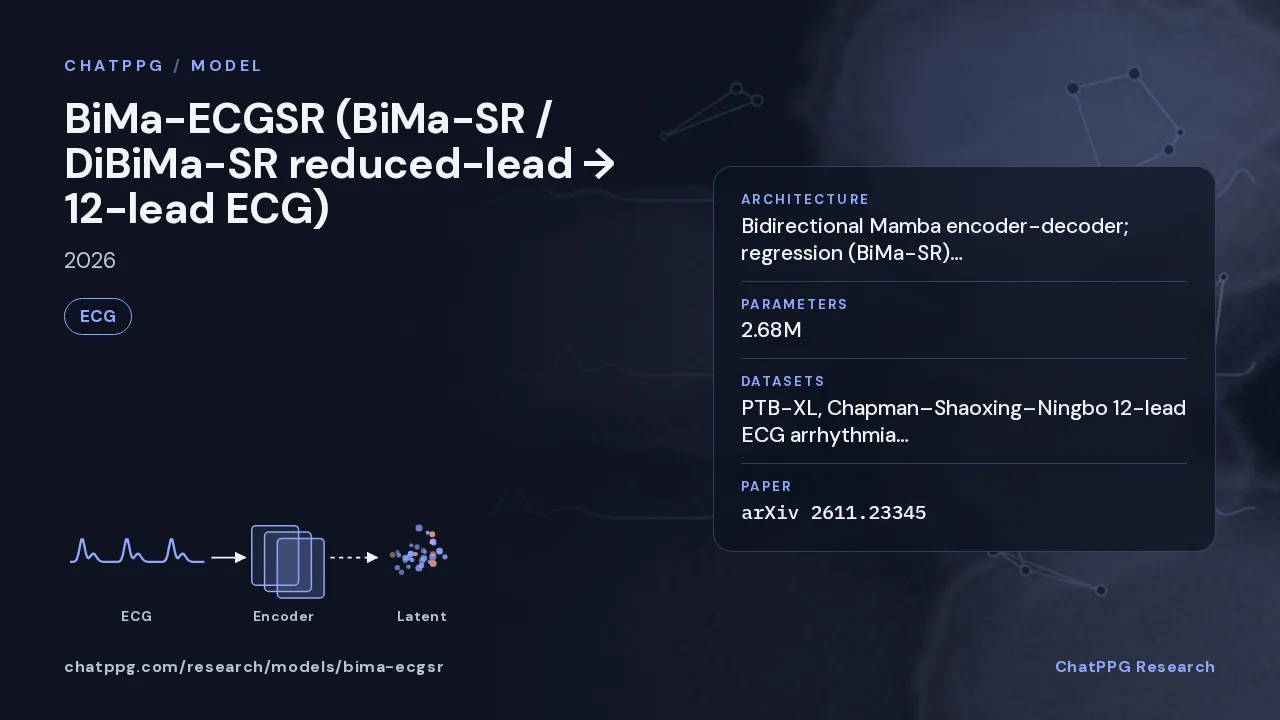
2.68 M-parameter bidirectional Mamba that reconstructs missing ECG leads; from lead II median PCC 0.914 on PTB-XL vs 0.784 for a linear filter; 45.8 ms per 10-s record on GPU (abstract). Paper: the BiMa-ECGSR paper.
Parameters
2.68M
Signals
ECG
Pretraining data
PTB-XL (six reduced-lead input sets)
License
none released
Year
2026
Architecture
Bidirectional Mamba encoder-decoder; regression (BiMa-SR) or diffusion (DiBiMa-SR, one-step or DDIM)
Wearables and monitors record few electrocardiogram (ECG) leads; most diagnostic tools assume 12 leads. BiMa-ECGSR reconstructs the 12-lead ECG from reduced lead sets with a bidirectional Mamba state-space encoder–decoder, as regression (BiMa-SR) or diffusion (DiBiMa-SR). Models were trained on PTB-XL for six input sets (I; II; I+II; I+II+V1; I+II+V2; I+II+V1+V4), see only the measured leads at inference, and were tested on the PTB-XL test fold (2,198 records) and two external cohorts (Georgia, 10,275 records; Chapman-Shaoxing/Ningbo, 43,559). From lead II alone, the pooled median Pearson correlation (PCC) over the 11 predicted leads was 0.914 on PTB-XL, against 0.784 for a least-squares linear filter (lead I: 0.906 against 0.789). As limb leads are exactly derivable from I and II, multi-lead inputs were compared on predicted chest leads: 0.939 against 0.849 for I+II and 0.979 against 0.962 for I+II+V1+V4. BiMa-SR exceeded the linear comparator in all 18 configuration–cohort pairs (by 0.012–0.136), a margin that shrank as chest leads were added. From lead II, regression was more accurate than diffusion (DiBiMa-SR: 0.903 one-step, 0.862 with six DDIM steps). A 12-lead classifier trained only on real ECGs reached a superclass macro AUROC of 0.912 on real PTB-XL ECGs, 0.843 on reconstructions from lead II and 0.908 from I+II+V1+V4; externally, reconstructions from three or four leads scored within 0.004 of real ECGs. BiMa-SR (2.68 M parameters) takes 45.8 ms per 10-s record on a GPU. Reconstruction makes reduced-lead recordings usable by 12-lead tools; it cannot add information absent from the measured leads.
Verbatim fromarXiv· arXiv metadata (abstracts are released under CC0)
How it works
Datasets linked in the hub; pretraining vs evaluation roles follow the paper.
Pretraining data
PTB-XL (six reduced-lead input sets)
Architecture
Bidirectional Mamba encoder-decoder; regression (BiMa-SR) or diffusion (DiBiMa-SR, one-step or DDIM)
Inputs
ECG
Approach
ecg reconstruction · mamba · reduced lead · no code
Cite the publication recorded for this model. Check it against the publisher before submitting.
Lomoio, U., Veltri, P., & Guzzi, P. H. (2026). BiMa-ECGSR: reconstructing the 12-lead ECG from reduced lead sets with bidirectional state-space models. arXiv preprint. https://arxiv.org/abs/2611.23345
Lomoio, Ugo, Pierangelo Veltri, and Pietro Hiram Guzzi. 2026. "BiMa-ECGSR: reconstructing the 12-lead ECG from reduced lead sets with bidirectional state-space models." arXiv preprint. https://arxiv.org/abs/2611.23345.
Lomoio, U., Veltri, P. and Guzzi, P. H. (2026) 'BiMa-ECGSR: reconstructing the 12-lead ECG from reduced lead sets with bidirectional state-space models', arXiv preprint. Available at: https://arxiv.org/abs/2611.23345
Lomoio, Ugo, et al. "BiMa-ECGSR: reconstructing the 12-lead ECG from reduced lead sets with bidirectional state-space models." arXiv preprint, 2026. https://arxiv.org/abs/2611.23345.
U. Lomoio, P. Veltri, and P. H. Guzzi, "BiMa-ECGSR: reconstructing the 12-lead ECG from reduced lead sets with bidirectional state-space models," arXiv preprint, 2026, [Online]. Available: https://arxiv.org/abs/2611.23345.
@misc{lomoio2026bimaecgsr,
  title         = {{BiMa-ECGSR: reconstructing the 12-lead ECG from reduced lead sets with bidirectional state-space models}},
  author        = {Lomoio, Ugo and Veltri, Pierangelo and Guzzi, Pietro Hiram},
  year          = {2026},
  howpublished  = {arXiv preprint},
  eprint        = {2611.23345},
  archivePrefix = {arXiv}
}
History
Added to the ChatPPG research hub
Newsletter
Get new PPG datasets, papers and models
Get alerts when BiMa-ECGSR (BiMa-SR / DiBiMa-SR reduced-lead → 12-lead ECG) is benchmarked on new datasets, plus the weekly digest.
New datasets, papers and models
Practical guides from the hub
Unsubscribe anytime
The waveform is an illustration of a PPG pulse, not a recording.