Activity counts measure attention, not model quality. Missing counts are unknown. Publication status follows the linked source; a listed venue alone does not confirm peer review.
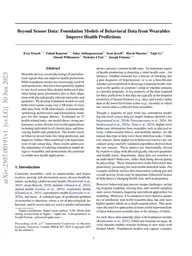
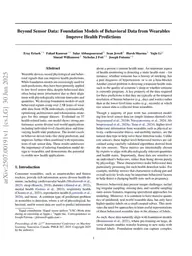
Apple's Wearable Behavioral Model (WBM) comes from "Beyond Sensor Data: Foundation Models of Behavioral Data from Wearables Improve Health Predictions" by Eray Erturk, Fahad Kamran, Salar Abbaspourazad, Sean Jewell, Harsh Sharma, Yujie Li, Sinead Williamson, Nicholas J. Foti and Joseph Futoma. It was accepted to ICML 2025 (arXiv 2507.00191).
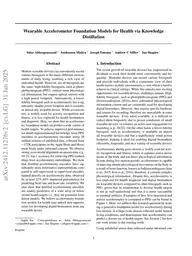
Most wearable foundation models, including Apple's own PPG and ECG models, learn from low-level sensor signals. WBM goes one level up. It models behavioral data, the kind of quantities a watch already computes, because those often line up better with physiologically relevant timescales and quantities. The paper focuses on 27 interpretable HealthKit quantities that are calculated from lower-level sensors using validated methods.
The training set is large: over 2.5B hours of wearable data from 162K individuals in the Apple Heart and Movement Study. The authors systematically compared architectures and tokenization strategies for this kind of irregularly sampled data. The model works on one week of a person's data at a time. In the TST-style tokenization, that week becomes a 168 by 27 matrix with one row per hour, and pairing it with a Mamba-2 backbone consistently gave the best model.
WBM was evaluated on 57 health-related tasks covering individual-level classification and time-varying health state prediction. It did especially well on behavior-driven tasks such as sleep prediction, and performance improved further when its embeddings were combined with representations of raw sensor data such as PPG. That last result is the main takeaway for PPG work: behavioral summaries and waveform embeddings carry complementary information.
No weights or data are public; the data comes from a consented Apple research study. WBM is best read alongside the Apple PPG and ECG foundation models from the same study, and as a design reference for anyone building models over watch-derived metrics instead of raw signals.
Signals
behavioral metrics (27 HealthKit variables)
Year
2025
Paper
Beyond Sensor Data: Foundation Models of Behavioral Data from Wearables Improve Health Predictions (Erturk et al.), ICML 2025, arXiv 2507.00191
Data
over 2.5B hours of wearable data from 162K individuals (Apple Heart and Movement Study)
Inputs
27 HealthKit quantities computed from lower-level sensors
Architecture
one week of hourly data (168 by 27 matrix) with TST-style tokenization and a Mamba-2 backbone
Evaluation
57 health-related tasks; strongest on behavior-driven tasks such as sleep prediction
Combining with raw sensor representations improved results further
Wearable devices record physiological and behavioral signals that can improve health predictions. While foundation models are increasingly used for such predictions, they have been primarily applied to low-level sensor data, despite behavioral data often being more informative due to their alignment with physiologically relevant timescales and quantities. We develop foundation models of such behavioral signals using over 2.5B hours of wearable data from 162K individuals, systematically optimizing architectures and tokenization strategies for this unique dataset. Evaluated on 57 health-related tasks, our model shows strong performance across diverse real-world applications including individual-level classification and time-varying health state prediction. The model excels in behavior-driven tasks like sleep prediction, and improves further when combined with representations of raw sensor data. These results underscore the importance of tailoring foundation model design to wearables and demonstrate the potential to enable new health applications.
Verbatim fromarXiv· arXiv metadata (abstracts are released under CC0)
How it works
Architecture
Mamba-2 over 27 derived HealthKit behavioural variables (contrastive)
WBM is an Apple foundation model of behavioral wearable data (27 HealthKit quantities) trained on over 2.5B hours of data from 162K individuals, presented at ICML 2025.
Can I download Apple WBM?
No. The arXiv record links no code or weights, and the data comes from the Apple Heart and Movement Study.
Apple WBM vs Apple's PPG foundation model?
The PPG foundation model learns from raw Apple Watch PPG. WBM learns from higher-level behavioral quantities computed by the watch, and the paper reports that combining WBM with raw sensor representations improves results further.
What are Apple WBM's benchmark results?
Across 57 health-related tasks, WBM performed well on individual-level classification and time-varying health state prediction, and it was strongest on behavior-driven tasks such as sleep prediction.
Cite this model
Cite the publication recorded for this model. Check it against the publisher before submitting.
Erturk, E., Kamran, F., Abbaspourazad, S., Jewell, S., Sharma, H., Li, Y., Williamson, S., Foti, N. J., & Futoma, J. (2025). Beyond Sensor Data: Foundation Models of Behavioral Data from Wearables Improve Health Predictions. ICML 2025. https://doi.org/10.48550/ARXIV.2507.00191
Erturk, Eray, Fahad Kamran, Salar Abbaspourazad, Sean Jewell, Harsh Sharma, Yujie Li, Sinead Williamson, Nicholas J Foti, and Joseph Futoma. 2025. "Beyond Sensor Data: Foundation Models of Behavioral Data from Wearables Improve Health Predictions." ICML 2025. https://doi.org/10.48550/ARXIV.2507.00191.
Erturk, E., Kamran, F., Abbaspourazad, S., Jewell, S., Sharma, H., Li, Y., Williamson, S., Foti, N. J. and Futoma, J. (2025) 'Beyond Sensor Data: Foundation Models of Behavioral Data from Wearables Improve Health Predictions', ICML 2025. doi: 10.48550/ARXIV.2507.00191.
Erturk, Eray, et al. "Beyond Sensor Data: Foundation Models of Behavioral Data from Wearables Improve Health Predictions." ICML 2025, 2025. https://doi.org/10.48550/ARXIV.2507.00191.
E. Erturk et al., "Beyond Sensor Data: Foundation Models of Behavioral Data from Wearables Improve Health Predictions," ICML 2025, 2025, doi: 10.48550/ARXIV.2507.00191.
@misc{erturk2025beyond,
  title         = {{Beyond Sensor Data: Foundation Models of Behavioral Data from Wearables Improve Health Predictions}},
  author        = {Erturk, Eray and Kamran, Fahad and Abbaspourazad, Salar and Jewell, Sean and Sharma, Harsh and Li, Yujie and Williamson, Sinead and Foti, Nicholas J. and Futoma, Joseph},
  year          = {2025},
  howpublished  = {ICML 2025},
  publisher     = {arXiv},
  doi           = {10.48550/ARXIV.2507.00191},
  eprint        = {2507.00191},
  archivePrefix = {arXiv}
}
History
Added to the ChatPPG research hub
Newsletter
Get new PPG datasets, papers and models
Get alerts when Apple WBM (Wearable Behavioral Model) is benchmarked on new datasets, plus the weekly digest.
New datasets, papers and models
Practical guides from the hub
Unsubscribe anytime
The waveform is an illustration of a PPG pulse, not a recording.