Cite this dataset
WHAMAP [Data set]. (n.d.). mendeley. https://doi.org/10.17632/8zt9g9g64c.1
@misc{whamapwhamap,
  title         = {{WHAMAP}},
  howpublished  = {mendeley},
  doi           = {10.17632/8zt9g9g64c.1}
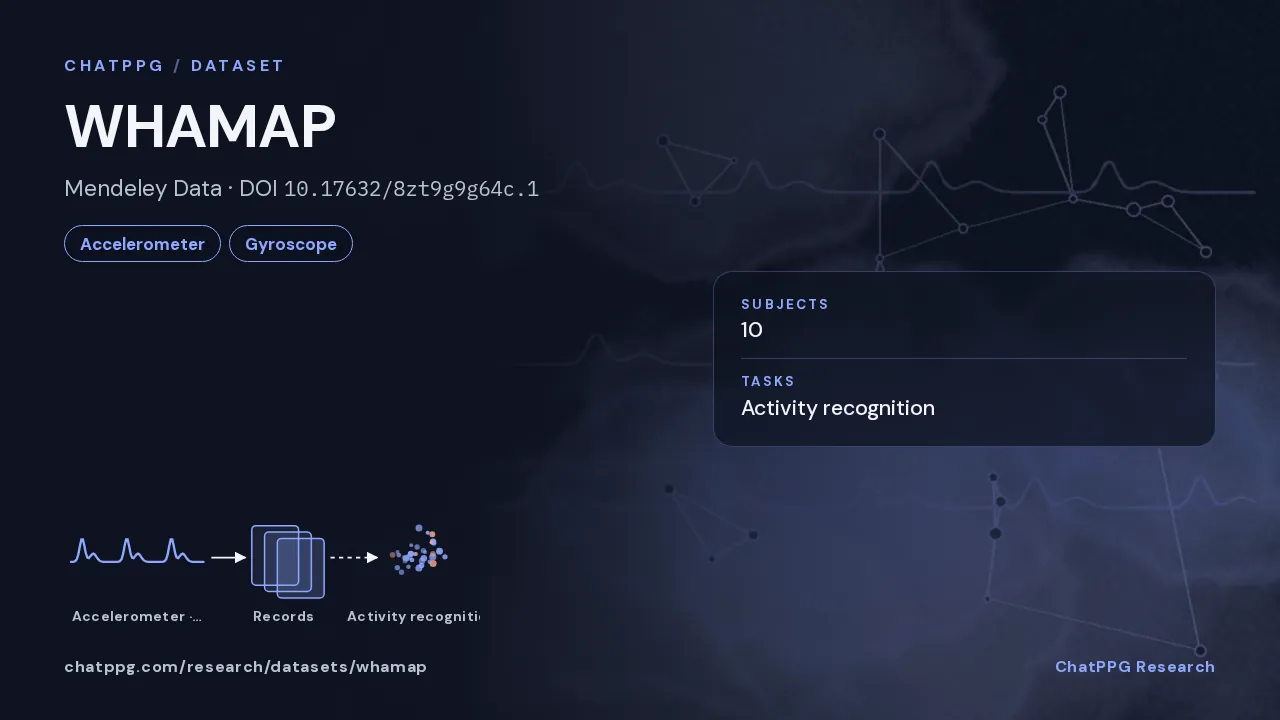
}WHAMAP contains data from five IMUs on the lower limbs (thighs, shanks and right foot) plus smartphone sensors, recorded from 10 participants. They sat, stood, walked, walked uphill and squatted, and the walking and squatting trials include fatigue levels rated on the Borg scale.
WHAMAP dataset contains inertial data collected from five IMU sensors positioned on the lower limbs (thighs, shanks, and right feet), along with data from smartphone sensors, from a group of 10 participants performing five activities: sitting, standing, walking, uphill walking, and squatting. In addition, the walking, uphill walking, and squatting activities include fatigue variations, annotated according to the Borg Rating of Perceived Exertion scale.
Verbatim fromDataCite· Licence: info:eu-repo/semantics/openAccess
No model in the hub reports results on this dataset yet.
WHAMAP has data from 10 subjects, as listed in its research record.
WHAMAP includes accelerometer and gyroscope data. Sampling rate as recorded: 50 Hz; 5 lower-limb IMUs + smartphone. Raw waveforms are included.
Research tasks it supports: human activity recognition. Reference labels: activity.
It is hosted on Mendeley Data at https://data.mendeley.com/datasets/8zt9g9g64c/1. Licence: CC BY 4.0.
WHAMAP [Data set]. (n.d.). mendeley. https://doi.org/10.17632/8zt9g9g64c.1
@misc{whamapwhamap,
title = {{WHAMAP}},
howpublished = {mendeley},
doi = {10.17632/8zt9g9g64c.1}
}Cite the dated snapshot 2026-10 for a fixed, reproducible version. Please also cite the original publications listed above.
ChatPPG. (2026). WHAMAP: dataset record (Version 2026-10) [Data set]. ChatPPG Research Hub. https://chatppg.com/research/datasets/whamap
@misc{chatppg_dataset_whamap,
  author       = {{ChatPPG}},
  title        = {{WHAMAP: dataset record}},
  year         = {2026},
  month        = nov,
  version      = {2026-10},
  howpublished = {\url{https://chatppg.com/research/datasets/whamap}},
  note         = {ChatPPG Research Hub, Snapshot 2026-10, https://chatppg.com/research/snapshots/2026-10}
}cff-version: 1.2.0 message: "If you use this resource, please cite it as below." type: dataset title: "WHAMAP: dataset record" authors: - name: "ChatPPG" url: "https://chatppg.com/research/datasets/whamap" repository-artifact: "https://chatppg.com/research/snapshots/2026-10" version: "2026-10" date-released: "2026-11-13"
Record updated
 Towards objective estimation of physical functioning in breast-cancer patients from real-world Garmin smartwatch steps + HR (REBECCA-CRF; 23 BCP + 20 controls)Same task: Activity recognitionarXiv · 2026