Dataset

Lown 2020 Polar H7

RR-interval AF screening (PLOS ONE)

This PLOS ONE study looked at whether a cheap consumer ECG chest strap, the Polar H7, can be used to detect atrial fibrillation. Such devices measure ECG but usually lack diagnostic algorithms.

Published
PLOS ONE, 2020
Device
Polar H7 chest strap
Target
atrial fibrillation detection
License
CC BY 4.0
At a glance
Type
Dataset
Access
Not reported
Subjects
415
Signals
HRV
Devices
PPG sites
None
Setting
Clinical
Wrist
No
Raw waveforms
No
Updated
Nov 13, 2026

Original description

Background Atrial Fibrillation is the most common arrhythmia worldwide with a global age adjusted prevalence of 0.5% in 2010. Anticoagulation treatment using warfarin or direct oral anticoagulants is effective in reducing the risk of AF-related stroke by approximately two-thirds and can provide a 10% reduction in overall mortality. There has been increased interest in detecting AF due to its increased incidence and the possibility to prevent AF-related strokes. Inexpensive consumer devices which measure the ECG may have the potential to accurately detect AF but do not generally incorporate diagnostic algorithms. Machine learning algorithms have the potential to improve patient outcomes particularly where diagnoses are made from large volumes or complex patterns of data such as in AF. Methods We designed a novel AF detection algorithm using a de-correlated Lorenz plot of 60 consecutive RR intervals. In order to reduce the volume of data, the resulting images were compressed using a wavelet transformation (JPEG200 algorithm) and the compressed images were used as input data to a Support Vector Machine (SVM) classifier. We used the Massachusetts Institute of Technology (MIT)—Beth Israel Hospital (BIH) Atrial Fibrillation database and the MIT-BIH Arrhythmia database as training data and verified the algorithm performance using RR intervals collected using an inexpensive consumer heart rate monitor device (Polar-H7) in a case-control study. Results The SVM algorithm yielded excellent discrimination in the training data with a sensitivity of 99.2% and a specificity of 99.5% for AF. In the validation data, the SVM algorithm correctly identified AF in 79/79 cases; sensitivity 100% (95% CI 95.4%-100%) and non-AF in 328/336 cases; specificity 97.6% (95% CI 95.4%-99.0%). Conclusions An inexpensive wearable heart rate monitor and machine learning algorithm can be used to detect AF with very high accuracy and has the capability to transmit ECG data which could be used to confirm AF. It could potentially be used for intermittent screening or continuously for prolonged periods to detect paroxysmal AF. Further work could lead to cost-effective and accurate estimation of AF burden and improved risk stratification in AF.
Verbatim fromSemantic Scholar· Abstract via Semantic Scholar; © the authors/publisher

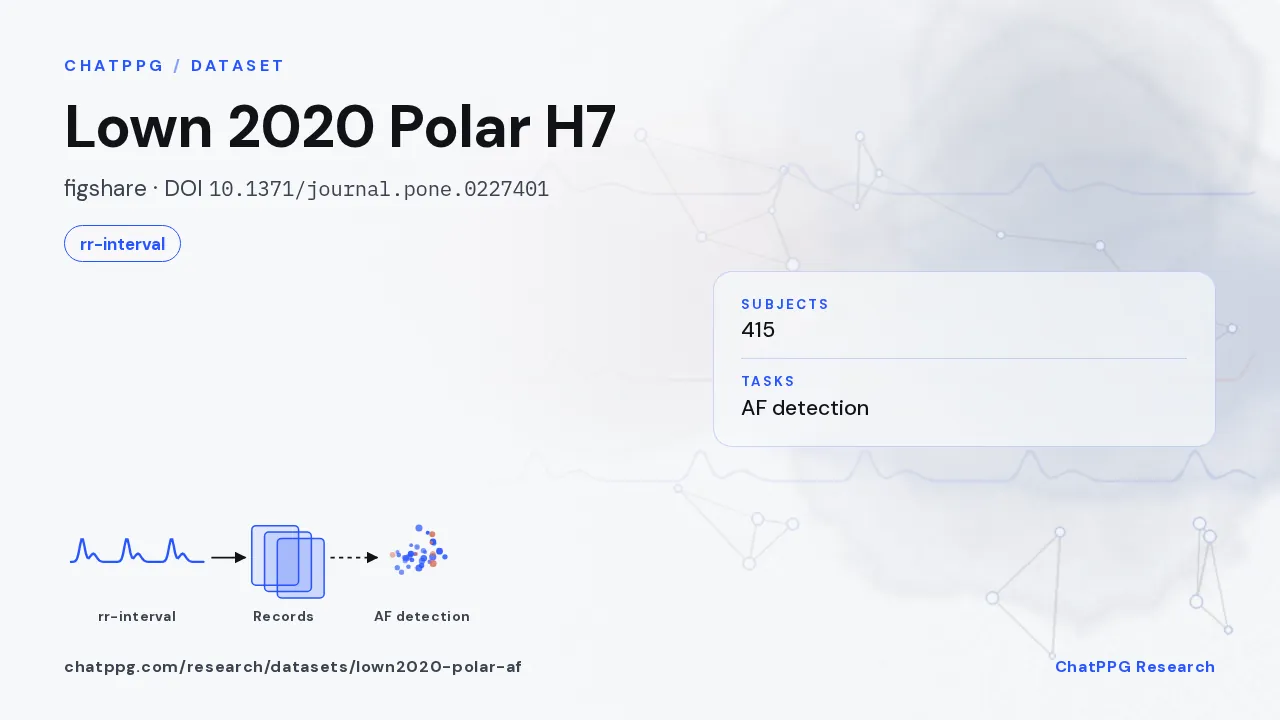
Lown 2020 Polar H7: ChatPPG research summary card

Key numbers

415
Subjects
2
Reference labels
AFIB, RESP RATE

How it works

How Lown 2020 Polar H7 works: Devices & body sites → Signals recorded → TasksDevices & body sites: Polar H7 (Polar · Chest). PPG sites: None. Signals recorded: Lown 2020 Polar H7, 415 subjects, signals HRV. Tasks: AF / rhythm.Devices & body sitesPolar H7: Polar · ChestPolar H7Polar · ChestPPG sites: NonePPG sitesNoneSignals recordedLown 2020 Polar H7415 subjectsHRVTasksAF / rhythmAF / rhythm

No model in the hub reports results on this dataset yet.

Sampling
RR intervals (beat-to-beat; not continuous PPG waveform)
Reference labels
afib, resp rate

Devices· 1

Icons show the form factor: we have no openly licensed or manufacturer-cleared photo of these exact devices yet.

FAQ

How many subjects are in Lown 2020 Polar H7?

Lown 2020 Polar H7 has data from 415 subjects, as listed in its research record.

What signals does Lown 2020 Polar H7 include?

Lown 2020 Polar H7 includes RR intervals data.

What can Lown 2020 Polar H7 be used for?

Research tasks it supports: atrial fibrillation detection. Reference labels: atrial fibrillation and resp rate.

How do I get Lown 2020 Polar H7, and what is its licence?

It is hosted on figshare at https://doi.org/10.1371/journal.pone.0227401. Licence: CC BY 4.0.

Cite this dataset

Cite this dataset with the fields recorded here. Check it against the publisher before submitting.

Lown 2020 Polar H7 [Data set]. (n.d.). figshare. https://doi.org/10.1371/journal.pone.0227401
@misc{lown2020polaraflown,
  title         = {{Lown 2020 Polar H7}},
  howpublished  = {figshare},
  doi           = {10.1371/journal.pone.0227401}
}

Cite the ChatPPG record

Cite the dated snapshot 2026-10 for a fixed, reproducible version. Please also cite the original publications listed above.

APA

ChatPPG. (2026). Lown 2020 Polar H7: dataset record (Version 2026-10) [Data set]. ChatPPG Research Hub. https://chatppg.com/research/datasets/lown2020-polar-af

BibTeX
@misc{chatppg_dataset_lown2020_polar_af,
  author       = {{ChatPPG}},
  title        = {{Lown 2020 Polar H7: dataset record}},
  year         = {2026},
  month        = nov,
  version      = {2026-10},
  howpublished = {\url{https://chatppg.com/research/datasets/lown2020-polar-af}},
  note         = {ChatPPG Research Hub, Snapshot 2026-10, https://chatppg.com/research/snapshots/2026-10}
}
CITATION.cff
cff-version: 1.2.0
message: "If you use this resource, please cite it as below."
type: dataset
title: "Lown 2020 Polar H7: dataset record"
authors:
  - name: "ChatPPG"
url: "https://chatppg.com/research/datasets/lown2020-polar-af"
repository-artifact: "https://chatppg.com/research/snapshots/2026-10"
version: "2026-10"
date-released: "2026-11-13"

History

  1. Record updated