PPG Sleep Fragmentation Biomarkers: What Optical Pulse Signals Reveal About Broken Sleep
PPG sleep fragmentation biomarkers use pulse timing, amplitude, and autonomic surges to estimate broken sleep, arousals, and sleep continuity loss.
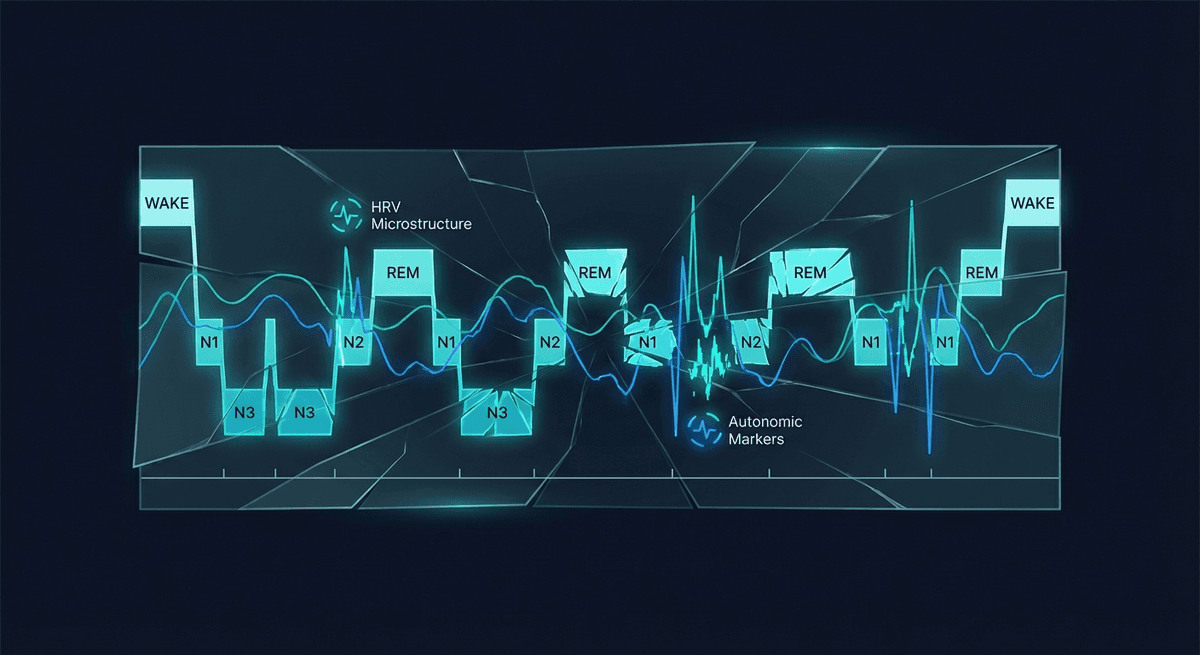
PPG sleep fragmentation biomarkers use pulse-derived autonomic signals to estimate how often sleep gets disrupted through the night. They do not measure cortical arousals the way polysomnography does, but they can still capture the physiological footprints of broken sleep, especially pulse accelerations, short-term variability shifts, and transient changes in waveform amplitude.
Definition box: Sleep fragmentation means repeated interruptions of continuous sleep, often caused by arousals, awakenings, breathing events, pain, limb movement, or environmental disturbance.
This is one of the more interesting clinical applications of wearable PPG because it goes beyond simple sleep duration. Plenty of people spend eight hours in bed and still wake up wrecked. Fragmentation is often the missing reason.
Can a pulse signal really reflect broken sleep?
Yes, indirectly. Sleep disruptions often trigger autonomic activation. That means a burst of sympathetic activity, a brief rise in heart rate, and sometimes a measurable shift in peripheral vascular tone. PPG is well positioned to detect those changes because it continuously tracks the pulse waveform.
What it cannot do is see the brain directly. A sleep lab measures EEG, eye movements, chin EMG, breathing, and oxygen simultaneously. A wearable uses pulse, motion, and sometimes skin temperature to infer what happened.
So the right question is not, can PPG see an arousal exactly like polysomnography? The right question is, can it detect the physiological consequences of repeated sleep disruption well enough to be useful? In many cases, yes.
Which PPG features act as sleep fragmentation biomarkers?
Pulse rate accelerations
A brief heart rate rise after an arousal is one of the most common signatures. These surges may follow respiratory events, pain, noise, or spontaneous arousals.
Short-term variability changes
Inter-beat interval dynamics often shift around an arousal. The pattern is usually different from stable deep sleep.
Waveform amplitude changes
Peripheral vasoconstriction can reduce pulse amplitude during sympathetic activation.
Repetition and clustering
Single events matter less than repeated clusters. If the signal shows a cycle of disturbance every few minutes, that is much more suggestive of clinically meaningful fragmentation.
How does this differ from sleep staging?
Sleep staging tries to estimate whether the person is in wake, light sleep, deep sleep, or REM. Fragmentation analysis asks a different question: how often is stable sleep getting interrupted?
That is why the two should not be confused. A wearable may label broad sleep stages reasonably well while still missing the full nuance of arousal burden. Likewise, fragmentation biomarkers can still be useful even if stage classification is imperfect.
For background, see PPG sleep staging algorithms and PPG circadian rhythm tracking.
Why fragmentation matters clinically
Daytime function
Fragmented sleep reduces restorative value. Patients report fatigue, poor concentration, mood changes, and slower recovery.
Sleep apnea and breathing disorders
Some patients care less about total hours slept than about repeated respiratory arousals tearing sleep apart.
Chronic pain and illness
Fragmentation often rises in chronic pain, neurologic disease, depression, hospitalization, and many inflammatory conditions.
Cardiometabolic strain
Repeated autonomic arousals increase sympathetic burden, which may worsen blood pressure control and cardiovascular risk over time.
Where wearables add real value
The biggest advantage is longitudinal tracking. A sleep lab gives one night of rich data. A wearable gives many nights of thinner data. That can be more useful for patterns.
Wearables help answer questions like:
- Is the patient's sleep getting more broken over several weeks?
- Did symptoms start after a medication change?
- Does alcohol, late exercise, or travel worsen arousal burden?
- Is treatment reducing overnight autonomic disruption?
Common causes of false interpretation
This is where consumer dashboards can mislead.
Motion-only events
Turning in bed can alter both accelerometer and PPG signals without a true physiologic arousal.
Poor contact
A loose sensor may create gaps or artificial pulse changes.
Normal REM variability
REM sleep naturally includes more autonomic fluctuation. Not every burst means pathology.
Arrhythmia
Irregular rhythm can distort pulse-based sleep interpretation.
That is why PPG sleep fragmentation biomarkers should be read as probability markers, not definitive scored arousals.
Best clinical use cases right now
Suspected sleep apnea follow-up
If a patient has known or suspected breathing-related sleep disruption, fragmentation biomarkers provide a useful additional lens alongside oxygen trends.
Treatment response tracking
CPAP, positional therapy, medication changes, or behavioral interventions may reduce fragmentation even before patients can explain the change clearly.
Recovery and fatigue monitoring
In recovery settings, especially after illness or travel, repeated fragmentation trends may help explain persistent daytime symptoms.
FAQ
Can PPG detect sleep fragmentation?
PPG can estimate sleep fragmentation indirectly by capturing pulse rate accelerations, autonomic arousals, and waveform changes that often follow sleep disruptions.
Is sleep fragmentation the same as insomnia?
No. Sleep fragmentation describes repeated interruptions of sleep continuity, while insomnia is a broader clinical disorder involving difficulty sleeping and daytime impact.
What biomarkers in PPG suggest an arousal?
Rapid pulse acceleration, short-term inter-beat variability shifts, and transient amplitude changes often suggest a sleep arousal or autonomic activation.
Can wearables count arousals like a sleep lab?
Not exactly. Polysomnography remains the standard for scoring cortical arousals, while wearables estimate related physiological disturbances.
Why does sleep fragmentation matter clinically?
Fragmented sleep is linked to daytime fatigue, impaired cognition, cardiometabolic stress, and worse outcomes in conditions like sleep apnea and chronic illness.
Which patients may benefit most from fragmentation tracking?
Some groups are especially good fits for this kind of monitoring:
- people with suspected sleep apnea but inconsistent symptoms
- patients reporting non-restorative sleep despite adequate time in bed
- individuals with chronic pain or frequent nocturnal awakenings
- recovery programs tracking fatigue after illness
- patients trying to understand whether a new medication is disrupting sleep continuity
Why repeated nights beat a single score
Sleep is variable. One bad night can happen for trivial reasons. The real strength of a wearable is that it can show whether fragmentation is persistent, improving, or triggered by specific behaviors. In that sense, repeated PPG-derived fragmentation markers may be more actionable than a one-night score with no context.
Frequently Asked Questions
- Can PPG detect sleep fragmentation?
- PPG can estimate sleep fragmentation indirectly by capturing pulse rate accelerations, autonomic arousals, and waveform changes that often follow sleep disruptions.
- Is sleep fragmentation the same as insomnia?
- No. Sleep fragmentation describes repeated interruptions of sleep continuity, while insomnia is a broader clinical disorder involving difficulty sleeping and daytime impact.
- What biomarkers in PPG suggest an arousal?
- Rapid pulse acceleration, short-term inter-beat variability shifts, and transient amplitude changes often suggest a sleep arousal or autonomic activation.
- Can wearables count arousals like a sleep lab?
- Not exactly. Polysomnography remains the standard for scoring cortical arousals, while wearables estimate related physiological disturbances.
- Why does sleep fragmentation matter clinically?
- Fragmented sleep is linked to daytime fatigue, impaired cognition, cardiometabolic stress, and worse outcomes in conditions like sleep apnea and chronic illness.