PaperarXiv:2607.06954
Physical activities enable scalable foundation modelling for broad-spectrum health prediction (StepFM)
arXiv preprint
TL;DR
StepFM is a foundation model built only on step-counter data for broad health prediction. Its pretraining learns temporal and behavioural patterns from large-scale step sequences, and it transfers to more than 20 health risk tasks across devices, regions and diseases.
- Input: step counts
- Evaluation: 20+ health risk prediction tasks
- Transfer: new devices, regions and diseases
Abstract
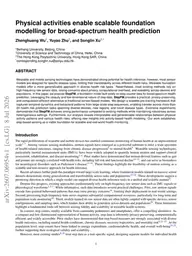
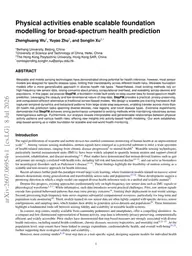
Wearable and mobile sensing technologies have demonstrated strong potential for health inference; however, most sensor models are designed for specific disease types, limiting their transferability across different health risks. Wearable foundation models offer a more generalizable approach in diverse health risk types. Nevertheless, most existing methods rely on high-frequency raw sensor data, raising concerns about privacy, computational overhead, and scalability across devices and populations. In this paper, we propose StepFM, a foundation model built solely on step counter data for broad-spectrum health prediction. Leveraging the ubiquity and low-dimensional nature of step data, StepFM provides a practical, privacy-preserving, and computation-efficient alternative to traditional sensor-based models. We design a scalable pre-training framework that captures temporal dynamics and behavioral patterns from large-scale step sequences, enabling transfer across more than 20 health risk prediction tasks spanning diverse devices, new regions, and novel disease types. Extensive experiments demonstrate that StepFM achieves strong performance compared to existing methods while maintaining robustness across heterogeneous settings. Furthermore, our analysis reveals interpretable and generalizable relationships between physical activity patterns and various health risks, offering new insights into activity-based health modeling. Our work establishes step-based sensing as a viable foundation for scalable and real-world health monitoring.
Verbatim from arXiv (opens in a new tab) · arXiv metadata (abstracts are released under CC0)
Results on ChatPPG leaderboards
All leaderboardsNo results from this paper on ChatPPG leaderboards yet. Browse the leaderboards.
Tasks & signals
Signals
Models
How it works
Cite this paper
Wu, Z., Zhu, Y., & Xu, S. (2026). Physical activities enable scalable foundation modelling for broad-spectrum health prediction (StepFM). arXiv preprint. https://arxiv.org/abs/2607.06954
Wu, Zhenghuang, Yuyao Zhu, and Songlin Xu. 2026. "Physical activities enable scalable foundation modelling for broad-spectrum health prediction (StepFM)." arXiv preprint. https://arxiv.org/abs/2607.06954.
Wu, Z., Zhu, Y. and Xu, S. (2026) 'Physical activities enable scalable foundation modelling for broad-spectrum health prediction (StepFM)', arXiv preprint. Available at: https://arxiv.org/abs/2607.06954
Wu, Zhenghuang, et al. "Physical activities enable scalable foundation modelling for broad-spectrum health prediction (StepFM)." arXiv preprint, 2026. https://arxiv.org/abs/2607.06954.
Z. Wu, Y. Zhu, and S. Xu, "Physical activities enable scalable foundation modelling for broad-spectrum health prediction (StepFM)," arXiv preprint, 2026, [Online]. Available: https://arxiv.org/abs/2607.06954.
@misc{wu2026physical,
  title         = {{Physical activities enable scalable foundation modelling for broad-spectrum health prediction (StepFM)}},
  author        = {Wu, Zhenghuang and Zhu, Yuyao and Xu, Songlin},
  year          = {2026},
  howpublished  = {arXiv preprint},
  eprint        = {2607.06954},
  archivePrefix = {arXiv}
}