Paperdoi:10.1038/s41586-026-10674-6
ECG Mortality/SCD Prediction with Generative Explainability
Nature
TL;DR
This Nature paper uses ECG to predict sudden cardiac death, where the standard marker, reduced ejection fraction, misses most cases. The model picked out a high-risk group (2.2% of patients) with a 7.0% yearly rate of sudden cardiac death, higher than people with reduced LVEF (4.6%). Most of the model's high-risk patients (86.1%) were not flagged by LVEF.
- Result: high-risk group 2.2% of sample, 7.0% annual SCD rate
- Result: 86.1% of high-risk patients missed by LVEF
Abstract
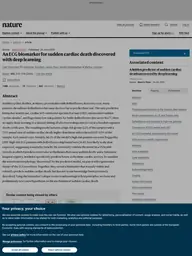
Sudden cardiac death is, in theory, preventable with defibrillators. But every year, many patients die without defibrillators because doctors fail to predict their risk 1 . The only predictive biomarker in wide use, cardiac left ventricular ejection fraction (LVEF), misses most sudden cardiac deaths 2 , and flags many low-risk patients for futile defibrillators that never fire 3,4 . Here we apply deep learning to a dataset linking all electrocardiograms (ECGs) in a Swedish region to death certificates. The resulting model isolates a high-risk group (2.2% of the sample) with a 7.0% annual rate of sudden cardiac death, higher than those with reduced LVEF (1.9% of the sample; 4.6% annual rate). Notably, 86.1% of the model’s high-risk patients were not flagged by LVEF. High-risk ECG patients with defibrillators implanted were 54.4% less likely to die than expected, suggesting a mortality benefit. We externally validate the model in a US health system, in which it predicts ventricular arrhythmias that cause sudden death; and a Taiwanese hospital registry, in which it specifically predicts future arrhythmic cardiac arrests. To visualize the waveform morphology ‘discovered’ by the predictive model, we pair it with a generative model of the ECG waveform. Together, they reveal a biomarker that is easily visible and robustly predicts sudden cardiac death, but has not to our knowledge been previously described. Tying the biomarker’s shape to electrophysiological first principles, we form and preliminarily test a new hypothesis on the mechanism of sudden cardiac death.
Verbatim from the publisher's DOI record (opens in a new tab) · Publisher licence: https://creativecommons.org/licenses/by/4.0
Results on ChatPPG leaderboards
All leaderboardsNo results from this paper on ChatPPG leaderboards yet. Browse the leaderboards.
Tasks & signals
Keywords
How it works
Cite this paper
Obermeyer, Z., Schubert, A., Ross, J., Mullainathan, S., & Lingman, M. (2026). ECG Mortality/SCD Prediction with Generative Explainability. Nature. https://doi.org/10.1038/s41586-026-10674-6
Obermeyer, Ziad, Alexander Schubert, James Ross, Sendhil Mullainathan, and Markus Lingman. 2026. "ECG Mortality/SCD Prediction with Generative Explainability." Nature. https://doi.org/10.1038/s41586-026-10674-6.
Obermeyer, Z., Schubert, A., Ross, J., Mullainathan, S. and Lingman, M. (2026) 'ECG Mortality/SCD Prediction with Generative Explainability', Nature. doi: 10.1038/s41586-026-10674-6.
Obermeyer, Ziad, et al. "ECG Mortality/SCD Prediction with Generative Explainability." Nature, 2026. https://doi.org/10.1038/s41586-026-10674-6.
Z. Obermeyer, A. Schubert, J. Ross, S. Mullainathan, and M. Lingman, "ECG Mortality/SCD Prediction with Generative Explainability," Nature, 2026, doi: 10.1038/s41586-026-10674-6.
@article{obermeyer2026mortalityscd,
  title         = {{ECG Mortality/SCD Prediction with Generative Explainability}},
  author        = {Obermeyer, Ziad and Schubert, Alexander and Ross, James and Mullainathan, Sendhil and Lingman, Markus},
  year          = {2026},
  journal       = {Nature},
  doi           = {10.1038/s41586-026-10674-6}
}