Paperdoi:10.1145/3829340.3842338
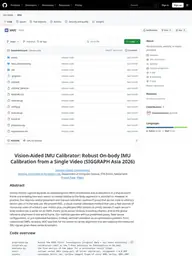
Vision-Aided IMU Calibrator (VAIC): Robust On-body IMU Calibration from a Single Video
SIGGRAPH Asia 2026 Conference Papers (published 2026-11-30)
TL;DR
Takes a few seconds of monocular video of any motion plus uncalibrated IMU streams and jointly recovers (1) each sensor's body location as a vertex on an SMPL mesh, (2) its sensor-to-body mounting rotation and (3) the world-frame alignment. No T-pose, fixed sensor layout or pre-calibrated hardware is needed. It synthesises "virtual" IMU signals for every mesh vertex from the video-recovered motion, solves a hand–eye-style non-linear fit per sensor–vertex pair, then runs a global assignment.
- Form factor: multi-site body-worn IMU (Xsens) + monocular video
Abstract
Inertial motion capture depends on expressing each IMU’s orientations and accelerations in a shared world frame and knowing how each sensor is rotated relative to the body segment it is attached to. However, in practice, this requires careful placement and manual calibration routines (T-pose) that do not scale to arbitrary sensor sets or in-the-wild use. We present VAIC, a visual–inertial calibration method that uses a few seconds of monocular video of arbitrary user motion plus uncalibrated IMU streams to jointly recover (1) each sensor’s body location (as a vertex on an SMPL mesh), (2) its sensor-to-body mounting rotation, and (3) the global reference alignment to the world frame. Our method operates without predefined poses, fixed sensor configurations, or pre-calibrated hardware. Instead, we treat calibration as an optimization problem: from video-based SMPL recovery, VAIC searches for the sensor-to-vertex alignment that best explains the measured IMU signals given these vertex kinematics. Evaluated on TotalCapture (13 IMUs), VAIC localizes sensors with 95.9% correct bone assignment and 5.8 cm positional RMSE (97.9% and 5.1 cm when excluding low-excitation motions), and achieves up to 15.5° end-to-end orientation error, which outperforms all classical calibration methods such as T-Pose or walking-based calibration. When sensor positions are known, VAIC improves over T-pose calibration, reduces body mounting error by 4.8° , and lowers overall body-orientation error. These results suggest a practical path toward plug-and-play inertial motion capture, providing reliable cold-start calibration that can also initialize or complement downstream continuous tracking systems. The code is released at: https://siplab.org/projects/VAIC
Verbatim from Semantic Scholar (opens in a new tab) · Abstract via Semantic Scholar; © the authors/publisher
Results on ChatPPG leaderboards
All leaderboardsNo results from this paper on ChatPPG leaderboards yet. Browse the leaderboards.
Tasks & signals
Signals
Keywords
How it works
Cite this paper
Hollidt, D., & Holz, C. (2026). Vision-Aided IMU Calibrator (VAIC): Robust On-body IMU Calibration from a Single Video. SIGGRAPH Asia 2026 Conference Papers. https://doi.org/10.1145/3829340.3842338
Hollidt, Dominik and Christian Holz. 2026. "Vision-Aided IMU Calibrator (VAIC): Robust On-body IMU Calibration from a Single Video." SIGGRAPH Asia 2026 Conference Papers. https://doi.org/10.1145/3829340.3842338.
Hollidt, D. and Holz, C. (2026) 'Vision-Aided IMU Calibrator (VAIC): Robust On-body IMU Calibration from a Single Video', SIGGRAPH Asia 2026 Conference Papers. doi: 10.1145/3829340.3842338.
Hollidt, Dominik, and Christian Holz "Vision-Aided IMU Calibrator (VAIC): Robust On-body IMU Calibration from a Single Video." SIGGRAPH Asia 2026 Conference Papers, 2026. https://doi.org/10.1145/3829340.3842338.
D. Hollidt and C. Holz, "Vision-Aided IMU Calibrator (VAIC): Robust On-body IMU Calibration from a Single Video," SIGGRAPH Asia 2026 Conference Papers, 2026, doi: 10.1145/3829340.3842338.
@inproceedings{hollidt2026visionaided,
  title         = {{Vision-Aided IMU Calibrator (VAIC): Robust On-body IMU Calibration from a Single Video}},
  author        = {Hollidt, Dominik and Holz, Christian},
  year          = {2026},
  booktitle     = {SIGGRAPH Asia 2026 Conference Papers},
  doi           = {10.1145/3829340.3842338}
}Added to the ChatPPG research hub