Finger-to-Ear ECG: Systematic Evaluation of an Earbud-Based Cardiac Monitoring Approach
Activity counts measure attention, not model quality. Missing counts are unknown. Publication status follows the linked source; a listed venue alone does not confirm peer review.
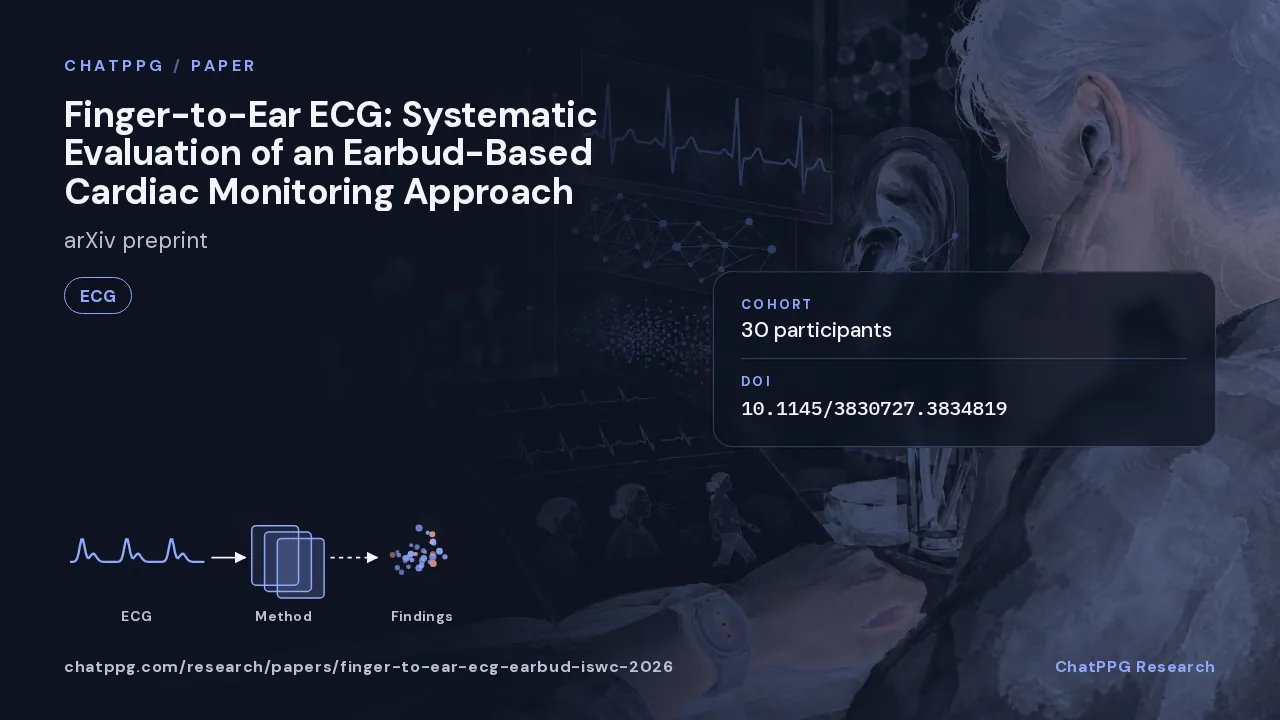
This study tests an earbud that records ECG between an in-ear electrode and a finger electrode on the back of the housing. Thirty participants tried four electrode layouts against a chest-reference ECG, including during music playback, talking and walking. Left-finger layouts detected R peaks with F1 above 99% and closely matched key ECG features.
- Signals: ECG
- Result: Left-finger configurations achieved R peak detection F1-scores >99% with high agreement of key ECG morphology features.
- Venue
- arXiv preprint
- Published
- 2026
- PMID
- Not reported
- Licence
- Not reported
- Signals
- ECG
- Form factor
- Not reported
- Subjects
- 30 participants
- Code
- Not reported
- Added
- Oct 12, 2026
Abstract
Ear-ECG enables unobtrusive cardiac monitoring, but existing approaches often struggle with low signal amplitudes and limited morphology preservation. We evaluate a finger-to-ear ECG paradigm that combines an in-ear electrode with a rear housing finger-contact electrode in a speaker-equipped earbud. A study with 30 participants investigated four finger-to-ear electrode geometries against chest-reference ECG and additionally assessed robustness under music playback, talking, and walking disturbances. Left-finger configurations achieved R peak detection F1-scores >99% with high agreement of key ECG morphology features. In contrast, right finger configurations as well as walking led to severe signal degradation. The results reveal a trade-off: while cross-body setups provided the highest signal fidelity, users preferred same-side contacts for comfort reasons. This establishes finger-to-ear ECG as a robust, morphology-aware paradigm for opportunistic sensing in earables.
Verbatim fromarXiv· arXiv metadata (abstracts are released under CC0)

Key results
How it works
- Cohort
- 30 participants
Cite
@article{fingertoearecgearbudiswc2026,
  title = {{Finger-to-Ear ECG: Systematic Evaluation of an Earbud-Based Cardiac Monitoring Approach}},
  author = {Philipp Lepold and Paula Breitling and Jonas Hummel and Tobias Röddiger and Michael Beigl},
  year = {2026},
  journal = {arXiv preprint},
  doi = {10.1145/3830727.3834819},
  eprint = {2609.24530}
}History
Added to the ChatPPG research hub
More on ChatPPG
- A meta-learning method with reduced data requirements for training and updating deep learning models on wearable devices
This paper proposes a meta-learning method that cuts how much labelled data a new wearable needs bef
- Agentic AI-enabled discovery across large-scale sleep physiology (AI Sleep Co-Scientist)
AI Sleep Co-Scientist is a setup in which human scientists direct specialist AI agents for hypothesi
- AnyECG-Echo: Wearable Single-Lead ECG Detects Fine-Grained Structural Heart Disease Through Echo-Report Supervision
AnyECG-Echo uses contrastive pretraining between single-lead ECGs and echocardiography reports to sc