PaperarXiv:2604.05926
FEEL: Quantifying Heterogeneity in Physiological Signals for Generalizable Emotion Recognition
NeurIPS 2025 Datasets and Benchmarks
Open code
TL;DR
Pragya Singh, Ankush Gupta, Somay Jalan, Mohan Kumar, Pushpendra Singh (IIIT-Delhi / RIT). arXiv 2604.05926 (posted 2026-04-07 America/Chicago). NeurIPS 2025 Datasets & Benchmarks.
Abstract
Emotion recognition from physiological signals has substantial potential for applications in mental health and emotion-aware systems. However, the lack of standardized, large-scale evaluations across heterogeneous datasets limits progress and model generalization. We introduce FEEL, the first large-scale benchmarking study of emotion recognition using electrodermal activity (EDA) and photoplethysmography (PPG) signals across 19 publicly available datasets. We evaluate 16 architectures spanning traditional machine learning, deep learning, and self-supervised pretraining approaches, structured into four representative modeling paradigms. Our study includes both within-dataset and cross-dataset evaluations, analyzing generalization across variations in experimental settings, device types, and labeling strategies. Our results showed that fine-tuned contrastive signal-language pretraining (CLSP) models (71/114) achieve the highest F1 across arousal and valence classification tasks, while simpler models like Random Forests, LDA, and MLP remain competitive (36/114). Models leveraging handcrafted features (107/114) consistently outperform those trained on raw signal segments, underscoring the value of domain knowledge in low-resource, noisy settings. Further cross-dataset analyses reveal that models trained on real-life setting data generalize well to lab (F1 = 0.79) and constraint-based settings (F1 = 0.78). Similarly, models trained on expert-annotated data transfer effectively to stimulus-labeled (F1 = 0.72) and self-reported datasets (F1 = 0.76). Moreover, models trained on lab-based devices also demonstrated high transferability to both custom wearable devices (F1 = 0.81) and the Empatica E4 (F1 = 0.73), underscoring the influence of heterogeneity. More information about FEEL can be found on our website https://alchemy18.github.io/FEEL_Benchmark/.
Verbatim from arXiv (opens in a new tab) · arXiv metadata (abstracts are released under CC0)
Results on ChatPPG leaderboards
All leaderboardsNo results from this paper on ChatPPG leaderboards yet. Browse the leaderboards.
Tasks & signals
Tasks
Signals
Devices
Keywords
Datasets
- ADARP (AUD EMA stress, E4)11 subjects · PPG · IMU · EDA
 CLASCognitive Load, Affect and Stress (Shimmer ECG/PPG/EDA)62 subjects · PPG · ECG · IMU
 DAPPERdaily ambulatory physiological + ecological momentary emotion (E4)90 subjects · PPG · IMU · EDA
 E4 Stress + Exercise (PhysioNet wearable-device-dataset)36 subjects · PPG · IMU · EDA
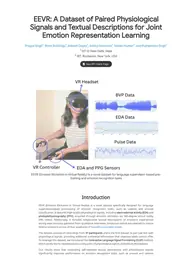 EEVRVR emotion elicitation with PPG + EDA and textual emotion descriptions (NeurIPS 2024 D&B)37 subjects · PPG · EDA
 Emognitionwearable emotion film-clip dataset (E4 + Galaxy Watch + Muse 2)43 subjects · PPG · IMU · EDA
- EmoWear (E4 SAM affect)48 subjects · PPG · IMU · EDA
- ForDigitStressforensic digital work stress (E4 + Muse S)37 subjects · PPG · IMU · EDA
 LAUREATElongitudinal university student wellbeing (E4)54 subjects · PPG · IMU · EDA
 MAUSMental Workload Assessment (N-back) with Wearable Sensors22 subjects · PPG · ECG · EDA
 MOCASmultimodal cognitive / affective states (E4 + Tobii + webcam)21 subjects · PPG · IMU · EDA
 NURSE (hospital stress, E4, Dryad)15 subjects · PPG · IMU · EDA
Show 6 more datasets
 PhyMERphysiological multimodal emotion + personality (E4 + Emotiv)30 subjects · PPG · EDA · Temp
 ScientISST MOVE: Annotated Wearable Multimodal Biosignals recorded during Everyday Life Activities in Naturalistic Environments17 subjects · PPG · ECG · IMU
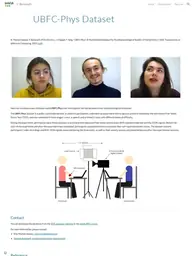 UBFC-Physmultimodal social-stress (wrist BVP+EDA + face video)56 subjects · PPG · rPPG · EDA
- UNIVERSE (mental workload + stress, ~315h E4)24 subjects · PPG · IMU · EDA
 VerBIOpublic speaking anxiety multimodal (E4 + Actiwave)49 subjects · PPG · ECG · IMU
 WESADWearable Stress and Affect Detection15 subjects · PPG · ECG · IMU
How it works
Cite this paper
APA
FEEL: Quantifying Heterogeneity in Physiological Signals for Generalizable Emotion Recognition. (2026). NeurIPS 2025 Datasets and Benchmarks. https://arxiv.org/abs/2604.05926
BibTeX
@inproceedings{feelheterogeneit2026feel,
  title         = {{FEEL: Quantifying Heterogeneity in Physiological Signals for Generalizable Emotion Recognition}},
  year          = {2026},
  booktitle     = {NeurIPS 2025 Datasets and Benchmarks},
  eprint        = {2604.05926},
  archivePrefix = {arXiv}
}
Built from the hub record. Check it against the publisher before submitting.
Added to the ChatPPG research hub