Paperdoi:10.1038/sj.jhh.1001478
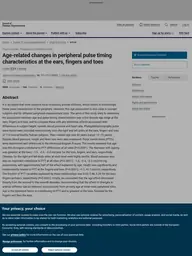
Age-related changes in peripheral pulse timing characteristics at the ears, fingers and toes
J. Hum. Hypertens. 2002;16:711–717
TL;DR
Bilateral PPG at the ears, fingers and toes of 116 healthy subjects aged 13–72, with ECG-referenced pulse transit time (PTT). Age was the strongest factor in PTT at every site: −1.6, −0.6 and −0.4 ms/year at toes, fingers and ears. Systolic BP also contributed (−1.0, −0.4, −0.3 ms/mmHg).
- Form factor: multi-site (ear, finger, toe)
Abstract
It is accepted that older subjects have increasing arterial stiffness, which results in increasingly faster pulse transmission to the periphery. However, this age association is less clear in younger subjects and for different peripheral measurement sites. The aims of this study were to determine the association between age and pulse timing characteristics over a five decade age range at the ears, fingers and toes, and to compare these with any additional effects associated with differences in subject height, systolic blood pressure and heart rate. Photoplethysmography pulse wave-forms were recorded noninvasively from the right and left sides at the ears, fingers and toes of 116 normal healthy human subjects. Their median age was 42 years (range 13-72 years). Systolic blood pressure, height and heart rate were also measured. Pulse transit times (PTTs) were determined and referenced to the electrocardiogram R wave. The results revealed that age was the strongest contributor to PTT differences at all sites (P<0.0001). The decrease with ageing was greatest at the toes: -1.6, -0.6, -0.4 ms/year for the toes, fingers, and ears, respectively. Changes for the right and left body sides at each level were highly similar. Blood pressure was also an important contributor to PTT at all sites (P<0.0001); -1.0, -0.4, -0.3 ms/mm Hg, respectively, with approximately half of the effect explained by age. Height was significantly and independently related to PTT at the fingers and toes (P<0.0001); +1.1, +0.7 ms/cm, respectively. The fraction of PTT variability explained by these relationships was 0.65, 0.48, 0.26 for the toes, fingers and ears, respectively (P<0.0001). Finally, we concluded that the age effect decreased linearly from the second to the seventh decades, demonstrating that the effect of changes in arterial stiffness can be detected noninvasively from an early age at three main peripheral sites. Age is the dominant factor in contributing to PTT, and is greatest at the toes, followed by the fingers and then the ears.
Verbatim from Europe PMC (opens in a new tab) · Abstract via Europe PMC; © the authors/publisher
Results on ChatPPG leaderboards
All leaderboardsNo results from this paper on ChatPPG leaderboards yet. Browse the leaderboards.
Tasks & signals
Tasks
Signals
Keywords
How it works
Cite this paper
Allen, J., & Murray, A. (2002). Age-related changes in peripheral pulse timing characteristics at the ears, fingers and toes. J. Hum. Hypertens. 2002, 16, 711–717. https://doi.org/10.1038/sj.jhh.1001478
Allen, John and Alan Murray. 2002. "Age-related changes in peripheral pulse timing characteristics at the ears, fingers and toes." J. Hum. Hypertens. 2002 16: 711–717. https://doi.org/10.1038/sj.jhh.1001478.
Allen, J. and Murray, A. (2002) 'Age-related changes in peripheral pulse timing characteristics at the ears, fingers and toes', J. Hum. Hypertens. 2002, 16, pp. 711–717. doi: 10.1038/sj.jhh.1001478.
Allen, John, and Alan Murray "Age-related changes in peripheral pulse timing characteristics at the ears, fingers and toes." J. Hum. Hypertens. 2002, vol. 16, 2002, pp. 711–717. https://doi.org/10.1038/sj.jhh.1001478.
J. Allen and A. Murray, "Age-related changes in peripheral pulse timing characteristics at the ears, fingers and toes," J. Hum. Hypertens. 2002, vol. 16, pp. 711–717, 2002, doi: 10.1038/sj.jhh.1001478.
@article{allen2002agerelated,
  title         = {{Age-related changes in peripheral pulse timing characteristics at the ears, fingers and toes}},
  author        = {Allen, John and Murray, Alan},
  year          = {2002},
  journal       = {J. Hum. Hypertens. 2002},
  volume        = {16},
  pages         = {711--717},
  doi           = {10.1038/sj.jhh.1001478}
}Added to the ChatPPG research hub