Activity counts measure attention, not model quality. Missing counts are unknown. Publication status follows the linked source; a listed venue alone does not confirm peer review.
xMAE is a biosignal pretraining method that reconstructs one signal from another, for example ECG and the delayed PPG pulse it produces, so the model learns physiological timing. Its representations beat unimodal and multimodal baselines on 15 of 19 tasks, including cardiovascular outcomes, abnormal lab tests, sleep staging and demographics, across different devices and body locations.
Published
arXiv preprint, 2026
Signals
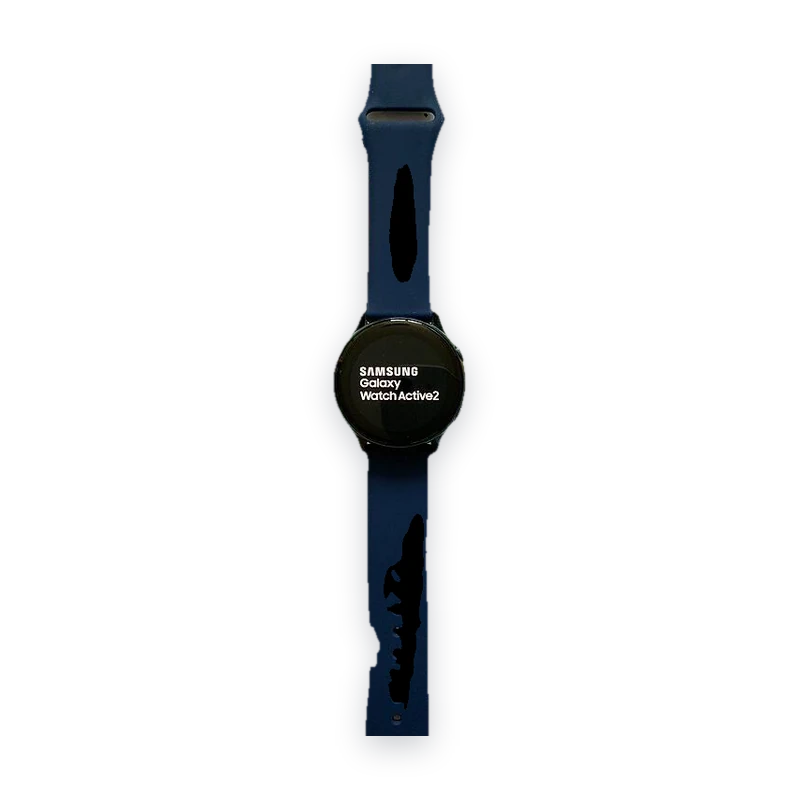
PPG, ECG
Result
better on 15 of 19 downstream tasks
Year
2026
Method
masked cross-modal reconstruction across time-ordered biosignals
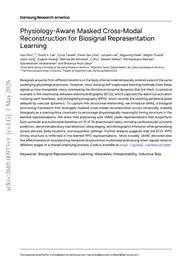
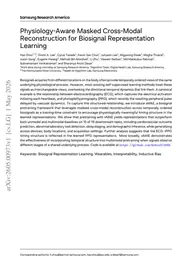
Biosignals acquired from different locations on the body often provide temporally ordered views of the same underlying physiological process. However, most existing self supervised learning methods treat these signals as interchangeable views, overlooking the directional temporal dynamics that link them. A canonical example is the relationship between electrocardiography (ECG), which captures the electrical activation initiating each heartbeat, and photoplethysmography (PPG), which records the resulting peripheral pulse delayed by vascular dynamics. To capture this structured relationship, we introduce xMAE, a biosignal pretraining framework that leverages masked cross modal reconstruction across temporally ordered biosignals as a training time constraint to encourage physiologically meaningful timing structure in the learned representations. We show that pretraining with xMAE yields representations that outperform both unimodal and multimodal baselines on 15 of 19 downstream tasks, including cardiovascular outcome prediction, abnormal laboratory test detection, sleep staging, and demographic inference, while generalizing across devices, body locations, and acquisition settings. Further analysis suggests that the ECG PPG timing structure is reflected in the learned PPG representations. More broadly, xMAE demonstrates the effectiveness of incorporating temporal structure into multimodal pretraining when signals observe different stages of a shared underlying process. Code is available at https://github.com/hzhou3/xMAE.
Verbatim fromarXiv· arXiv metadata (abstracts are released under CC0)
How it works
Datasets linked in the hub; pretraining vs evaluation roles follow the paper.
Cite the publication recorded for this model. Check it against the publisher before submitting.
Zhou, H., Lee, S. A., Tanade, C., Chun, K. S., Lee, J., Gwak, M., Thukral, M., Sung, J., Hwang, E., Bin Morshed, M., Zhu, L., Nathan, V., et al. (2026). xMAE: Physiology-Aware Masked Cross-Modal Reconstruction for Biosignal Representation Learning. arXiv preprint. https://arxiv.org/abs/2605.00973
Zhou, Hao, Simon A. Lee, Cyrus Tanade, Keum San Chun, Juhyeon Lee, Migyeong Gwak, and Megha Thukral, et al. 2026. "xMAE: Physiology-Aware Masked Cross-Modal Reconstruction for Biosignal Representation Learning." arXiv preprint. https://arxiv.org/abs/2605.00973.
Zhou, H., Lee, S. A., Tanade, C., Chun, K. S., Lee, J., Gwak, M. and Thukral, M. et al. (2026) 'xMAE: Physiology-Aware Masked Cross-Modal Reconstruction for Biosignal Representation Learning', arXiv preprint. Available at: https://arxiv.org/abs/2605.00973
Zhou, Hao, et al. "xMAE: Physiology-Aware Masked Cross-Modal Reconstruction for Biosignal Representation Learning." arXiv preprint, 2026. https://arxiv.org/abs/2605.00973.
H. Zhou et al., "xMAE: Physiology-Aware Masked Cross-Modal Reconstruction for Biosignal Representation Learning," arXiv preprint, 2026, [Online]. Available: https://arxiv.org/abs/2605.00973.
@misc{zhou2026xmae,
  title         = {{xMAE: Physiology-Aware Masked Cross-Modal Reconstruction for Biosignal Representation Learning}},
  author        = {Zhou, Hao and Lee, Simon A. and Tanade, Cyrus and Chun, Keum San and Lee, Juhyeon and Gwak, Migyeong and Thukral, Megha and Sung, Justin and Hwang, Eugene and Bin Morshed, Mehrab and Zhu, Li and Nathan, Viswam and others},
  year          = {2026},
  howpublished  = {arXiv preprint},
  eprint        = {2605.00973},
  archivePrefix = {arXiv}
}
History
Record updated
Added to the ChatPPG research hub
Newsletter
Get new PPG datasets, papers and models
Get alerts when xMAE is benchmarked on new datasets, plus the weekly digest.
New datasets, papers and models
Practical guides from the hub
Unsubscribe anytime
The waveform is an illustration of a PPG pulse, not a recording.