Foundation model

UME

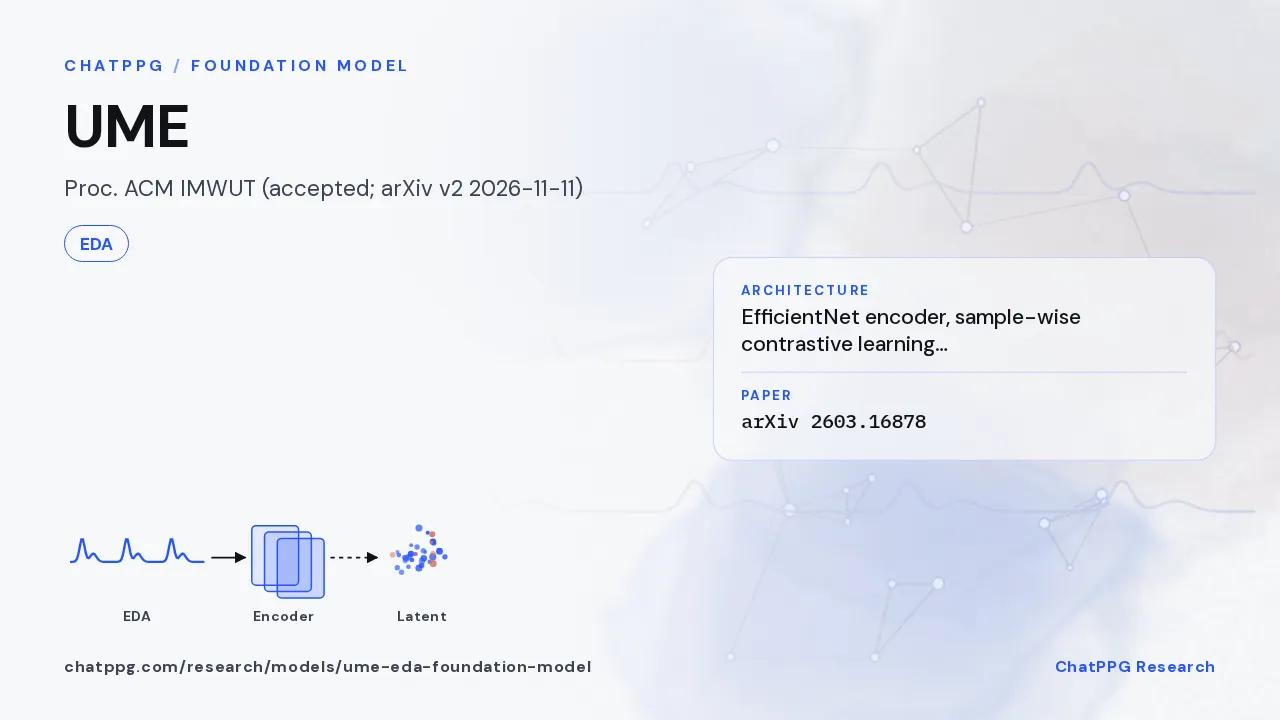
foundation model for wearable electrodermal activity (EDA), pretrained on the EDAMAME collection (USI, IMWUT)

Venue listedCatalog paper date: 2026Added to atlas: Nov 13, 2026Source

Activity counts measure attention, not model quality. Missing counts are unknown. Publication status follows the linked source; a listed venue alone does not confirm peer review.

UME is the first foundation model for wearable EDA, pretrained on EDAMAME (29 public datasets, ~23k hours, 731 users). As a frozen extractor it matches generic TSFMs at 20x less compute. Code and weights are MIT; IMWUT accepted.

Signals
EDA
Form factor
wrist EDA (pretraining split Empatica E4 only, 4 Hz)
Year
2026
Architecture

EfficientNet encoder, sample-wise contrastive learning (EDA augmentations after Matton et al.); tiny/small/base/large configs

License

MIT (code and weights); EDAMAME data is separate and tiered: open-licence datasets keep their own licences, others require a data-sharing agreement

At a glance
Type
Foundation model
Modalities
EDA
Parameters
Not reported
Architecture
EfficientNet encoder, sample-wise contrastive learning (EDA augmentations after Matton et al.); tiny/small/base/large configs
Venue
Proc. ACM IMWUT (accepted; arXiv v2 2026-11-11)
Year
2026
DOI
Not reported
Licence
MIT (code and weights); EDAMAME data is separate and tiered: open-licence datasets keep their own licences, others require a data-sharing agreement
Caveats
Not reported
Datasets
Not reported
Added
Nov 13, 2026
Updated
Nov 20, 2026

Abstract

Foundation models have recently extended beyond natural language and vision to time-series domains, including physiological signals. Yet developing foundation models for electrodermal activity (EDA) remains hindered by the absence of large-scale, curated, openly accessible datasets. EDA reflects sympathetic activity and is widely used to infer cognitive load, stress, and engagement. However, few wearable devices feature EDA sensing, and the only large-scale EDA archive to date is proprietary. To address this gap, we compile EDAMAME, a collection of EDA traces from 29 public datasets comprising approximately 23,000 hours of data from 731 users. Using this collection, we train UME, the first foundation model for EDA. As a frozen feature extractor, UME outperforms generic handcrafted features and matches generalist time-series foundation models while requiring 20x fewer computational resources; fine-tuning on the downstream tasks further yields additional performance gains in most experiments. UME also generalizes to EDA from two devices unseen during training. We further show that UME's performance improves as the amount of pretraining data grows, underscoring the importance of large-scale data for effective foundation models. Our findings highlight intrinsic challenges of EDA signals, revealing future research opportunities. We share EDAMAME under tiered access and also release model weights and code.

Verbatim fromarXiv· arXiv metadata (abstracts are released under CC0)

UME: ChatPPG research summary card

How it works

How UME works: Input signals → Foundation model → Downstream tasksInput signals: EDA (Electrodermal activity). Foundation model: UME (Contrastive learning). Downstream tasks: Stress.Input signalsEDA: Electrodermal activityEDAElectrodermal activityFoundation modelUMEContrastive learningDownstream tasksStressStress
Architecture
EfficientNet encoder, sample-wise contrastive learning (EDA augmentations after Matton et al.); tiny/small/base/large configs
Inputs
EDA
Approach
foundation model · eda · electrodermal · empatica e4 · contrastive · efficientnet

Datasets used

No public datasets linked yet.

Cite this model

Cite the publication recorded for this model. Check it against the publisher before submitting.

UME. (2026). Proc. ACM IMWUT. https://arxiv.org/abs/2603.16878
@inproceedings{umeedafoundation2026,
  title         = {{UME}},
  year          = {2026},
  booktitle     = {Proc. ACM IMWUT},
  eprint        = {2603.16878},
  archivePrefix = {arXiv}
}

Source metadata: 2026

Record updated Nov 20, 2026

History

  1. Record updated

  2. Added to the ChatPPG research hub