Activity counts measure attention, not model quality. Missing counts are unknown. Publication status follows the linked source; a listed venue alone does not confirm peer review.
Open random-forest sleep/wake (and non-wear) classifier from raw wrist accelerometer, with GGIR integration. Outperforms the van Hees heuristic baseline on the authors’ clinic PSG test set; open weights on Zenodo.
Signals
IMU
Form factor
Wrist
License
Apache-2.0 (code); CC BY 4.0 (article)
Year
2021
Architecture
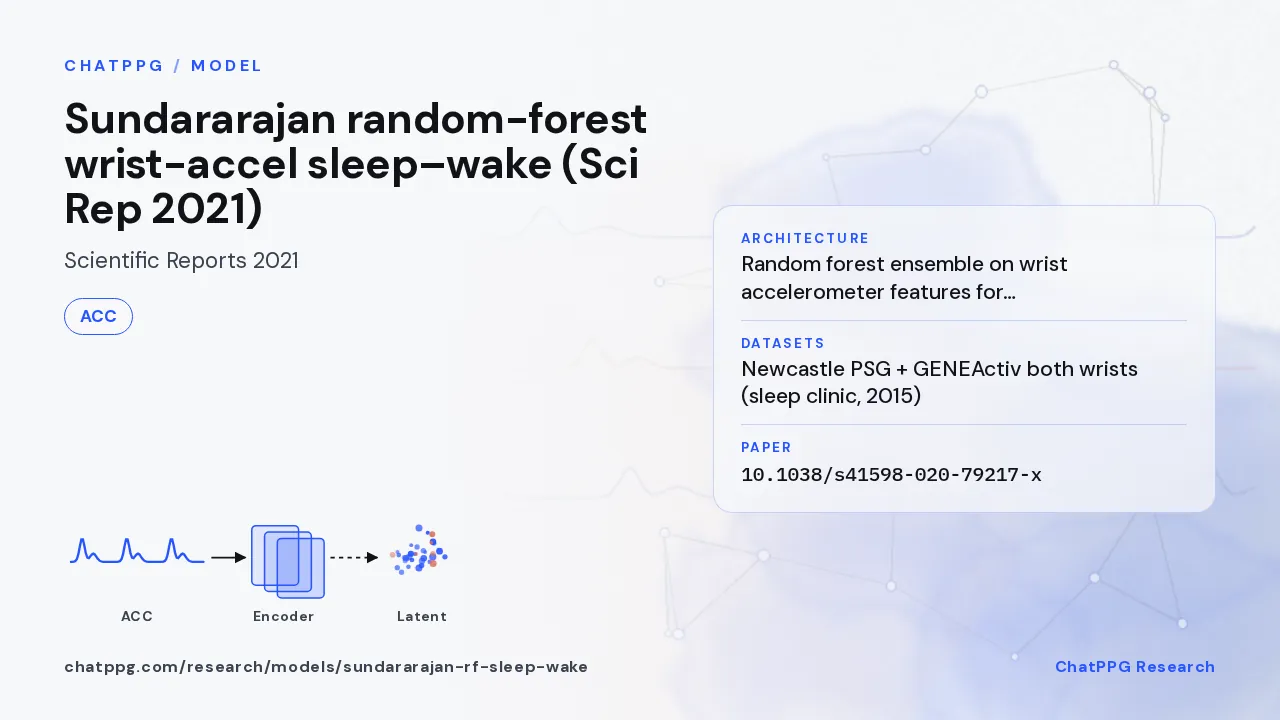
Random forest ensemble on wrist accelerometer features for sleep/wake (and separate non-wear RF); GGIR-integrated application path; hyperparameters per outer CV fold e.g. (trees, max-depth) tuples such as (400,Full)…(200,Full) as reported
Random forest ensemble on wrist accelerometer features for sleep/wake (and separate non-wear RF); GGIR-integrated application path; hyperparameters per outer CV fold e.g. (trees, max-depth) tuples such as (400,Full)…(200,Full) as reported
Accurate and low-cost sleep measurement tools are needed in both clinical and epidemiological research. To this end, wearable accelerometers are widely used as they are both low in price and provide reasonably accurate estimates of movement. Techniques to classify sleep from the high-resolution accelerometer data primarily rely on heuristic algorithms. In this paper, we explore the potential of detecting sleep using Random forests. Models were trained using data from three different studies where 134 adult participants (70 with sleep disorder and 64 good healthy sleepers) wore an accelerometer on their wrist during a one-night polysomnography recording in the clinic. The Random forests were able to distinguish sleep-wake states with an F1 score of 73.93% on a previously unseen test set of 24 participants. Detecting when the accelerometer is not worn was also successful using machine learning ( F1-score > 93.31%
F1-score > 93.31 %
), and when combined with our sleep detection models on day-time data provide a sleep estimate that is correlated with self-reported habitual nap behaviour ( r=.60
r = . 60
). These Random forest models have been made open-source to aid further research. In line with literature, sleep stage classification turned out to be difficult using only accelerometer data.
Datasets linked in the hub; pretraining vs evaluation roles follow the paper.
Architecture
Random forest ensemble on wrist accelerometer features for sleep/wake (and separate non-wear RF); GGIR-integrated application path; hyperparameters per outer CV fold e.g. (trees, max-depth) tuples such as (400,Full)…(200,Full) as reported
Inputs
IMU
Approach
sleep · sleep wake · actigraphy · random forest · GGIR · open weights
Cite the publication recorded for this model. Check it against the publisher before submitting.
Sundararajan, K., Georgievska, S., Lindert, B. H. W. T., et al. (2021). Sleep classification from wrist-worn accelerometer data using random forests. Scientific Reports 2021. https://doi.org/10.1038/s41598-020-79217-x
Sundararajan, Kalaivani, Sonja Georgievska, and Bart H. W. te Lindert, et al. 2021. "Sleep classification from wrist-worn accelerometer data using random forests." Scientific Reports 2021. https://doi.org/10.1038/s41598-020-79217-x.
Sundararajan, K., Georgievska, S. and Lindert, B. H. W. T. et al. (2021) 'Sleep classification from wrist-worn accelerometer data using random forests', Scientific Reports 2021. doi: 10.1038/s41598-020-79217-x.
Sundararajan, Kalaivani, et al. "Sleep classification from wrist-worn accelerometer data using random forests." Scientific Reports 2021, 2021. https://doi.org/10.1038/s41598-020-79217-x.
K. Sundararajan et al., "Sleep classification from wrist-worn accelerometer data using random forests," Scientific Reports 2021, 2021, doi: 10.1038/s41598-020-79217-x.
@article{sundararajan2021sleep,
  title         = {{Sleep classification from wrist-worn accelerometer data using random forests}},
  author        = {Sundararajan, Kalaivani and Georgievska, Sonja and Lindert, Bart H. W. te and others},
  year          = {2021},
  journal       = {Scientific Reports 2021},
  doi           = {10.1038/s41598-020-79217-x}
}
History
Added to the ChatPPG research hub
Newsletter
Get new PPG datasets, papers and models
Get alerts when Sundararajan random-forest wrist-accel sleep–wake (Sci Rep 2021) is benchmarked on new datasets, plus the weekly digest.
New datasets, papers and models
Practical guides from the hub
Unsubscribe anytime
The waveform is an illustration of a PPG pulse, not a recording.