Activity counts measure attention, not model quality. Missing counts are unknown. Publication status follows the linked source; a listed venue alone does not confirm peer review.
1. z-angle every 5 s 2. 5-minute rolling median of absolute successive Δz-angle 3. Per noon–noon day: threshold = 10th percentile × 15 4. Keep blocks below threshold lasting ≥30 min; bridge gaps <60 min 5. Longest block = SPT-window
Signals
IMU
Form factor
Wrist
Year
2018
Architecture
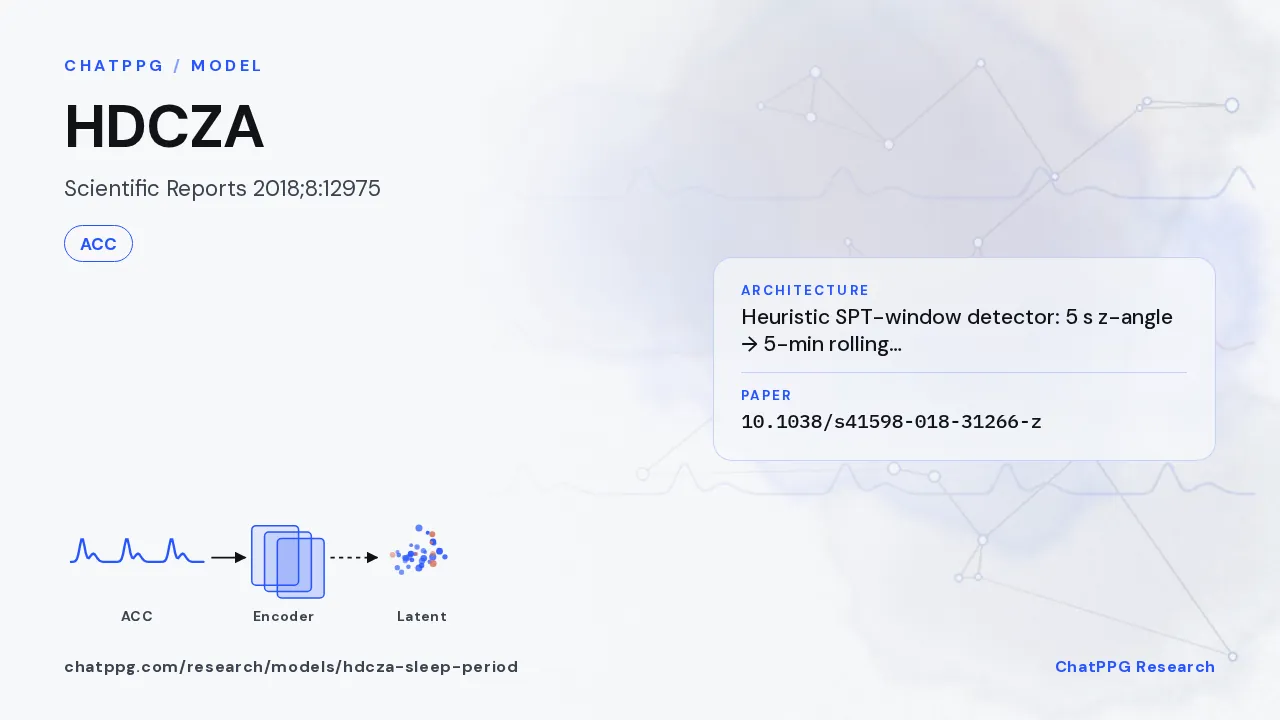
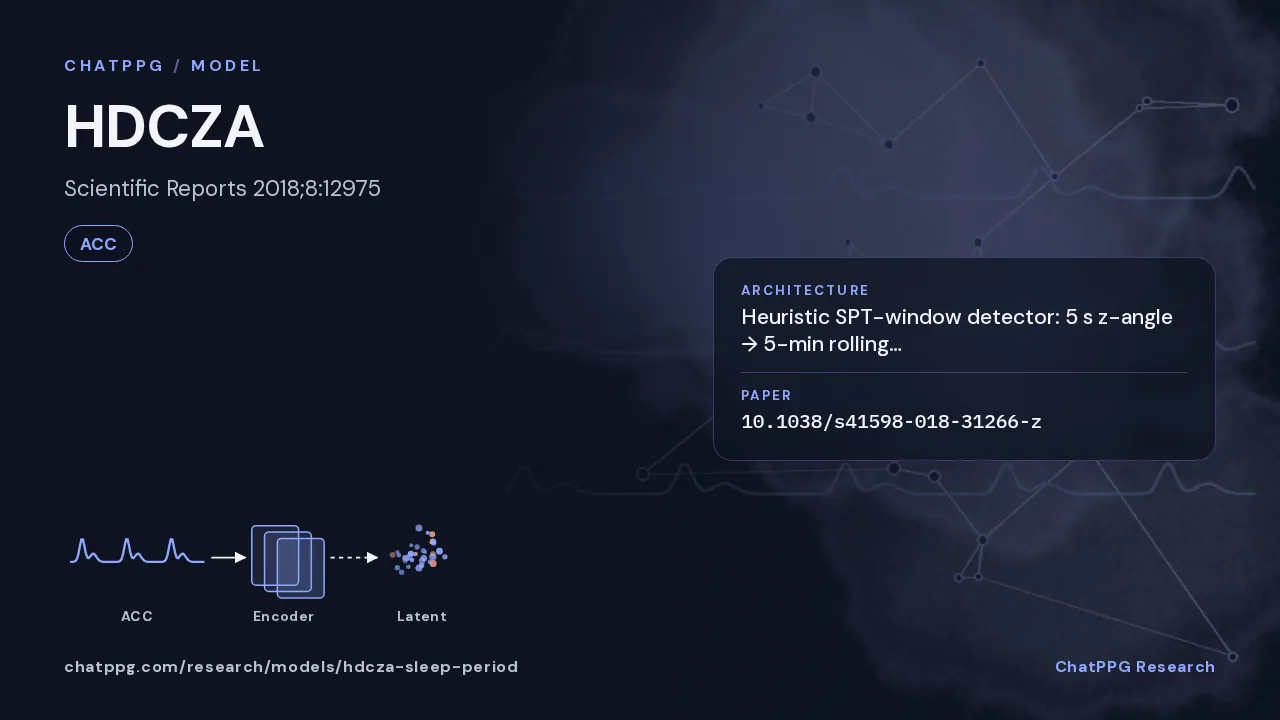
Heuristic SPT-window detector: 5 s z-angle → 5-min rolling median of |Δz-angle| → per noon–noon day threshold = 10th percentile × 15 → keep low-change blocks ≥30 min → bridge gaps <60 min → longest block = SPT-window (sleep onset to wake). Implemented as GGIR HASPT.algo='HDCZA'
License
Algorithm in CC BY 4.0 article; reference implementation in GGIR (Apache-2.0) — ggir
Heuristic SPT-window detector: 5 s z-angle → 5-min rolling median of |Δz-angle| → per noon–noon day threshold = 10th percentile × 15 → keep low-change blocks ≥30 min → bridge gaps <60 min → longest block = SPT-window (sleep onset to wake). Implemented as GGIR HASPT.algo='HDCZA'
Wrist worn raw-data accelerometers are used increasingly in large-scale population research. We examined whether sleep parameters can be estimated from these data in the absence of sleep diaries. Our heuristic algorithm uses the variance in estimated z-axis angle and makes basic assumptions about sleep interruptions. Detected sleep period time window (SPT-window) was compared against sleep diary in 3752 participants (range = 60–82 years) and polysomnography in sleep clinic patients (N = 28) and in healthy good sleepers (N = 22). The SPT-window derived from the algorithm was 10.9 and 2.9 minutes longer compared with sleep diary in men and women, respectively. Mean C-statistic to detect the SPT-window compared to polysomnography was 0.86 and 0.83 in clinic-based and healthy sleepers, respectively. We demonstrated the accuracy of our algorithm to detect the SPT-window. The value of this algorithm lies in studies such as UK Biobank where a sleep diary was not used.
Heuristic SPT-window detector: 5 s z-angle → 5-min rolling median of |Δz-angle| → per noon–noon day threshold = 10th percentile × 15 → keep low-change blocks ≥30 min → bridge gaps <60 min → longest block = SPT-window (sleep onset to wake). Implemented as GGIR HASPT.algo='HDCZA'
Cite the publication recorded for this model. Check it against the publisher before submitting.
van Hees, V. T., et al. (2018). Estimating sleep parameters using an accelerometer without sleep diary. Scientific Reports 2018, 8, 12975. https://doi.org/10.1038/s41598-018-31266-z
van Hees, Vincent T., et al. 2018. "Estimating sleep parameters using an accelerometer without sleep diary." Scientific Reports 2018 8: 12975. https://doi.org/10.1038/s41598-018-31266-z.
van Hees, V. T. et al. (2018) 'Estimating sleep parameters using an accelerometer without sleep diary', Scientific Reports 2018, 8, p. 12975. doi: 10.1038/s41598-018-31266-z.
van Hees, Vincent T., et al. "Estimating sleep parameters using an accelerometer without sleep diary." Scientific Reports 2018, vol. 8, 2018, p. 12975. https://doi.org/10.1038/s41598-018-31266-z.
V. T. van Hees et al., "Estimating sleep parameters using an accelerometer without sleep diary," Scientific Reports 2018, vol. 8, p. 12975, 2018, doi: 10.1038/s41598-018-31266-z.
@article{hees2018estimating,
  title         = {{Estimating sleep parameters using an accelerometer without sleep diary}},
  author        = {van Hees, Vincent T. and others},
  year          = {2018},
  journal       = {Scientific Reports 2018},
  volume        = {8},
  pages         = {12975},
  doi           = {10.1038/s41598-018-31266-z}
}
History
Added to the ChatPPG research hub
Newsletter
Get new PPG datasets, papers and models
Get alerts when HDCZA is benchmarked on new datasets, plus the weekly digest.
New datasets, papers and models
Practical guides from the hub
Unsubscribe anytime
The waveform is an illustration of a PPG pulse, not a recording.
Software: GGIR is listed in Wearable Signal Tools, with its licence, commercial use and last commit.