Model

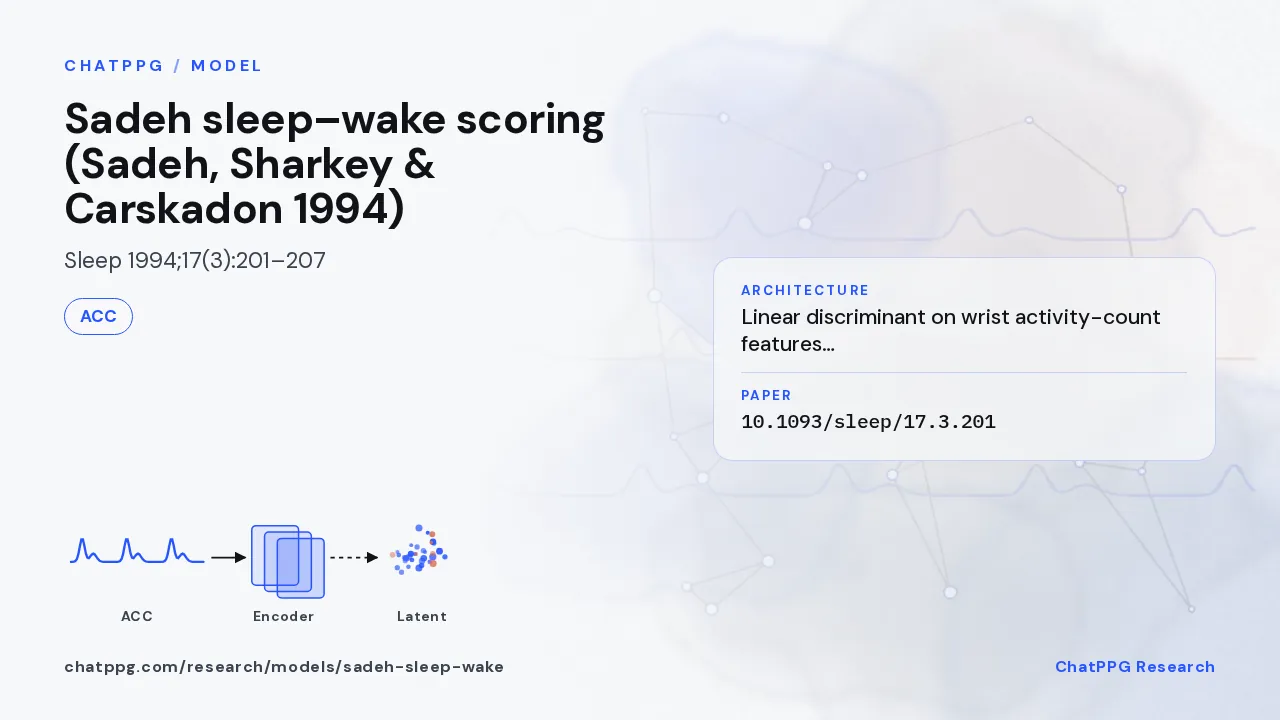
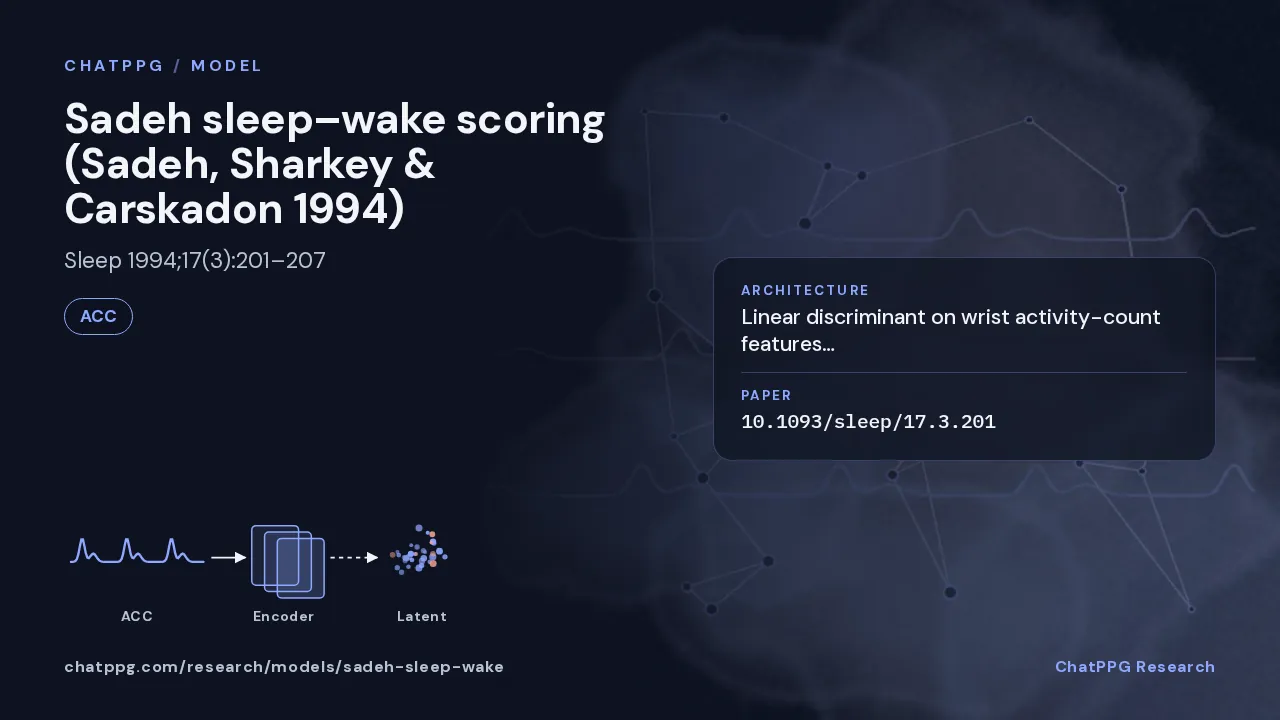
Sadeh sleep–wake scoring (Sadeh, Sharkey & Carskadon 1994)

Cite
Venue listedCatalog paper date: 1994Added to atlas: Nov 9, 2026Source

Activity counts measure attention, not model quality. Missing counts are unknown. Publication status follows the linked source; a listed venue alone does not confirm peer review.

Classical wrist actigraphy count sleep/wake classifier (Sadeh, Sharkey & Carskadon, Sleep 1994). Still a clinical/research baseline; Sleepacta’s commercial DORMI homepage compares against Sadeh on its CE cohort.

Signals
IMU
Form factor
Wrist
Year
1994
Architecture

Linear discriminant on wrist activity-count features (1-min epochs typical): PS = 7.601 − 0.065·mean_W5 − 1.08·NAT − 0.056·sd_Last6 − 0.703·logAct; PS≥0 → sleep, PS<0 → wake (pyActigraphy docs citing Sadeh 1994)

License

Algorithm published in paper; open reimplementations e.g. pyActigraphy (project licence) — original article is paywalled Oxford SLEEP

At a glance
Type
Task model
Modalities
IMU
Form factor
Wrist
Parameters
Not reported
Architecture
Linear discriminant on wrist activity-count features (1-min epochs typical): PS = 7.601 − 0.065·mean_W5 − 1.08·NAT − 0.056·sd_Last6 − 0.703·logAct; PS≥0 → sleep, PS<0 → wake (pyActigraphy docs citing Sadeh 1994)
Venue
Sleep 1994;17(3):201–207
Year
1994
arXiv
Not reported
Code
Open
Weights
Not released
Licence
Algorithm published in paper; open reimplementations e.g. pyActigraphy (project licence) — original article is paywalled Oxford SLEEP
Caveats
Not reported
Datasets
Not reported
Added
Nov 9, 2026
Updated
Nov 9, 2026

Abstract

The effects of actigraph placement and device sensitivity on actigraphic automatic sleep-wake scoring were assessed using concomitant polysomnographic and wrist actigraphic data from dominant and nondominant hands of 20 adults and 16 adolescents during 1 laboratory night. Although activity levels differed between dominant and nondominant wrists during periods of sleep (F = 4.57; p < 0.05) and wake (F = 15.5; p < 0.0005), resulting sleep-wake scoring algorithms were essentially the same and were equally explanatory (R2 = 0.64; p < 0.0001). When the sleep-wake scoring algorithm derived from the nondominant hand was used to score the nondominant data for sleep-wake, overall agreement rates with polysomnography scoring ranged between 91 and 93% for the calibration and validation samples. Results obtained with the same algorithm for the dominant-wrist data were within the same range. Agreement for sleep scoring was consistently higher than for wake scoring. Statistical manipulation of activity levels before applying the scoring algorithm indicated that this algorithm is quite robust toward moderate changes in activity level. Use of "twin-wrist actigraphy" enables identification of artifacts that may result from breathing-related motions.

Verbatim fromEurope PMC· Abstract via Europe PMC; © the authors/publisher

Sadeh sleep–wake scoring (Sadeh, Sharkey & Carskadon 1994): ChatPPG research summary card

Key results

How it works

How Sadeh sleep–wake scoring (Sadeh, Sharkey & Carskadon 1994) works: Input signals → Model → Downstream tasksInput signals: IMU (Accelerometer, 3-axis). Model: Sadeh sleep–wake scoring (Sadeh, Sharkey & Carskadon 1994). Downstream tasks: Sleep staging.Input signalsIMU: Accelerometer, 3-axisxyzIMUAccelerometer, 3-axisModelSadeh sleep–wake scoring…Downstream tasksSleep stagingSleep staging
Architecture
Linear discriminant on wrist activity-count features (1-min epochs typical): PS = 7.601 − 0.065·mean_W5 − 1.08·NAT − 0.056·sd_Last6 − 0.703·logAct; PS≥0 → sleep, PS<0 → wake (pyActigraphy docs citing Sadeh 1994)
Inputs
IMU
Approach
sleep · sleep wake · actigraphy · classical · Sadeh · baseline

Leaderboard rows· 3

All leaderboards
TaskDatasetMetricValueRank
Sleep/wake detection (actigraphy-style)MESA SleepAccuracy ↑0.882#1 / 1
Sleep/wake detection (actigraphy-style)Newcastle PSG + GENEActiv both wrists (sleep clinic, 2015)f1 ↑0.7393#1 / 1
Sleep/wake detection (actigraphy-style)own-sadeh-1994-labAccuracy ↑0.92#1 / 1

Datasets used

No public datasets linked yet.

Papers· 3

Cite this model

Cite the publication recorded for this model. Check it against the publisher before submitting.

Sadeh, A., Sharkey, M., & Carskadon, M. A. (1994). Activity-Based Sleep-Wake Identification: An Empirical Test of Methodological Issues. Sleep 1994, 17(3), 201–207. https://doi.org/10.1093/sleep/17.3.201
Sadeh, Avi, M. Sharkey, and Mary A. Carskadon. 1994. "Activity-Based Sleep-Wake Identification: An Empirical Test of Methodological Issues." Sleep 1994 17 (3): 201–207. https://doi.org/10.1093/sleep/17.3.201.
Sadeh, A., Sharkey, M. and Carskadon, M. A. (1994) 'Activity-Based Sleep-Wake Identification: An Empirical Test of Methodological Issues', Sleep 1994, 17(3), pp. 201–207. doi: 10.1093/sleep/17.3.201.
Sadeh, Avi, et al. "Activity-Based Sleep-Wake Identification: An Empirical Test of Methodological Issues." Sleep 1994, vol. 17, no. 3, 1994, pp. 201–207. https://doi.org/10.1093/sleep/17.3.201.
A. Sadeh, M. Sharkey, and M. A. Carskadon, "Activity-Based Sleep-Wake Identification: An Empirical Test of Methodological Issues," Sleep 1994, vol. 17, no. 3, pp. 201–207, 1994, doi: 10.1093/sleep/17.3.201.
@article{sadeh1994activitybased,
  title         = {{Activity-Based Sleep-Wake Identification: An Empirical Test of Methodological Issues}},
  author        = {Sadeh, Avi and Sharkey, M. and Carskadon, Mary A.},
  year          = {1994},
  journal       = {Sleep 1994},
  volume        = {17},
  number        = {3},
  pages         = {201--207},
  doi           = {10.1093/sleep/17.3.201}
}

History

  1. Added to the ChatPPG research hub