Model

Reliability-Guided Video Token Learning for contactless HR + RR with uncertainty (CIKM 2026)

Cite
Venue listedCatalog paper date: 2026Source

Activity counts measure attention, not model quality. Missing counts are unknown. Publication status follows the linked source; a listed venue alone does not confirm peer review.

The model learns which video tokens to trust before it estimates vitals. An evidence miner weights spatiotemporal tokens so that skin and chest-motion tokens count and background, lighting and pose tokens are suppressed. Masked video-token modelling makes the encoder robust to missing evidence.

Signals
NIR, RGB
Form factor
camera_rppg
Year
2026
Architecture

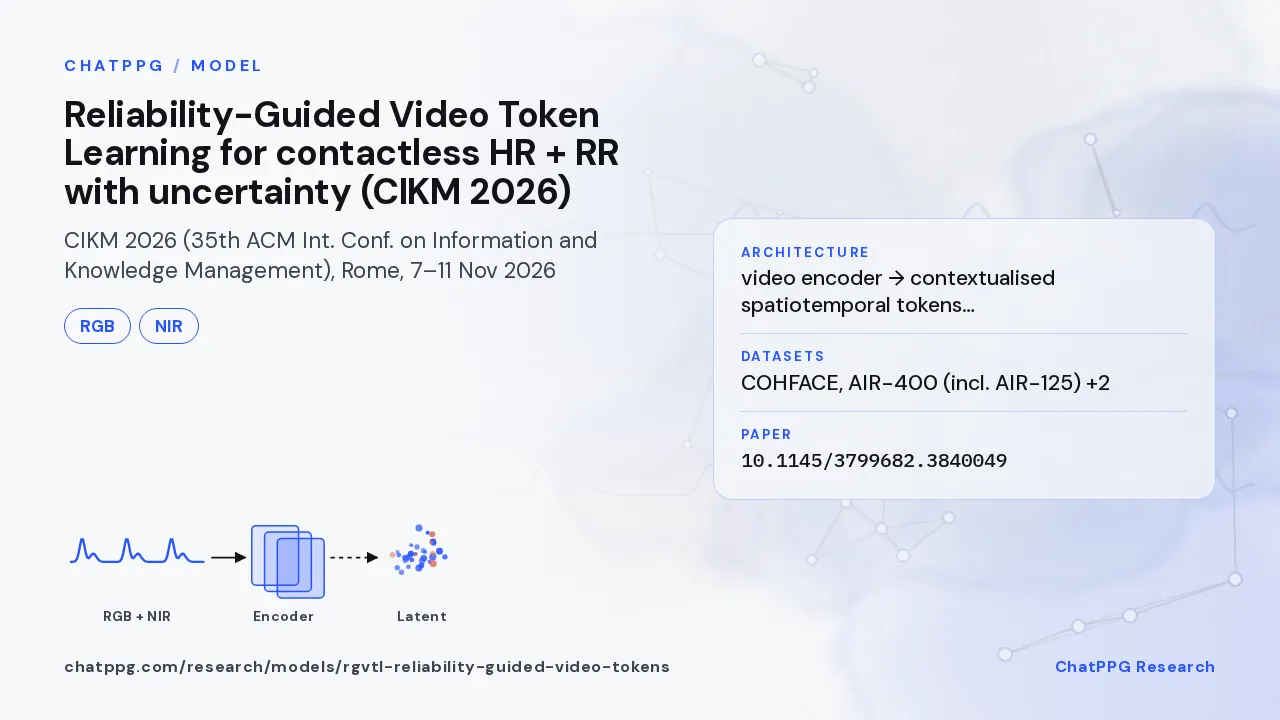
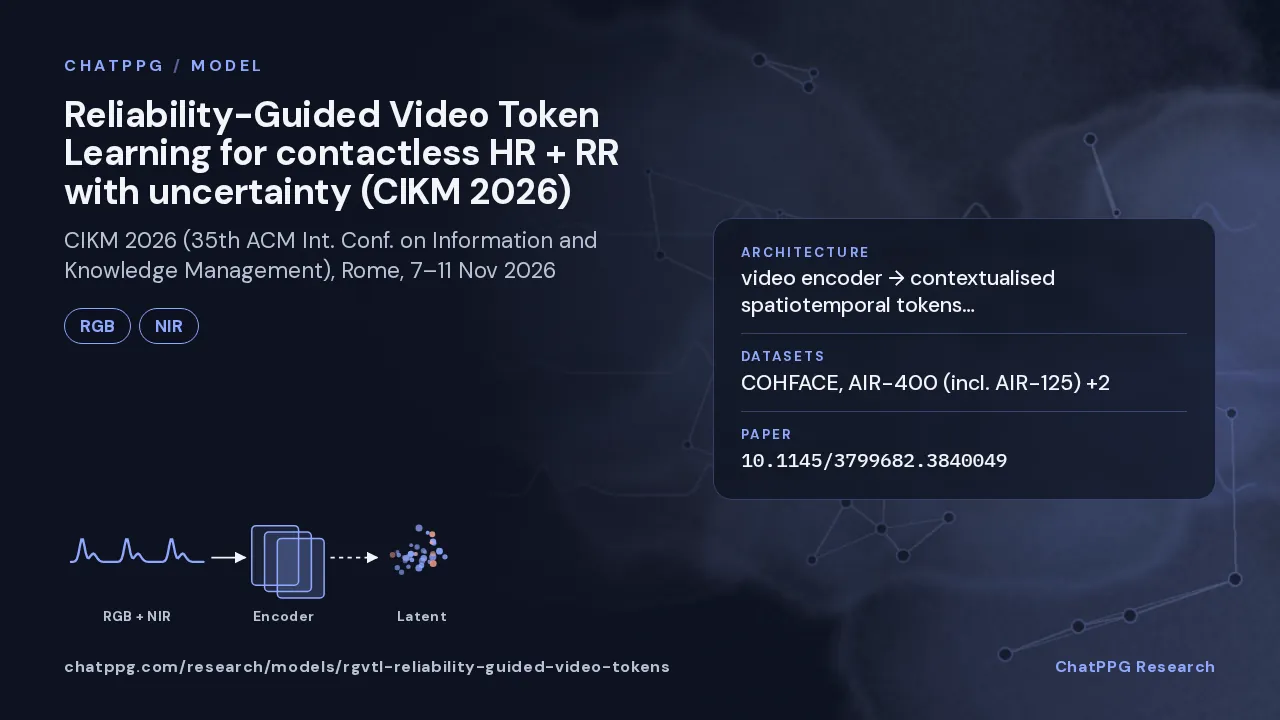
video encoder → contextualised spatiotemporal tokens; masked video-token reconstruction regulariser; evidence miner assigns token reliability weights (softmax over tokens); signal encoder for in-batch video↔signal alignment (training only); latent physiological state queries with self- and cross-attention over reliability-weighted tokens; three heads (waveform, rates, log-variance uncertainty)

At a glance
Type
Task model
Modalities
NIRRGB
Form factor
Camera rPPG
Parameters
Not reported
Architecture
video encoder → contextualised spatiotemporal tokens; masked video-token reconstruction regulariser; evidence miner assigns token reliability weights (softmax over tokens); signal encoder for in-batch video↔signal alignment (training only); latent physiological state queries with self- and cross-attention over reliability-weighted tokens; three heads (waveform, rates, log-variance uncertainty)
Venue
CIKM 2026 (35th ACM Int. Conf. on Information and Knowledge Management), Rome, 7–11 Nov 2026
Year
2026
arXiv
Not reported
Code
Not reported
Weights
Not reported
Licence
Not reported
Caveats
Not reported
Added
Not reported
Updated
Nov 10, 2026

Abstract

Contactless vital-sign estimation from video remains difficult because physiological cues are weak, spatially localized, and easily corrupted by illumination changes, motion artifacts, pose variation, and sensor noise. Existing methods typically learn deterministic mappings from video to physiological waveforms or rates, but they rarely model which visual evidence is reliable or when a prediction should be trusted. We propose a reliability-guided video token learning framework for uncertainty-aware physiological signal estimation. The framework learns to mine informative spatiotemporal tokens, suppress unreliable visual evidence, and infer structured physiological dynamics through masked video-token modeling, signal-guided alignment, and supervised vital-sign estimation. In addition to predicting physiological waveforms and rates, the model outputs an uncertainty score that reflects visual ambiguity and prediction reliability. We evaluate the framework across heterogeneous contactless sensing settings, including respiratory and rPPG benchmarks. In addition to standard accuracy metrics, we assess reliability using uncertainty separation, high-error detection, and risk–coverage analysis. Results show that explicit visual-evidence reliability modeling improves robustness across datasets and provides a practical confidence measure for contactless physiological monitoring.
Verbatim fromSemantic Scholar· Abstract via Semantic Scholar; © the authors/publisher

Reliability-Guided Video Token Learning for contactless HR + RR with uncertainty (CIKM 2026): ChatPPG research summary card

Key results

How it works

How Reliability-Guided Video Token Learning for contactless HR + RR with uncertainty (CIKM 2026) works: Input signals → Model → Downstream tasksInput signals: NIR; RGB. Datasets: COHFACE, AIR-400 (incl. AIR-125), IMVIA-NIR, MPSC-RR. Model: Reliability-Guided Video Token Learning for contactless HR + RR with uncertainty (CIKM 2026) (Transformer · Masked reconstruction). Downstream tasks: Heart rate; Video rr; Respiration.Input signalsNIRNIRRGBRGBDatasets: COHFACE, AIR-400 (incl. AIR-125), IMVIA-NIR, MPSC-RRDatasetsCOHFACE, AIR-400 (incl. AIR-125) +2 moreModel×NReliability-Guided Video…Transformer · Masked reconstructionDownstream tasksHeart rateHeart rateVideo rrVideo rrRespirationRespiration

Datasets linked in the hub; pretraining vs evaluation roles follow the paper.

Architecture
video encoder → contextualised spatiotemporal tokens; masked video-token reconstruction regulariser; evidence miner assigns token reliability weights (softmax over tokens); signal encoder for in-batch video↔signal alignment (training only); latent physiological state queries with self- and cross-attention over reliability-weighted tokens; three heads (waveform, rates, log-variance uncertainty)
Inputs
NIR, RGB
Approach
rppg · respiratory rate · model · uncertainty · selective prediction · masked modeling

Leaderboard rows· 3

All leaderboards
TaskDatasetMetricValueRank
Rppg hrCOHFACEHR MAE ↓3.34#1 / 1
Rppg hrIMVIA-NIRHR MAE ↓4.71#1 / 1
Video rrAIR-400 (incl. AIR-125)RR MAE ↓3.42#1 / 1

Datasets used· 4

Cite this model

Cite the publication recorded for this model. Check it against the publisher before submitting.

Reliability-Guided Video Token Learning for contactless HR + RR with uncertainty (CIKM 2026). (2026). CIKM 2026 , Rome, 7–11 Nov 2026. https://doi.org/10.1145/3799682.3840049
@article{rgvtlreliability2026reliabilityguided,
  title         = {{Reliability-Guided Video Token Learning for contactless HR + RR with uncertainty (CIKM 2026)}},
  year          = {2026},
  journal       = {CIKM 2026 , Rome, 7–11 Nov 2026},
  doi           = {10.1145/3799682.3840049}
}

History

  1. Record updated