Activity counts measure attention, not model quality. Missing counts are unknown. Publication status follows the linked source; a listed venue alone does not confirm peer review.
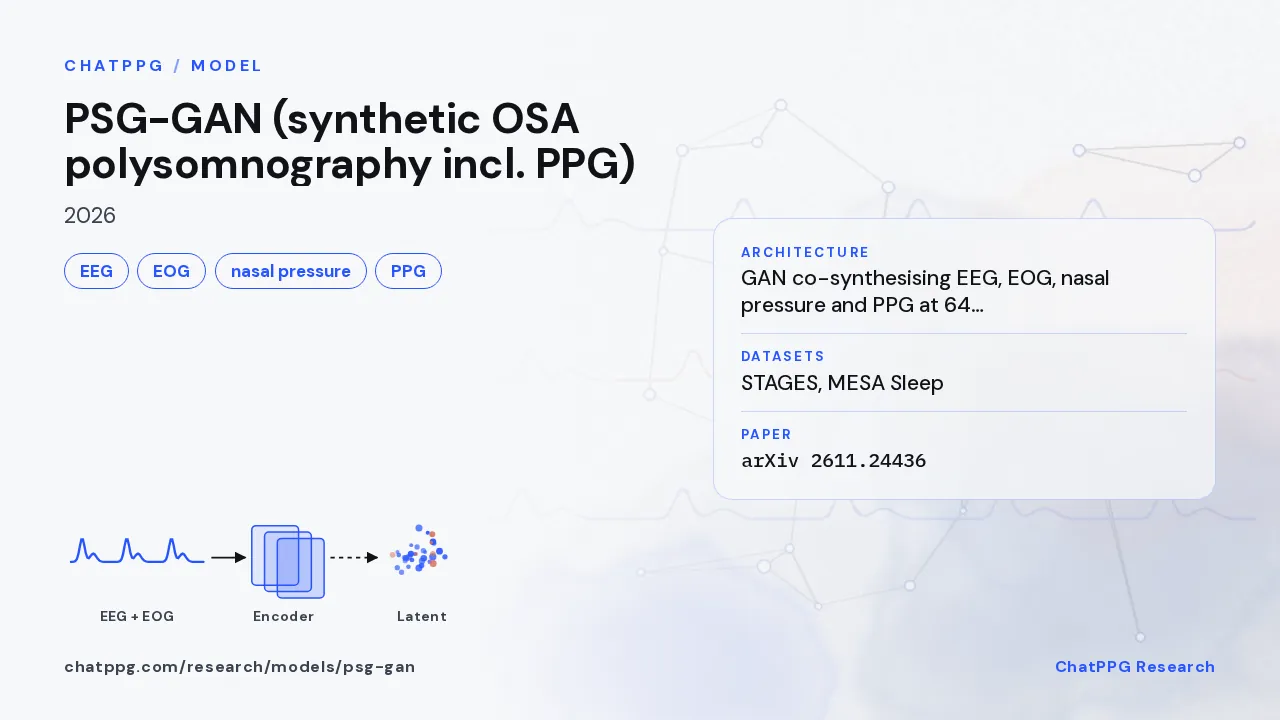
GAN that generates multi-signal OSA polysomnography (EEG, EOG, nasal pressure, PPG) with realistic inter-signal coupling (PPG HR around obstructions). Scoring models trained only on its output reach κ 0.71/0.63 staging and 0.57/0.60 respiratory events. Paper: the From real to synthetic paper.
Signals
PPG, EEG, EOG, nasal pressure
Pretraining data
STAGES PSG (NSRR)
License
MIT (code)
Year
2026
Architecture
GAN co-synthesising EEG, EOG, nasal pressure and PPG at 64 Hz over long OSA segments
Synthetic polysomnography (PSG) data has great potential in healthcare applications, for example in substituting real data that is sensitive and challenging to collect. Previous research on synthetic PSG data has been largely focused on short segments of individual signals, overlooking the inter-signal dynamics related to sleep disorders. In this study, we developed a generative adversarial network (PSG-GAN) for co-synthesizing longer segments of multiple PSG signals with diverse and complex characteristics typical of obstructive sleep apnea (OSA). The synthetic signals appeared realistic, and the electroencephalography and electrooculography band powers were similarly distributed across sleep stages. Moreover, the PSG-GAN learned to mirror signal interactions such as changes in photoplethysmography-based heart rate during and after breathing obstructions. An automatic scoring model trained solely with automatically scored synthetic signals reached good performance on sleep staging (appa=0.71 and 0.63) and respiratory event segmentation (appa=0.57 and 0.60), on two test sets consisting of healthy volunteers and OSA patients, respectively. This demonstrates the potential of synthetic data in supporting algorithm development for sleep diagnostics. The source code is available at https://github.com/rikuhuttunen/psg-gan.
Verbatim fromarXiv· arXiv metadata (abstracts are released under CC0)
How it works
Datasets linked in the hub; pretraining vs evaluation roles follow the paper.
Pretraining data
STAGES PSG (NSRR)
Architecture
GAN co-synthesising EEG, EOG, nasal pressure and PPG at 64 Hz over long OSA segments
Inputs
PPG, EEG, EOG, nasal pressure
Approach
synthetic data · gan · osa · polysomnography · ppg
Cite the publication recorded for this model. Check it against the publisher before submitting.
Huttunen, R., Kainulainen, S., Rusanen, M., Myllymaa, S., Töyräs, J., Leppänen, T., & Korkalainen, H. (2026). From real to synthetic: PSG-GAN learns sleep apnea signal dynamics for AI training. arXiv:2611.24436. https://arxiv.org/abs/2611.24436
Huttunen, Riku, Samu Kainulainen, Matias Rusanen, Sami Myllymaa, Juha Töyräs, Timo Leppänen, and Henri Korkalainen. 2026. "From real to synthetic: PSG-GAN learns sleep apnea signal dynamics for AI training." arXiv:2611.24436. https://arxiv.org/abs/2611.24436.
Huttunen, R., Kainulainen, S., Rusanen, M., Myllymaa, S., Töyräs, J., Leppänen, T. and Korkalainen, H. (2026) 'From real to synthetic: PSG-GAN learns sleep apnea signal dynamics for AI training', arXiv:2611.24436. Available at: https://arxiv.org/abs/2611.24436
Huttunen, Riku, et al. "From real to synthetic: PSG-GAN learns sleep apnea signal dynamics for AI training." arXiv:2611.24436, 2026. https://arxiv.org/abs/2611.24436.
R. Huttunen et al., "From real to synthetic: PSG-GAN learns sleep apnea signal dynamics for AI training," arXiv:2611.24436, 2026, [Online]. Available: https://arxiv.org/abs/2611.24436.
@misc{huttunen2026from,
  title         = {{From real to synthetic: PSG-GAN learns sleep apnea signal dynamics for AI training}},
  author        = {Huttunen, Riku and Kainulainen, Samu and Rusanen, Matias and Myllymaa, Sami and Töyräs, Juha and Leppänen, Timo and Korkalainen, Henri},
  year          = {2026},
  howpublished  = {arXiv:2611.24436},
  eprint        = {2611.24436},
  archivePrefix = {arXiv}
}
History
Added to the ChatPPG research hub
Newsletter
Get new PPG datasets, papers and models
Get alerts when PSG-GAN (synthetic OSA polysomnography incl. PPG) is benchmarked on new datasets, plus the weekly digest.
New datasets, papers and models
Practical guides from the hub
Unsubscribe anytime
The waveform is an illustration of a PPG pulse, not a recording.