Activity counts measure attention, not model quality. Missing counts are unknown. Publication status follows the linked source; a listed venue alone does not confirm peer review.
Sleepacta’s EU MDR 2017/745 Class I OSA risk screening software (BD/RDM 2506496, CND Z12030692, registered 22/11/2023). Runs on the same multi-day home recording as dormi; company: no respiratory sensors, no sleep-lab night required; outputs four risk bands per sleep episode (AHI-equivalent: <5, 5–15, 15–30, ≥30). Screening only — diagnosis remains clinical (company).
Signals
PPG, IMU
Form factor
Wrist
License
proprietary (Sleepacta commercial MD)
Year
2022
Architecture
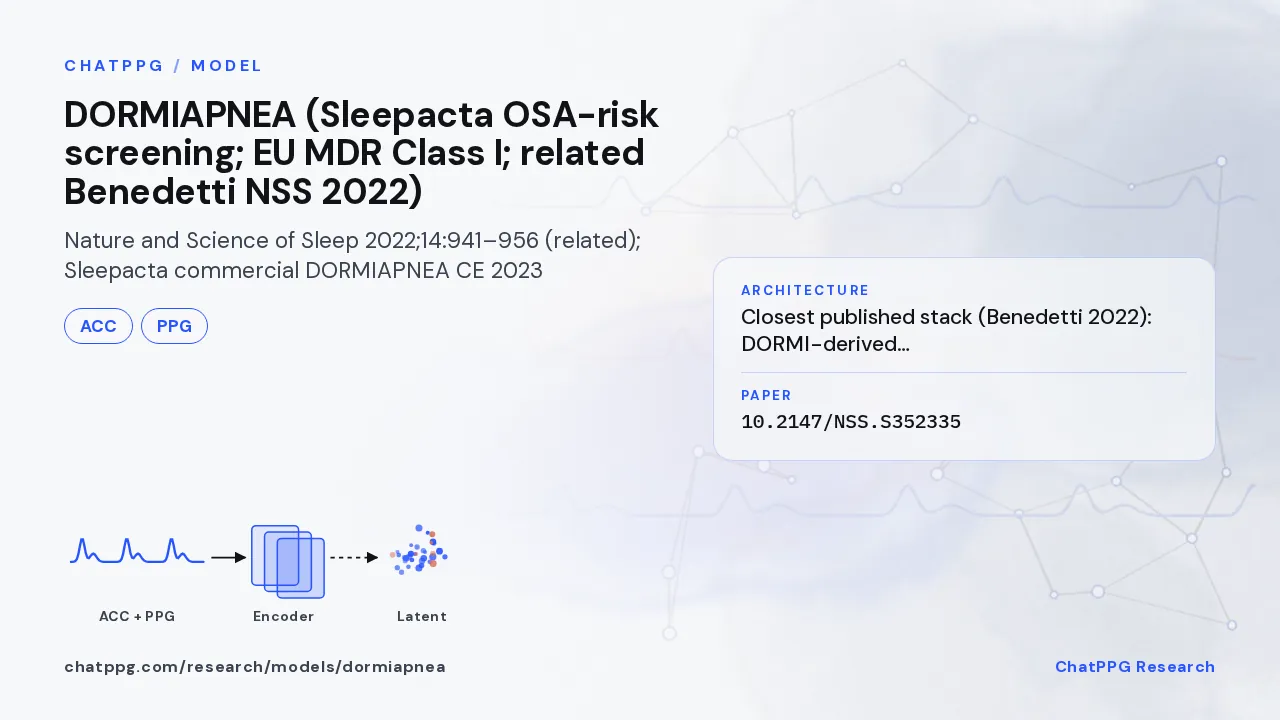
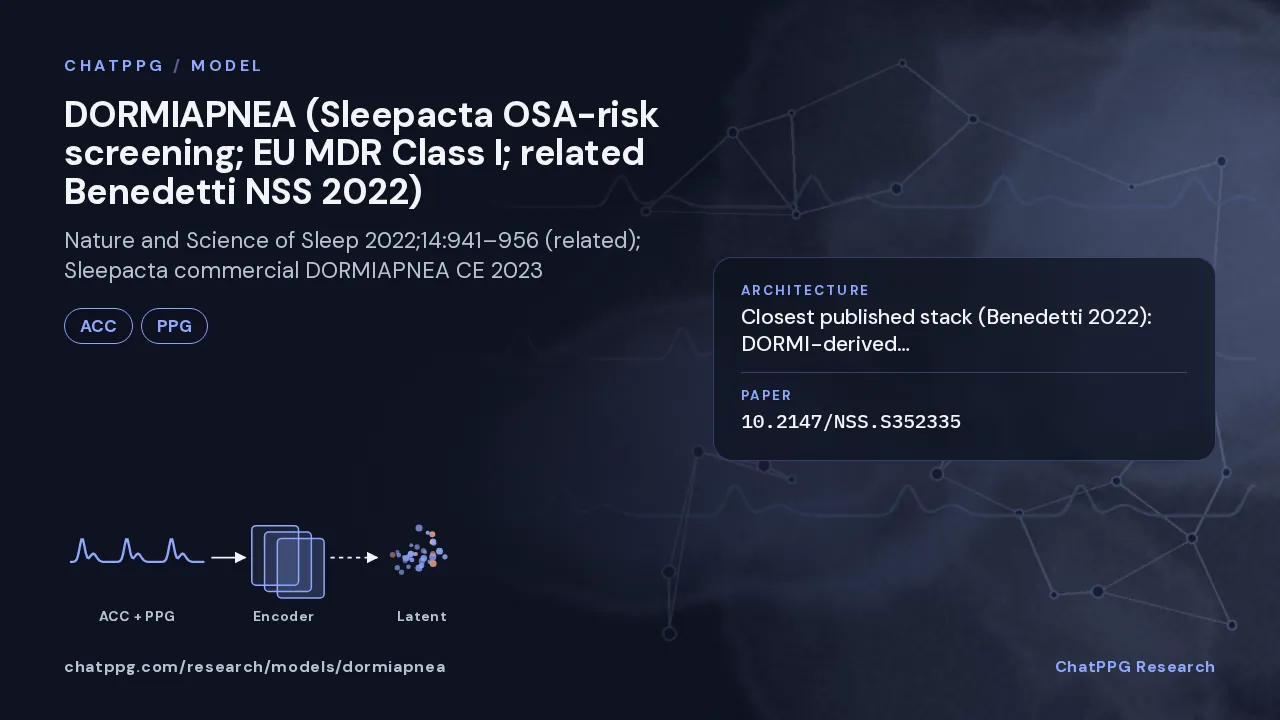
Closest published stack (Benedetti 2022): DORMI-derived minute sleep metrics + Fitbit proprietary energy-expenditure/steps + PPG-derived HR features → paired MLP / RandomForest classifiers for AHI cut-offs 5/15/30 with LOO and class-balanced warm-start training
Closest published stack (Benedetti 2022): DORMI-derived minute sleep metrics + Fitbit proprietary energy-expenditure/steps + PPG-derived HR features → paired MLP / RandomForest classifiers for AHI cut-offs 5/15/30 with LOO and class-balanced warm-start training
Venue
Nature and Science of Sleep 2022;14:941–956 (related); Sleepacta commercial DORMIAPNEA CE 2023
PurposeA large portion of the adult population is thought to suffer from obstructive sleep apnoea syndrome (OSAS), a sleep-related breathing disorder associated with increased morbidity and mortality. International guidelines include the polysomnography and the cardiorespiratory monitoring (CRM) as diagnostic tools for OSAS, but they are unfit for a large-scale screening, given their invasiveness, high cost and lengthy process of scoring. Current screening methods are based on self-reported questionnaires that suffer from lack of objectivity. On the contrary, commercial smartbands are wearable devices capable of collecting accelerometric and photoplethysmographic data in a user-friendly and objective way. We questioned whether machine-learning (ML) classifiers trained on data collected through these wearable devices would help predict OSAS severity.Patients and methodsEach of the patients (n = 78, mean age ± SD: 57.2 ± 12.9 years; 30 females) underwent CRM and concurrently wore a commercial wrist smartband. CRM's traces were scored, and OSAS severity was reported as apnoea hypopnoea index (AHI). We trained three pairs of classifiers to make the following prediction: AHI ResultsAccording to the Matthews correlation coefficient (MCC), the proposed algorithms reached an overall good correlation with the ground truth (CRM) for AHI ConclusionMachine learning algorithms showed an overall good performance. Unlike questionnaires, these are based on objectively collected data. Furthermore, these commercial devices are widely distributed in the general population. The aforementioned advantages of machine-learning algorithms applied to smartbands' data over questionnaires lead to the conclusion that they could serve a population-scale screening for OSAS.
Closest published stack (Benedetti 2022): DORMI-derived minute sleep metrics + Fitbit proprietary energy-expenditure/steps + PPG-derived HR features → paired MLP / RandomForest classifiers for AHI cut-offs 5/15/30 with LOO and class-balanced warm-start training
Inputs
PPG, IMU
Approach
sleep · osa · AHI · screening · actigraphy · EU MDR
Cite the publication recorded for this model. Check it against the publisher before submitting.
Benedetti, D., Olcese, U., Bruno, S., Barsotti, M., Tassoni, M. M., Bonanni, E., Siciliano, G., & Faraguna, U. (2022). Obstructive Sleep Apnoea Syndrome Screening Through Wrist-Worn Smartbands: A Machine-Learning Approach. Nature and Science of Sleep 2022, 14, 941–956. https://doi.org/10.2147/NSS.S352335
Benedetti, Davide, Umberto Olcese, Simone Bruno, Marta Barsotti, Michelangelo Maestri Tassoni, Enrica Bonanni, Gabriele Siciliano, and Ugo Faraguna. 2022. "Obstructive Sleep Apnoea Syndrome Screening Through Wrist-Worn Smartbands: A Machine-Learning Approach." Nature and Science of Sleep 2022 14: 941–956. https://doi.org/10.2147/NSS.S352335.
Benedetti, D., Olcese, U., Bruno, S., Barsotti, M., Tassoni, M. M., Bonanni, E., Siciliano, G. and Faraguna, U. (2022) 'Obstructive Sleep Apnoea Syndrome Screening Through Wrist-Worn Smartbands: A Machine-Learning Approach', Nature and Science of Sleep 2022, 14, pp. 941–956. doi: 10.2147/NSS.S352335.
Benedetti, Davide, et al. "Obstructive Sleep Apnoea Syndrome Screening Through Wrist-Worn Smartbands: A Machine-Learning Approach." Nature and Science of Sleep 2022, vol. 14, 2022, pp. 941–956. https://doi.org/10.2147/NSS.S352335.
D. Benedetti et al., "Obstructive Sleep Apnoea Syndrome Screening Through Wrist-Worn Smartbands: A Machine-Learning Approach," Nature and Science of Sleep 2022, vol. 14, pp. 941–956, 2022, doi: 10.2147/NSS.S352335.
@article{benedetti2022obstructive,
  title         = {{Obstructive Sleep Apnoea Syndrome Screening Through Wrist-Worn Smartbands: A Machine-Learning Approach}},
  author        = {Benedetti, Davide and Olcese, Umberto and Bruno, Simone and Barsotti, Marta and Tassoni, Michelangelo Maestri and Bonanni, Enrica and Siciliano, Gabriele and Faraguna, Ugo},
  year          = {2022},
  journal       = {Nature and Science of Sleep 2022},
  volume        = {14},
  pages         = {941--956},
  doi           = {10.2147/NSS.S352335}
}
History
Added to the ChatPPG research hub
Newsletter
Get new PPG datasets, papers and models
Get alerts when DORMIAPNEA (Sleepacta OSA-risk screening; EU MDR Class I; related Benedetti NSS 2022) is benchmarked on new datasets, plus the weekly digest.
New datasets, papers and models
Practical guides from the hub
Unsubscribe anytime
The waveform is an illustration of a PPG pulse, not a recording.