Model

Amsterdam UMC ECG-LVEF model

ConvNeXt V2 on 12-lead ECG images for LVEF ≤40%

Cite
Venue listedCatalog paper date: 2026Added to atlas: Nov 11, 2026Source

Activity counts measure attention, not model quality. Missing counts are unknown. Publication status follows the linked source; a listed venue alone does not confirm peer review.

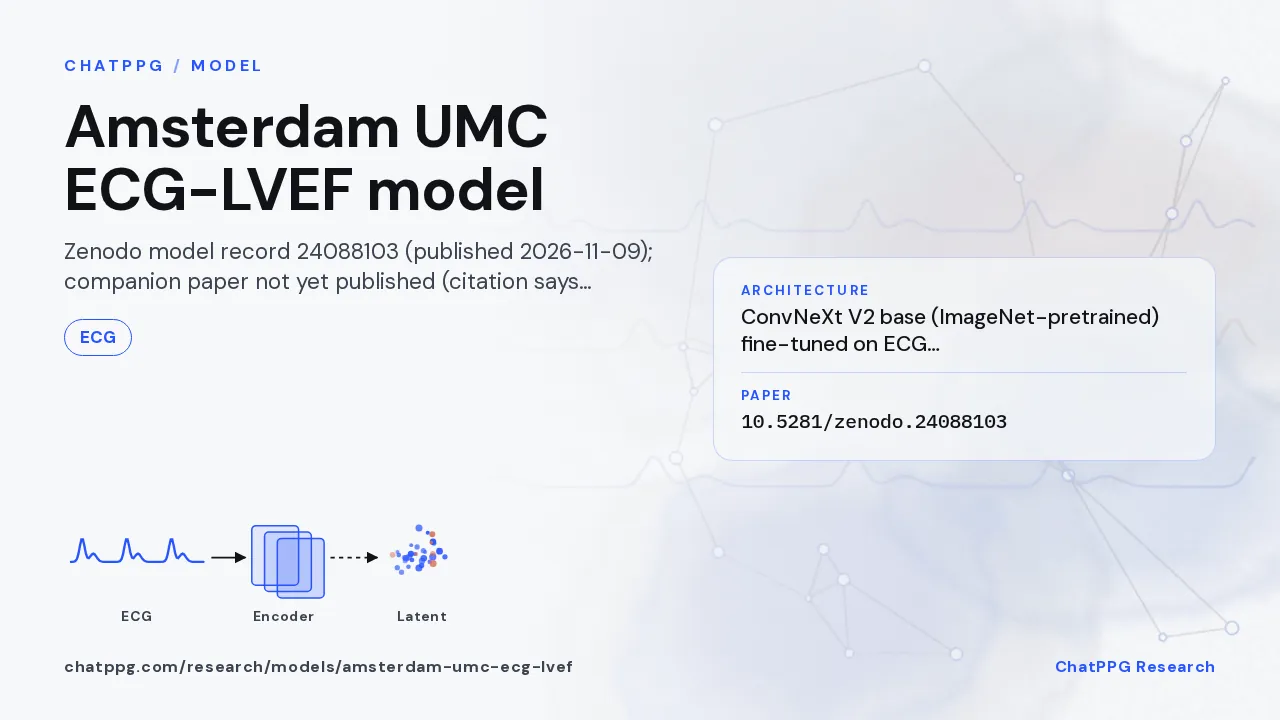
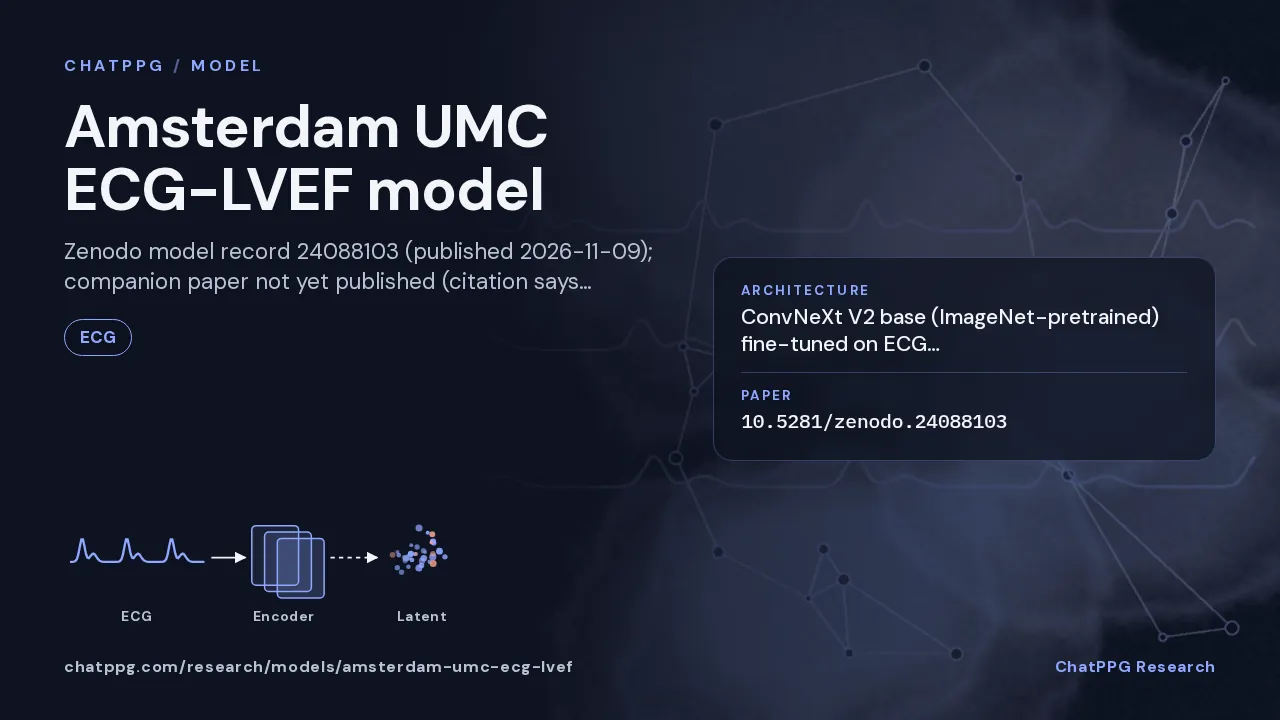
A supervised task model, not a foundation model. An ImageNet-pretrained ConvNeXt V2 base network is fine-tuned on images of the ECG: each 10-s, 500 Hz, 12-lead recording is band-pass filtered (Butterworth 0.5–40 Hz, order 2), median-smoothed, cut into five 2-s strips of eight leads (I, II, V1–V6), drawn as stacked rows and resized to 384×384. Each strip gets a probability of LVEF ≤40%; the five are averaged per ECG.

Signals
ECG
License
CC BY-NC 4.0 (code and weights)
Year
2026
Architecture

ConvNeXt V2 base (ImageNet-pretrained) fine-tuned on ECG trace images; each 10-s ECG → five 2-s strips of 8 stacked leads drawn on a 1000×1000 canvas, resized to 384×384; per-strip probabilities averaged

Pretraining data

ImageNet (ConvNeXt V2 backbone); fine-tuned on Amsterdam UMC ECGs paired with LVEF from transthoracic echocardiography or cardiac MR (soft labels by imaging-method uncertainty); external validation on an Erasmus MC CMR cohort. Patient data not released.

Form factor

clinical 12-lead resting ECG (8 leads used: I, II, V1–V6)

At a glance
Type
Task model
Modalities
ECG
Form factor
Clinical 12 lead resting ECG (8 leads used: I, II, V1–V6)
Parameters
Not reported
Architecture
ConvNeXt V2 base (ImageNet-pretrained) fine-tuned on ECG trace images; each 10-s ECG → five 2-s strips of 8 stacked leads drawn on a 1000×1000 canvas, resized to 384×384; per-strip probabilities averaged
Venue
Zenodo model record 24088103 (published 2026-11-09); companion paper not yet published (citation says 'Journal, year, DOI – to be added')
Year
2026
arXiv
Not reported
Code
Open
Weights
Open
Caveats
Not reported
Datasets
Not reported
Added
Nov 11, 2026
Updated
Nov 11, 2026

Abstract

ECG-LVEF model: deep learning detection of left ventricular systolic dysfunction from the 12-lead ECG

This record contains the trained model weights and the code for a deep learning model that detects left ventricular systolic dysfunction (LVEF ≤40%) from a standard 10-second, 12-lead ECG.

Model. The model is a ConvNeXt V2 base network (pretrained on ImageNet), fine-tuned on ECG images. Each ECG is filtered and cut into five 2-second strips of eight leads (I, II, V1–V6), and each strip is converted to an image. The model scores each strip, and the five probabilities are averaged into one probability of LVEF ≤40% per ECG.

Training data. The model was developed with ECGs from Amsterdam UMC, paired with LVEF from transthoracic echocardiography or cardiac magnetic resonance (CMR). Soft labels reflected the measurement uncertainty of each imaging method. The model was externally validated in an independent CMR cohort from Erasmus MC. The patient data are not included.

Contents

weights/model.pt: trained model weights

src/: code for preprocessing, training, validation and inference

config/: configuration files

README.md: installation and usage

Use. Place your ECGs (DICOM) in a zip file, set the paths in config/inference.json, and run uv run ecg-inference. The output is one probability per ECG. The model overestimates absolute risk. Recalibrate it and check thresholds locally before use.

Intended use and limitations. This model is for research, independent validation and non-commercial evaluation. It is not a CE-marked medical device and must not be used for clinical decisions. It was developed in patients referred for imaging at Dutch academic centres. Performance with other ECG vendors, healthcare systems and populations is unknown.

License. CC BY-NC 4.0. This follows the license of the pretrained ConvNeXt V2 weights.

Citation. Please cite: Selder JL, van der Meer O, van der Zwaard S, et al. A publicly available, externally validated ECG model for left ventricular systolic dysfunction, trained on echocardiography- and CMR-derived ejection fraction. [Journal, year, DOI – to be added]
Verbatim fromDataCite· Licence: https://creativecommons.org/licenses/by-nc/4.0/legalcode

Amsterdam UMC ECG-LVEF model: ChatPPG research summary card

How it works

How Amsterdam UMC ECG-LVEF model works: Input signals → Model → Downstream tasksInput signals: ECG (Electrocardiogram). Pretraining data: ImageNet (ConvNeXt V2 backbone); fine-tuned on Amsterdam UMC ECGs paired with LVEF from transthoracic echocardiography or cardiac MR (soft labels by imaging-method uncertainty); external validation on an Erasmus MC CMR cohort. Patient data not released.. Model: Amsterdam UMC ECG-LVEF model.Input signalsECG: ElectrocardiogramECGElectrocardiogramPretraining data: ImageNet (ConvNeXt V2 backbone); fine-tuned on Amsterdam UMC ECGs paired with LVEF from transthoracic echocardiography or cardiac MR (soft labels by imaging-method uncertainty); external validation on an Erasmus MC CMR cohort. Patient data not released.Pretraining dataImageNet (ConvNeXt V2 backbone)…ModelAmsterdam UMC ECG-LVEF model
Pretraining data
ImageNet (ConvNeXt V2 backbone); fine-tuned on Amsterdam UMC ECGs paired with LVEF from transthoracic echocardiography or cardiac MR (soft labels by imaging-method uncertainty); external validation on an Erasmus MC CMR cohort. Patient data not released.
Architecture
ConvNeXt V2 base (ImageNet-pretrained) fine-tuned on ECG trace images; each 10-s ECG → five 2-s strips of 8 stacked leads drawn on a 1000×1000 canvas, resized to 384×384; per-strip probabilities averaged
Inputs
ECG
Approach
ecg · 12 lead · lvef · lv systolic dysfunction · image based ecg · convnext

Datasets used

No public datasets linked yet.

Cite this model

Cite the publication recorded for this model. Check it against the publisher before submitting.

Amsterdam UMC ECG-LVEF model. (2026). Zenodo model record 24088103. https://doi.org/10.5281/zenodo.24088103
@article{amsterdamumcecgl2026amsterdam,
  title         = {{Amsterdam UMC ECG-LVEF model}},
  year          = {2026},
  journal       = {Zenodo model record 24088103},
  doi           = {10.5281/zenodo.24088103}
}

History

  1. Added to the ChatPPG research hub