PPG Atrial Fibrillation Screening
Atrial fibrillation is the most common sustained cardiac arrhythmia, affecting roughly 33 million people worldwide, and it is frequently undiagnosed b...
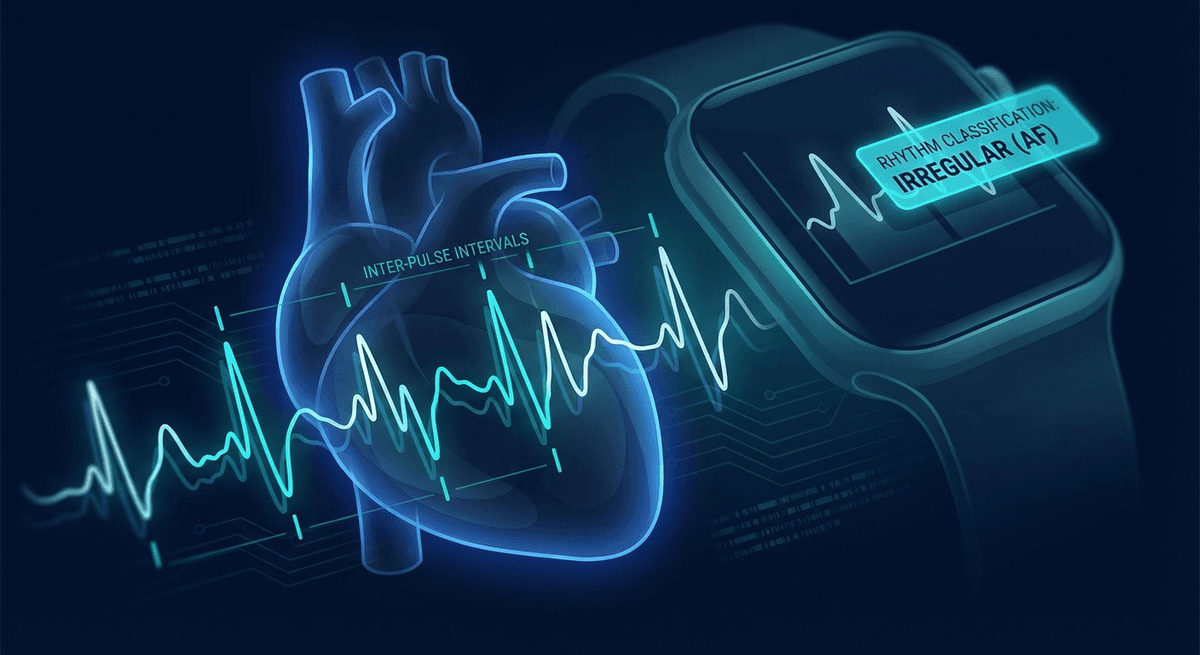
Atrial fibrillation is the most common sustained cardiac arrhythmia, affecting roughly 33 million people worldwide, and it is frequently undiagnosed because it can be intermittent and asymptomatic. PPG-based wearables have emerged as a potential mass-screening tool, but the path from "your watch flagged an irregular rhythm" to a clinical AF diagnosis is more complex than most users realize.
This article covers how the detection actually works, what the clinical studies show, and what the limitations are.
How PPG Detects Atrial Fibrillation
During normal sinus rhythm, the heart's sinoatrial node fires at regular intervals, producing a consistent, predictable pulse pattern. Each PPG waveform from a wrist sensor arrives at roughly equal time intervals.
In atrial fibrillation, the atria fibrillate chaotically. The atrioventricular node fires irregularly in response, producing heartbeats at variable intervals. This shows up in PPG as irregular pulse-to-pulse intervals, which are called inter-pulse intervals (IPIs) or pulse arrival times (PAT).
The core algorithm for AF detection from PPG is straightforward in concept:
- Extract inter-pulse intervals from the PPG signal
- Analyze the variability and irregularity of those intervals
- Apply a classifier: is this irregular pattern consistent with AF, or is it normal sinus variability?
The challenge is distinguishing AF-pattern irregularity from other irregularities: ectopic beats (premature atrial or ventricular contractions), motion artifacts, and the natural variability of normal HRV.
Detection Algorithms: From Simple to Complex
Early algorithms used basic statistics: if the root mean square of successive IPI differences (rMSSD analog) exceeded a threshold, the rhythm was flagged as potentially irregular. This works for sustained AF but fails for brief episodes and ectopic beats.
More sophisticated approaches include:
Shannon Entropy: Measures the unpredictability of the IPI sequence. AF tends to produce higher entropy than sinus rhythm with ectopics, because AF irregularity is continuous rather than isolated events. A study by Petrėnas et al. (2015, doi:10.1109/TBME.2015.2403129) demonstrated Shannon entropy approaches achieving sensitivity >94% and specificity >96% on clinical datasets.
Rhythm probability density curves: The Irregular Pulse Survey algorithm used by AliveCor's KardiaMobile builds a histogram of IPI patterns and classifies the shape. AF produces a characteristic diffuse distribution, while sinus rhythm with ectopics produces a concentrated cluster with isolated outliers.
Deep learning classifiers: Modern wearable devices use convolutional or recurrent neural networks trained on millions of labeled PPG recordings to classify rhythm as sinus, AF, other arrhythmia, or unclassifiable. Apple's AFib history feature uses this approach, with the model retrained on diverse demographic datasets.
Key Clinical Validation Studies
The Apple Heart Study
The largest published validation of PPG-based AF screening enrolled 419,297 participants across the United States from 2017 to 2018 (Perez MV et al., 2019, doi:10.1056/NEJMoa1901183). Participants with an irregular pulse notification were sent an ECG patch monitor; 34% of those who returned patch data had AF confirmed. The positive predictive value (PPV) of 34% sounds low, but the context matters: this was an unselected population, many of whom were young and low-risk for AF.
Among participants 65 and older, the PPV was substantially higher (approximately 46%), which is where opportunistic screening has the most clinical value.
Fitbit Heart Study
The Fitbit Heart Study (Lubitz SA et al., 2022, doi:10.1161/CIRCULATIONAHA.121.057135) enrolled 455,699 participants. The sensitivity of the irregular-rhythm notification for identifying AF on subsequent ECG patch monitoring was 98.2%, with a specificity of 72.5% and PPV of 40%. The high sensitivity with lower specificity is consistent with a screening tool design where missing cases is worse than over-alerting.
European Validation Data
A European registry study (Desteghe L et al., 2017, doi:10.1093/europace/euw416) evaluated handheld and wristband PPG devices in a clinical cardiology setting and found sensitivities of 92–97% for AF detection with specificities of 88–94%. Performance was better in sustained AF than paroxysmal AF, which is the clinically harder detection problem.
The Paroxysmal AF Problem
Paroxysmal AF, which starts and stops spontaneously, is both the hardest type to detect and potentially the most important. A brief AF episode lasting 30 minutes may never coincide with when the algorithm is actively classifying rhythm, resulting in a false negative.
Continuous monitoring improves paroxysmal AF detection. A study by Desteghe et al. found that extending monitoring from 24 hours to 7 days increased paroxysmal AF detection yield from 6% to 14% in a high-risk population. Wearables that analyze rhythm 24/7 rather than during discrete 30-second on-demand recordings have a theoretical advantage here.
The practical limitation is that most consumer devices do not analyze every heartbeat continuously. They sample rhythm in intervals (Apple Watch performs background rhythm checks roughly every few hours unless you manually trigger a reading).
What a Positive Result Actually Means
If your wearable detects an irregular pulse or sends you an "AFib Detected" notification, here is what you should do:
- Do not panic: The positive predictive value is 34–46% in typical populations. More than half of positive alerts are not AF.
- See your physician: A 12-lead ECG during an episode is the diagnostic standard. If you have symptoms (palpitations, breathlessness, lightheadedness), seek evaluation promptly.
- Consider a wearable ECG patch: If your physician suspects paroxysmal AF not captured on a 12-lead ECG, a 7–14 day continuous ECG patch (ZioPatch, BioTel, etc.) is the standard next step for detection.
- Do not start anticoagulation based on a wearable alone: The clinical decision to start anticoagulation requires confirmed AF diagnosis, CHA₂DS₂-VASc risk score assessment, and shared decision making with a physician.
Limitations of PPG-Based AF Screening
Cannot distinguish AF from other arrhythmias: PPG detects irregular pulse timing. It cannot differentiate AF from multifocal atrial tachycardia, frequent ectopic beats, or other rhythm disturbances that produce pulse irregularity. All produce similar IPI variability patterns.
Reduced accuracy in poor signal quality: Motion artifacts, cold peripheral vasoconstriction, and poor sensor contact all degrade the PPG signal, increasing both false positives (artifact-induced irregularity) and false negatives (masking of true AF irregularity).
Not validated for all populations: Most large validation studies enrolled predominantly white, higher socioeconomic-status, tech-savvy participants. Accuracy in populations with darker skin tones, obesity (which can affect wrist sensor contact and signal quality), and significant comorbidities is less well characterized.
Leads to downstream testing burden: The Apple Heart Study estimated that each case of AF identified required approximately 5,000 participants to be enrolled and generated substantial downstream testing. From a population health economics perspective, the yield in low-risk populations may not justify the downstream costs and anxiety.
Regulatory Status
The FDA has cleared multiple PPG-based AF detection features as Class II medical devices under the De Novo pathway, including Apple Watch Series 4 and later (K182343) and some Fitbit devices. This clearance covers irregular rhythm notification and AF detection history features, with the indication limited to adult users in sinus rhythm or AF without other diagnosed arrhythmias.
These are cleared as screening tools, not diagnostic devices. Clinical guidelines from the European Society of Cardiology (2020) and the American College of Cardiology recognize consumer wearables as useful opportunistic screening tools for AF but emphasize ECG confirmation before treatment.
Internal Links
- For the signal processing behind PPG inter-pulse interval extraction, see PPG Morphology Features
- For heart rate variability methodology: PPG HRV Motion Artifacts and Accuracy
- For arrhythmia classification approaches: PPG Arrhythmia Classification ML
FAQ
Can a smartwatch diagnose atrial fibrillation? No. Smartwatches are screening tools that can detect irregular pulse patterns consistent with AF. Formal AF diagnosis requires ECG confirmation by a physician. A positive wearable notification means you should get an ECG, not that you have AF.
How sensitive is PPG for detecting atrial fibrillation? In controlled clinical studies, sensitivity ranges from 92–98% for sustained AF. For paroxysmal AF, sensitivity is lower because brief episodes may not be captured during monitoring windows. Large studies like the Fitbit Heart Study found 98.2% sensitivity, though this reflects detection in people who had an episode long enough to be captured.
What should I do if my Apple Watch detects an irregular rhythm? See your physician for a 12-lead ECG. If you have symptoms like palpitations, breathlessness, or chest discomfort, seek evaluation promptly. Do not start any medications or change existing therapy based on a wearable notification alone.
Why does PPG have a low positive predictive value for AF? The positive predictive value depends heavily on the prevalence of AF in the population being tested. In young, healthy people (who are the majority of wearable users), AF is rare, so even a sensitive test produces many false positives relative to true positives. In older, higher-risk populations, the PPV is substantially higher.
Can PPG detect other heart arrhythmias besides atrial fibrillation? PPG can detect rhythm irregularity broadly. Some devices flag "other arrhythmia" patterns. However, specific arrhythmia diagnosis (distinguishing AF from atrial flutter, SVT, VT, etc.) requires ECG and typically physician interpretation.
How does PPG AF detection compare to a Holter monitor? A Holter monitor provides continuous 2–3 lead ECG recording for 24–48 hours, reviewed by a cardiologist. It is far more sensitive and specific for arrhythmia detection than any PPG device. PPG-based screening is appropriate for opportunistic detection in asymptomatic populations; Holter monitoring is appropriate for symptomatic patients with suspected arrhythmia.
Frequently Asked Questions
- Can a smartwatch diagnose atrial fibrillation?
- No. Smartwatches are screening tools that can detect irregular pulse patterns consistent with AF. Formal AF diagnosis requires ECG confirmation by a physician.
- What should I do if my Apple Watch detects an irregular rhythm?
- See your physician for a 12-lead ECG. If you have symptoms like palpitations, breathlessness, or chest discomfort, seek evaluation promptly. Do not start any medications based on a wearable notification alone.
- How sensitive is PPG for detecting atrial fibrillation?
- In controlled clinical studies, sensitivity ranges from 92–98% for sustained AF. The Fitbit Heart Study found 98.2% sensitivity, though this reflects detection in people who had an episode long enough to be captured during monitoring.