PaperarXiv:2607.07996
SpO2 Predictor-Guided Stage-Wise Time-Frequency Reconstruction of Low-Quality Dual-Wavelength PPG for Oxygen Saturation Estimation
arXiv preprint (eess.SP, cs.AI, cs.LG)
 (opens in a new tab)
Liang, Zequan et al., "SpO$_2$ Predictor-Guided Stage-Wise Time-Frequency Reconstruction of Low-Quality Dual-Wavelength PPG for Oxygen Saturation Estimation", arXiv:2607.07996, CC BY 4.0
TL;DR
Continuous oxygen saturation (SpO$2$) estimation from wearable photoplethysmography (PPG) is important for long-term health monitoring, but low-quality red and infrared PPG segments can distort waveform morphology and degrade SpO$2$ prediction accuracy. Existing PPG denoising and reconstruction methods usually optimize waveform fidelity or heart rate characteristics, while time-domain waveform loss on PPG signals alone insufficiently preserves frequency structure and SpO$2$-relevant information. This paper proposes a SpO$2$ predictor-guided stage-wise time-frequency reconstruction framework for low-quality dual-wavelength PPG signals.
- Form factor: wrist
Abstract
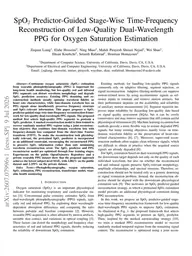
Continuous oxygen saturation (SpO_2) estimation from wearable photoplethysmography (PPG) is important for long-term health monitoring, but low-quality red and infrared PPG segments can distort waveform morphology and degrade SpO_2 prediction accuracy. Existing PPG denoising and reconstruction methods usually optimize waveform fidelity or heart rate characteristics, while time-domain waveform loss on PPG signals alone insufficiently preserves frequency structure and SpO_2-relevant information. This paper proposes a SpO_2 predictor-guided stage-wise time-frequency reconstruction framework for low-quality dual-wavelength PPG signals. The proposed method first selects high-quality PPG segments to pretrain a SpO_2 predictor. A masked reconstruction model is then trained to recover randomly masked PPG regions using a joint reconstruction objective that combines time-domain waveform loss with frequency-domain loss computed from the short-time Fourier transform (STFT). To make the reconstruction task physiologically relevant, the pretrained SpO_2 predictor is incorporated as an additional constraint, encouraging the reconstructed PPG to preserve SpO_2 information rather than only minimizing waveform reconstruction error. The SpO_2 predictor and PPG reconstructor model are optimized through four training stages. Experiments on the public OpenOximetry Repository and a private wearable PPG dataset show that the proposed approach achieves the lowest subject-level MAE, with 2.882% on the public dataset and 2.359% on the private dataset.
Verbatim from arXiv (opens in a new tab) · arXiv metadata (abstracts are released under CC0)
Results on ChatPPG leaderboards
All leaderboardsNo results from this paper on ChatPPG leaderboards yet. Browse the leaderboards.
Tasks & signals
Tasks
Signals
Keywords
How it works
- Wavelengths
- red, IR
Cite this paper
APA
Liang, Z., Hosseini, E., Miao, N., Nejad, M. P. S., Shao, W., Kourkchi, E., et al. (2026). SpO2 Predictor-Guided Stage-Wise Time-Frequency Reconstruction of Low-Quality Dual-Wavelength PPG for Oxygen Saturation Estimation. arXiv preprint. https://doi.org/10.48550/arXiv.2607.07996
BibTeX
@misc{liang2026spo2,
  title         = {{SpO2 Predictor-Guided Stage-Wise Time-Frequency Reconstruction of Low-Quality Dual-Wavelength PPG for Oxygen Saturation Estimation}},
  author        = {Liang, Zequan and Hosseini, Elahe and Miao, Ning and Nejad, Mahdi Pirayesh Shirazi and Shao, Wei and Kourkchi, Ehsan and others},
  year          = {2026},
  howpublished  = {arXiv preprint},
  doi           = {10.48550/arXiv.2607.07996},
  eprint        = {2607.07996},
  archivePrefix = {arXiv}
}
Built from the hub record. Check it against the publisher before submitting.
Added to the ChatPPG research hub