PaperarXiv:2509.12515
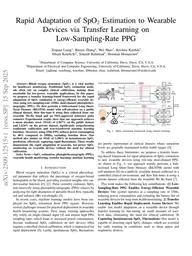
Rapid Adaptation of SpO2 Estimation to Wearable Devices via Transfer Learning on Low-Sampling-Rate PPG
arXiv preprint (eess.SP, cs.LG) · In the proceedings of IEEE-EMBS International Conference on Body Sensor Networks 2025
 (opens in a new tab)
Liang, Zequan et al., "Rapid Adaptation of SpO2 Estimation to Wearable Devices via Transfer Learning on Low-Sampling-Rate PPG", arXiv:2509.12515, CC BY 4.0
TL;DR
Blood oxygen saturation (SpO2) is a vital marker for healthcare monitoring. Traditional SpO2 estimation methods often rely on complex clinical calibration, making them unsuitable for low-power, wearable applications.
- Form factor: wrist
Abstract
Blood oxygen saturation (SpO2) is a vital marker for healthcare monitoring. Traditional SpO2 estimation methods often rely on complex clinical calibration, making them unsuitable for low-power, wearable applications. In this paper, we propose a transfer learning-based framework for the rapid adaptation of SpO2 estimation to energy-efficient wearable devices using low-sampling-rate (25Hz) dual-channel photoplethysmography (PPG). We first pretrain a bidirectional Long Short-Term Memory (BiLSTM) model with self-attention on a public clinical dataset, then fine-tune it using data collected from our wearable We-Be band and an FDA-approved reference pulse oximeter. Experimental results show that our approach achieves a mean absolute error (MAE) of 2.967% on the public dataset and 2.624% on the private dataset, significantly outperforming traditional calibration and non-transferred machine learning baselines. Moreover, using 25Hz PPG reduces power consumption by 40% compared to 100Hz, excluding baseline draw. Our method also attains an MAE of 3.284% in instantaneous SpO2 prediction, effectively capturing rapid fluctuations. These results demonstrate the rapid adaptation of accurate, low-power SpO2 monitoring on wearable devices without the need for clinical calibration.
Verbatim from arXiv (opens in a new tab) · arXiv metadata (abstracts are released under CC0)
Results on ChatPPG leaderboards
All leaderboardsNo results from this paper on ChatPPG leaderboards yet. Browse the leaderboards.
Tasks & signals
Tasks
Signals
Keywords
How it works
- Wavelengths
- red, IR
Cite this paper
APA
Liang, Z., Zhang, R., Shao, W., Karthik, K., Kourkchi, E., Rafatirad, S., et al. (2025). Rapid Adaptation of SpO2 Estimation to Wearable Devices via Transfer Learning on Low-Sampling-Rate PPG. arXiv preprint · In the proceedings of IEEE-EMBS International Conference on Body Sensor Networks 2025. https://doi.org/10.1109/BSN66969.2025.11337411
BibTeX
@misc{liang2025rapid,
  title         = {{Rapid Adaptation of SpO2 Estimation to Wearable Devices via Transfer Learning on Low-Sampling-Rate PPG}},
  author        = {Liang, Zequan and Zhang, Ruoyu and Shao, Wei and Karthik, krishna and Kourkchi, Ehsan and Rafatirad, Setareh and others},
  year          = {2025},
  howpublished  = {arXiv preprint · In the proceedings of IEEE-EMBS International Conference on Body Sensor Networks 2025},
  doi           = {10.1109/BSN66969.2025.11337411},
  eprint        = {2509.12515},
  archivePrefix = {arXiv}
}
Built from the hub record. Check it against the publisher before submitting.
Added to the ChatPPG research hub