Paperdoi:10.64898/2026.07.02.26356952
Accelerometry-Derived REM Sleep Behavior Disorder Score Is Associated with Incident Parkinson's Disease in the UK Biobank
medRxiv preprint (neurology); v1 2026-07-06 titled "Accelerometry-Derived REM Sleep Behavior Disorder Predicts Future Parkinson's Disease in the UK Biobank", v2 2026-11-09 retitled
 (opens in a new tab)
Giorgio Ricciardiello Mejia et al., "Accelerometry-Derived REM Sleep Behavior Disorder Score Is Associated with Incident Parkinson's Disease in the UK Biobank", doi:10.64898/2026.07.02.26356952, CC BY 4.0
TL;DR
Applies a previously validated machine-learning RBD classifier to 7-day wrist accelerometry from 87,975 UK Biobank participants with 10-year follow-up. The top risk stratum (>99th percentile) had roughly a fivefold hazard of incident Parkinson's disease versus the 0–90th percentile, with a dose-dependent relationship across the score. The signal was independent of a PD polygenic risk score and synergistic with it.
- Form factor: wrist
Abstract
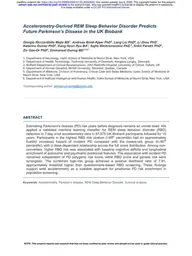
Estimating Parkinson's disease (PD) risk years before diagnosis remains an unmet need. We applied a validated machine learning classifier for REM sleep behavior disorder (RBD) detection to 7-day wrist accelerometry data in 87,975 UK Biobank participants followed for 10 years. Participants in the highest RBD risk stratum (>99th percentile) had an approximately fivefold increased hazard of incident PD compared with the lowest-risk group (0–90th percentile), with a dose-dependent relationship across the full score distribution. Among non-converters, higher RBD-classifier scores were associated with baseline cognitive deficits and greater burden of autonomic and psychiatric prodromal features. The association with incident PD remained independent of PD polygenic risk score, while RBD-classifier score and genetic risk were synergistic. The combined high-risk group achieved a positive likelihood ratio of 7.91, approximately threefold higher than questionnaire-based RBD screening. At this High-risk threshold over the 10-year horizon, the classifier showed a sensitivity of 7.4%, specificity of 99.2%, positive predictive value of 7.5%, and negative predictive value of 99.2% for incident PD (N=50,816). These findings support wrist accelerometry as a scalable, high-specificity approach for prodromal PD risk enrichment.
Verbatim from the publisher's DOI record (opens in a new tab) · Publisher licence: http://creativecommons.org/licenses/by/4.0/
Results on ChatPPG leaderboards
All leaderboardsNo results from this paper on ChatPPG leaderboards yet. Browse the leaderboards.
Tasks & signals
Tasks
Signals
Keywords
How it works
Cite this paper
Mejia, G. R., Brink-Kjaer, A., Liu, L., Zhou, L., Gunter, K., Ryu, K. H., Wickramaratne, S. D., Parekh, A., Gan-Or, Z., & During, E. (2026). Accelerometry-Derived REM Sleep Behavior Disorder Score Is Associated with Incident Parkinson's Disease in the UK Biobank. medRxiv preprint. https://doi.org/10.64898/2026.07.02.26356952
Mejia, G. R., A. Brink-Kjaer, L. Liu, L. Zhou, K. Gunter, K. H. Ryu, S. D. Wickramaratne, A. Parekh, Z. Gan-Or, and E. During. 2026. "Accelerometry-Derived REM Sleep Behavior Disorder Score Is Associated with Incident Parkinson's Disease in the UK Biobank." medRxiv preprint. https://doi.org/10.64898/2026.07.02.26356952.
Mejia, G. R., Brink-Kjaer, A., Liu, L., Zhou, L., Gunter, K., Ryu, K. H., Wickramaratne, S. D., Parekh, A., Gan-Or, Z. and During, E. (2026) 'Accelerometry-Derived REM Sleep Behavior Disorder Score Is Associated with Incident Parkinson's Disease in the UK Biobank', medRxiv preprint. doi: 10.64898/2026.07.02.26356952.
Mejia, G. R., et al. "Accelerometry-Derived REM Sleep Behavior Disorder Score Is Associated with Incident Parkinson's Disease in the UK Biobank." medRxiv preprint, 2026. https://doi.org/10.64898/2026.07.02.26356952.
G. R. Mejia et al., "Accelerometry-Derived REM Sleep Behavior Disorder Score Is Associated with Incident Parkinson's Disease in the UK Biobank," medRxiv preprint, 2026, doi: 10.64898/2026.07.02.26356952.
@misc{mejia2026accelerometryderived,
  title         = {{Accelerometry-Derived REM Sleep Behavior Disorder Score Is Associated with Incident Parkinson's Disease in the UK Biobank}},
  author        = {Mejia, G. R. and Brink-Kjaer, A. and Liu, L. and Zhou, L. and Gunter, K. and Ryu, K. H. and Wickramaratne, S. D. and Parekh, A. and Gan-Or, Z. and During, E.},
  year          = {2026},
  howpublished  = {medRxiv preprint},
  doi           = {10.64898/2026.07.02.26356952}
}Added to the ChatPPG research hub