PaperarXiv:2508.10805
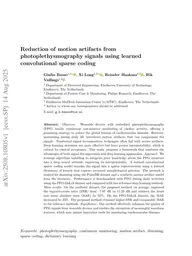
Reduction of motion artifacts from photoplethysmography signals using learned convolutional sparse coding
arXiv preprint (eess.SP) · 23 pages, 6 figures
 (opens in a new tab)
Basso, Giulio et al., "Reduction of motion artifacts from photoplethysmography signals using learned convolutional sparse coding", arXiv:2508.10805, CC BY 4.0
TL;DR
Objective. Wearable devices with embedded photoplethysmography (PPG) enable continuous non-invasive monitoring of cardiac activity, offering a promising strategy to reduce the global burden of cardiovascular diseases. However, monitoring during daily life introduces motion artifacts that can compromise the signals.
- Form factor: other
Abstract
Objective. Wearable devices with embedded photoplethysmography (PPG) enable continuous non-invasive monitoring of cardiac activity, offering a promising strategy to reduce the global burden of cardiovascular diseases. However, monitoring during daily life introduces motion artifacts that can compromise the signals. Traditional signal decomposition techniques often fail with severe artifacts. Deep learning denoisers are more effective but have poorer interpretability, which is critical for clinical acceptance. This study proposes a framework that combines the advantages of both signal decomposition and deep learning approaches. Approach. We leverage algorithm unfolding to integrate prior knowledge about the PPG structure into a deep neural network, improving its interpretability. A learned convolutional sparse coding model encodes the signal into a sparse representation using a learned dictionary of kernels that capture recurrent morphological patterns. The network is trained for denoising using the PulseDB dataset and a synthetic motion artifact model from the literature. Performance is benchmarked with PPG during daily activities using the PPG-DaLiA dataset and compared with two reference deep learning methods. Main results. On the synthetic dataset, the proposed method, on average, improved the signal-to-noise ratio (SNR) from -7.07 dB to 11.23 dB and reduced the heart rate mean absolute error (MAE) by 55%. On the PPG-DaLiA dataset, the MAE decreased by 23%. The proposed method obtained higher SNR and comparable MAE to the reference methods. Significance. Our method effectively enhances the quality of PPG signals from wearable devices and enables the extraction of meaningful waveform features, which may inspire innovative tools for monitoring cardiovascular diseases.
Verbatim from arXiv (opens in a new tab) · arXiv metadata (abstracts are released under CC0)
Results on ChatPPG leaderboards
All leaderboardsNo results from this paper on ChatPPG leaderboards yet. Browse the leaderboards.
Tasks & signals
Tasks
Signals
Keywords
How it works
Cite this paper
APA
Basso, G., Long, X., Haakma, R., & Vullings, R. (2025). Reduction of motion artifacts from photoplethysmography signals using learned convolutional sparse coding. arXiv preprint · 23 pages, 6 figures. https://doi.org/10.48550/arXiv.2508.10805
BibTeX
@misc{basso2025reduction,
  title         = {{Reduction of motion artifacts from photoplethysmography signals using learned convolutional sparse coding}},
  author        = {Basso, Giulio and Long, Xi and Haakma, Reinder and Vullings, Rik},
  year          = {2025},
  howpublished  = {arXiv preprint · 23 pages, 6 figures},
  doi           = {10.48550/arXiv.2508.10805},
  eprint        = {2508.10805},
  archivePrefix = {arXiv}
}
Built from the hub record. Check it against the publisher before submitting.
Added to the ChatPPG research hub