PaperarXiv:2502.09291
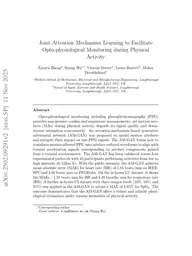
Joint Attention Mechanism Learning to Facilitate Opto-physiological Monitoring during Physical Activity
arXiv preprint (eess.SP, cs.LG)
TL;DR
Opto-physiological monitoring including photoplethysmography (PPG) provides non-invasive cardiac and respiratory measurements, yet motion artefacts (MAs) during physical activity degrade its signal quality and downstream estimation concurrently. An attention-mechanism-based generative adversarial network (AM-GAN) was proposed to model motion artefacts and mitigate their impact on raw PPG signals. The AM-GAN learns how to transform motion-affected PPG into artefact-reduced waveforms to align with triaxial acceleration signals corresponding to artefact components gained from a triaxial accelerometer.
- Form factor: other
Abstract
Opto-physiological monitoring including photoplethysmography (PPG) provides non-invasive cardiac and respiratory measurements, yet motion artefacts (MAs) during physical activity degrade its signal quality and downstream estimation concurrently. An attention-mechanism-based generative adversarial network (AM-GAN) was proposed to model motion artefacts and mitigate their impact on raw PPG signals. The AM-GAN learns how to transform motion-affected PPG into artefact-reduced waveforms to align with triaxial acceleration signals corresponding to artefact components gained from a triaxial accelerometer. The AM-GAN has been validated across four experimental protocols with 43 participants performing activities from low to high intensity (6–12km/h). With the public datasets, the AM-GAN achieves mean absolute error (MAE) for heart rate (HR) of 1.81 beats/min on IEEE-SPC and 3.86 beats/min on PPGDalia. On the in-house LU dataset, it shows the MAEs < 1.37 beats/min for HR and 2.49 breaths/min for respiratory rate (RR). A further in-house C2 dataset with three oxygen levels (16%, 18%, and 21%) was applied in the AM-GAN to attain a MAE of 1.65% for SpO2. The outcome demonstrates that the AM-GAN offers a robust and reliable physiological estimation under various intensities of physical activity.
Verbatim from arXiv (opens in a new tab) · arXiv metadata (abstracts are released under CC0)
Results on ChatPPG leaderboards
All leaderboardsNo results from this paper on ChatPPG leaderboards yet. Browse the leaderboards.
Tasks & signals
Tasks
Signals
Keywords
How it works
Cite this paper
APA
Zheng, X., Hu, S., Dwyer, V., Derakhshani, M., & Barrett, L. (2025). Joint Attention Mechanism Learning to Facilitate Opto-physiological Monitoring during Physical Activity. arXiv preprint. https://doi.org/10.48550/arXiv.2502.09291
BibTeX
@misc{zheng2025joint,
  title         = {{Joint Attention Mechanism Learning to Facilitate Opto-physiological Monitoring during Physical Activity}},
  author        = {Zheng, Xiaoyu and Hu, Sijung and Dwyer, Vincent and Derakhshani, Mahsa and Barrett, Laura},
  year          = {2025},
  howpublished  = {arXiv preprint},
  doi           = {10.48550/arXiv.2502.09291},
  eprint        = {2502.09291},
  archivePrefix = {arXiv}
}
Built from the hub record. Check it against the publisher before submitting.
Added to the ChatPPG research hub