PaperarXiv:2510.11058
Robust Photoplethysmography Signal Denoising via Mamba Networks
arXiv preprint (cs.LG, eess.SP) · Published in EMBC 2026
TL;DR
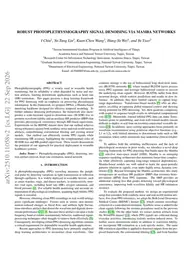
Photoplethysmography (PPG) is widely used in wearable health monitoring, but its reliability is often degraded by noise and motion artifacts, limiting downstream applications such as heart rate (HR) estimation. This paper presents a deep learning framework for PPG denoising with an emphasis on preserving physiological information. To further enhance denoising performance, the framework also incorporates a scale-invariant signal-to-distortion ratio (SI-SDR) loss to promote waveform fidelity and an auxiliary HR predictor (HRP) that provides physiological consistency through HR-based supervision.
- Form factor: other
Abstract
Photoplethysmography (PPG) is widely used in wearable health monitoring, but its reliability is often degraded by noise and motion artifacts, limiting downstream applications such as heart rate (HR) estimation. This paper presents a deep learning framework for PPG denoising with an emphasis on preserving physiological information. In this framework, we propose DPNet, a Mamba-based denoising backbone designed for effective temporal modeling. To further enhance denoising performance, the framework also incorporates a scale-invariant signal-to-distortion ratio (SI-SDR) loss to promote waveform fidelity and an auxiliary HR predictor (HRP) that provides physiological consistency through HR-based supervision. Experiments on the BIDMC dataset show that our method achieves strong robustness against both synthetic noise and real-world motion artifacts, outperforming conventional filtering and existing neural models. Our method can effectively restore PPG signals while maintaining HR accuracy, highlighting the complementary roles of SI-SDR loss and HR-guided supervision. These results demonstrate the potential of our approach for practical deployment in wearable healthcare systems.
Verbatim from arXiv (opens in a new tab) · arXiv metadata (abstracts are released under CC0)
Results on ChatPPG leaderboards
All leaderboardsNo results from this paper on ChatPPG leaderboards yet. Browse the leaderboards.
Tasks & signals
Tasks
Signals
Keywords
How it works
Cite this paper
APA
Chiu, I., Liu, Y.-T., Wang, K.-C., Wei, H.-Y., & Tsao, Y. (2025). Robust Photoplethysmography Signal Denoising via Mamba Networks. arXiv preprint · Published in EMBC 2026. https://doi.org/10.48550/arXiv.2510.11058
BibTeX
@misc{chiu2025robust,
  title         = {{Robust Photoplethysmography Signal Denoising via Mamba Networks}},
  author        = {Chiu, I. and Liu, Yu-Tung and Wang, Kuan-Chen and Wei, Hung-Yu and Tsao, Yu},
  year          = {2025},
  howpublished  = {arXiv preprint · Published in EMBC 2026},
  doi           = {10.48550/arXiv.2510.11058},
  eprint        = {2510.11058},
  archivePrefix = {arXiv}
}
Built from the hub record. Check it against the publisher before submitting.
Added to the ChatPPG research hub