PaperarXiv:2510.06158
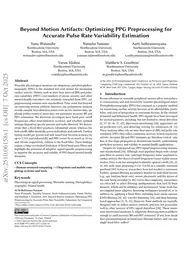
Beyond Motion Artifacts: Optimizing PPG Preprocessing for Accurate Pulse Rate Variability Estimation
arXiv preprint (cs.OH) · 7 pages, 3 figures, to be published in Companion of the 2025 ACM International Joint Conference on Pervasive and Ubiquitous Computing
 (opens in a new tab)
Watanabe, Yuna et al., "Beyond Motion Artifacts: Optimizing PPG Preprocessing for Accurate Pulse Rate Variability Estimation", arXiv:2510.06158, CC BY 4.0
TL;DR
Wearable physiological monitors are ubiquitous, and photoplethysmography (PPG) is the standard low-cost sensor for measuring cardiac activity. Metrics such as inter-beat interval (IBI) and pulse-rate variability (PRV) -- core markers of stress, anxiety, and other mental-health outcomes -- are routinely extracted from PPG, yet preprocessing remains non-standardized.
- Form factor: wrist
Abstract
Wearable physiological monitors are ubiquitous, and photoplethysmography (PPG) is the standard low-cost sensor for measuring cardiac activity. Metrics such as inter-beat interval (IBI) and pulse-rate variability (PRV) – core markers of stress, anxiety, and other mental-health outcomes – are routinely extracted from PPG, yet preprocessing remains non-standardized. Prior work has focused on removing motion artifacts; however, our preliminary analysis reveals sizeable beat-detection errors even in low-motion data, implying artifact removal alone may not guarantee accurate IBI and PRV estimation. We therefore investigate how band-pass cutoff frequencies affect beat-detection accuracy and whether optimal settings depend on specific persons and tasks observed. We demonstrate that a fixed filter produces substantial errors, whereas the best cutoffs differ markedly across individuals and contexts. Further, tuning cutoffs per person and task raised beat-location accuracy by up to 7.15% and reduced IBI and PRV errors by as much as 35 ms and 145 ms, respectively, relative to the fixed filter. These findings expose a long-overlooked limitation of fixed band-pass filters and highlight the potential of adaptive, signal-specific preprocessing to improve the accuracy and validity of PPG-based mental-health measures.
Verbatim from arXiv (opens in a new tab) · arXiv metadata (abstracts are released under CC0)
Results on ChatPPG leaderboards
All leaderboardsNo results from this paper on ChatPPG leaderboards yet. Browse the leaderboards.
Tasks & signals
Tasks
Signals
Keywords
How it works
Cite this paper
APA
Watanabe, Y., Yamane, N., Sathyanarayana, A., Mishra, V., & Goodwin, M. S. (2025). Beyond Motion Artifacts: Optimizing PPG Preprocessing for Accurate Pulse Rate Variability Estimation. arXiv preprint · 7 pages, 3 figures, to be published in Companion of the 2025 ACM International Joint Conference on Pervasive and Ubiquitous Computing. https://doi.org/10.1145/3714394.3756241
BibTeX
@misc{watanabe2025beyond,
  title         = {{Beyond Motion Artifacts: Optimizing PPG Preprocessing for Accurate Pulse Rate Variability Estimation}},
  author        = {Watanabe, Yuna and Yamane, Natasha and Sathyanarayana, Aarti and Mishra, Varun and Goodwin, Matthew S.},
  year          = {2025},
  howpublished  = {arXiv preprint · 7 pages, 3 figures, to be published in Companion of the 2025 ACM International Joint Conference on Pervasive and Ubiquitous Computing},
  doi           = {10.1145/3714394.3756241},
  eprint        = {2510.06158},
  archivePrefix = {arXiv}
}
Built from the hub record. Check it against the publisher before submitting.
Added to the ChatPPG research hub