PaperarXiv:2610.26618
Global Time-Aware Conditioning (GTC): A Mechanism for Time-Aware Pediatric Sleep Representation Learning
arXiv 2610.26618v1 (submitted 2026-10-19)
 (opens in a new tab)
Pandey, Saurav Raj et al., "Global Time-Aware Conditioning (GTC): A Mechanism for Time-Aware Pediatric Sleep Representation Learning", arXiv:2610.26618, CC BY 4.0
TL;DR
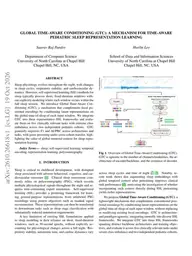
A small add-on, not a new model. GTC tells an SSL encoder where each 30-s window sits in the whole night, using the window's segment index normalised by dataset-level session length and a FiLM-style per-sample scale and shift on the latents. It is architecture-agnostic and adds parameters linear in the latent width.
- Form factor: other
Abstract
Sleep physiology evolves throughout the night, with changes in sleep cycles, respiratory stability, and cardiovascular dynamics. However, self-supervised learning (SSL) methods for sleep typically process short, fixed-duration windows without explicitly modeling where each window occurs within the full sleep session. We introduce Global Time-Aware Conditioning (GTC), a mechanism that complements local positional encodings by conditioning latent representations on the global time-of-sleep of each input window. We integrate GTC into three representative SSL frameworks and evaluate them on five clinically relevant tasks with extreme class imbalance across two independent pediatric cohorts. GTC generally improves F1 and AUPRC across architectures and tasks, with gains persisting under cross-cohort transfer, highlighting the value of global temporal context for sleep representation learning.
Verbatim from arXiv (opens in a new tab) · arXiv metadata (abstracts are released under CC0)
Results on ChatPPG leaderboards
All leaderboardsNo results from this paper on ChatPPG leaderboards yet. Browse the leaderboards.
Tasks & signals
Tasks
Signals
Keywords
How it works
Cite this paper
APA
Pandey, S. R., & Lee, H. (2026). Global Time-Aware Conditioning (GTC): A Mechanism for Time-Aware Pediatric Sleep Representation Learning. arXiv 2610.26618v1. https://arxiv.org/abs/2610.26618
BibTeX
@misc{pandey2026global,
  title         = {{Global Time-Aware Conditioning (GTC): A Mechanism for Time-Aware Pediatric Sleep Representation Learning}},
  author        = {Pandey, Saurav Raj and Lee, Harlin},
  year          = {2026},
  howpublished  = {arXiv 2610.26618v1},
  eprint        = {2610.26618},
  archivePrefix = {arXiv}
}
Built from the hub record. Check it against the publisher before submitting.
Added to the ChatPPG research hub