Paperdoi:10.1136/bmjdrc-2020-002027
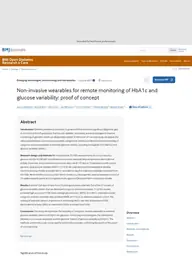
Non-invasive wearables for remote monitoring of HbA1c and glucose variability: proof of concept
BMJ Open Diabetes Research & Care 9:e002027
TL;DR
16 prospective participants (Empatica E4 + CGM) plus 10 retrospective external participants: 250 days from 26 people. Data available on reasonable request.
- Form factor: wrist
Abstract
Introduction
Diabetes prevalence continues to grow and there remains a significant diagnostic gap in one-third of the US population that has pre-diabetes. Innovative, practical strategies to improve monitoring of glycemic health are desperately needed. In this proof-of-concept study, we explore the relationship between non-invasive wearables and glycemic metrics and demonstrate the feasibility of using non-invasive wearables to estimate glycemic metrics, including hemoglobin A1c (HbA1c) and glucose variability metrics.
Research design and methods
We recorded over 25 000 measurements from a continuous glucose monitor (CGM) with simultaneous wrist-worn wearable (skin temperature, electrodermal activity, heart rate, and accelerometry sensors) data over 8–10 days in 16 participants with normal glycemic state and pre-diabetes (HbA1c 5.2–6.4). We used data from the wearable to develop machine learning models to predict HbA1c recorded on day 0 and glucose variability calculated from the CGM. We tested the accuracy of the HbA1c model on a retrospective, external validation cohort of 10 additional participants and compared results against CGM-based HbA1c estimation models.
Results
A total of 250 days of data from 26 participants were collected. Out of the 27 models of glucose variability metrics that we developed using non-invasive wearables, 11 of the models achieved high accuracy ( Conclusions
This study demonstrates the feasibility of using non-invasive wearables to estimate glucose variability metrics and HbA1c for glycemic monitoring and investigates the relationship between non-invasive wearables and the glycemic metrics of glucose variability and HbA1c. The methods used in this study can be used to inform future studies confirming the results of this proof-of-concept study.
Verbatim from the publisher's DOI record (opens in a new tab) · Publisher licence: http://creativecommons.org/licenses/by-nc/4.0/
Results on ChatPPG leaderboards
All leaderboardsNo results from this paper on ChatPPG leaderboards yet. Browse the leaderboards.
Tasks & signals
Tasks
Signals
Keywords
How it works
Cite this paper
APA
Bent, B., Cho, P. J., Wittmann, A., Thacker, C., Muppidi, S., Snyder, M., Crowley, M. J., Feinglos, M., & Dunn, J. P. (2021). Non-invasive wearables for remote monitoring of HbA1c and glucose variability: proof of concept. BMJ Open Diabetes Research & Care 9:e002027. https://doi.org/10.1136/bmjdrc-2020-002027
BibTeX
@article{bent2021noninvasive,
  title         = {{Non-invasive wearables for remote monitoring of HbA1c and glucose variability: proof of concept}},
  author        = {Bent, Brinnae and Cho, Peter J. and Wittmann, April and Thacker, Connie and Muppidi, Srikanth and Snyder, Michael and Crowley, Matthew J. and Feinglos, Mark and Dunn, Jessilyn P.},
  year          = {2021},
  journal       = {BMJ Open Diabetes Research \& Care 9:e002027},
  doi           = {10.1136/bmjdrc-2020-002027}
}
Built from the hub record. Check it against the publisher before submitting.
Added to the ChatPPG research hub