Activity counts measure attention, not model quality. Missing counts are unknown. Publication status follows the linked source; a listed venue alone does not confirm peer review.
Open (MIT code, Apache-2.0 weights) wavelet FM family with dynamic scale folding; 30M ECG encoder on HF; top macro-F1 on PTB-XL Super and Chapman; RALF fusion for wearable seizure detection.
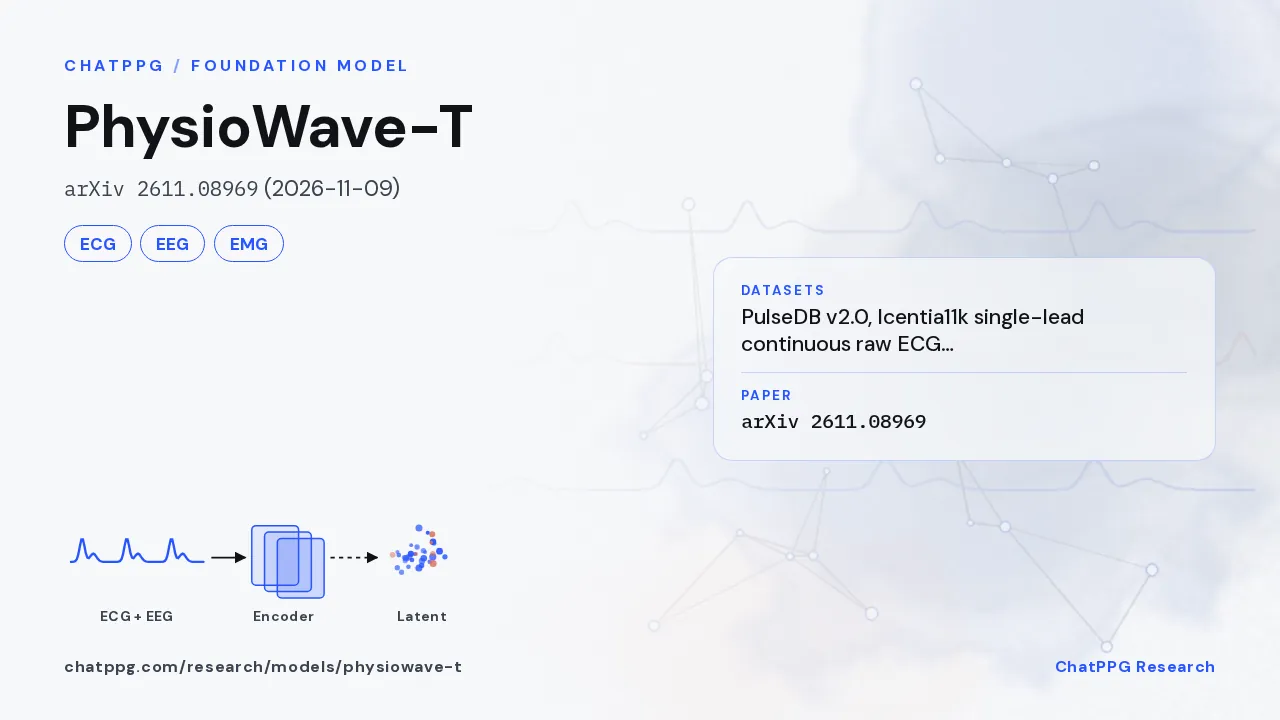
We present PhysioWave-T, a token-efficient wavelet foundation model family for EEG, ECG, and sEMG. Dynamic scale folding recombines J+1 wavelet subbands prior to tokenization, compressing sequence length from (J+1)CS to CS tokens for J levels, C channels, and S temporal patches. Route-specific front ends and learned channel-name embeddings allow one Transformer per modality to handle diverse montages and sampling rates, while unseen setups reuse the backbone via lightweight adapters. We pre-train a 30M-parameter EEG model on over 15M windows (19–128 channels), alongside ECG (30M) and sEMG (12M) encoders. Across four EEG routes, scale folding cuts Transformer latency by 4.0–7.2x and peak memory by 6.8–12.7x over scale expansion without accuracy loss. Our EEG encoder leads 8 of 9 metrics against BENDR, BIOT, LaBraM, and EEGPT, and surpasses LUNA-L on wearable seizure detection with fewer parameters. Reliability-aware latent fusion (RALF) further integrates summary tokens from independently pre-trained encoders via sample-adaptive weights. On SeizeIT2, RALF raises event sensitivity at 11 false alarms/h from 61.4% to 74.4% and window AUPRC from 0.321 to 0.399 over the best unimodal baseline, outperforming weighted-logit and concatenation fusion across all variants. PhysioWave-T also achieves state-of-the-art sEMG accuracies and top macro-F1 on PTB-XL Super and Chapman-Shaoxing. Code and models: https://github.com/ForeverBlue816/PhysioWave.
Verbatim fromarXiv· arXiv metadata (abstracts are released under CC0)
Cite the publication recorded for this model. Check it against the publisher before submitting.
Chen, Y., Benatti, S., Benini, L., Guan, C., & Li, Y. (2026). PhysioWave-T: Token-Efficient Wavelet Foundation Models for Biosignals. arXiv 2611.08969. https://arxiv.org/abs/2611.08969
Chen, Yanlong, Simone Benatti, Luca Benini, Cuntai Guan, and Yawei Li. 2026. "PhysioWave-T: Token-Efficient Wavelet Foundation Models for Biosignals." arXiv 2611.08969. https://arxiv.org/abs/2611.08969.
Chen, Y., Benatti, S., Benini, L., Guan, C. and Li, Y. (2026) 'PhysioWave-T: Token-Efficient Wavelet Foundation Models for Biosignals', arXiv 2611.08969. Available at: https://arxiv.org/abs/2611.08969
Chen, Yanlong, et al. "PhysioWave-T: Token-Efficient Wavelet Foundation Models for Biosignals." arXiv 2611.08969, 2026. https://arxiv.org/abs/2611.08969.
Y. Chen, S. Benatti, L. Benini, C. Guan, and Y. Li, "PhysioWave-T: Token-Efficient Wavelet Foundation Models for Biosignals," arXiv 2611.08969, 2026, [Online]. Available: https://arxiv.org/abs/2611.08969.
@misc{chen2026physiowavet,
  title         = {{PhysioWave-T: Token-Efficient Wavelet Foundation Models for Biosignals}},
  author        = {Chen, Yanlong and Benatti, Simone and Benini, Luca and Guan, Cuntai and Li, Yawei},
  year          = {2026},
  howpublished  = {arXiv 2611.08969},
  eprint        = {2611.08969},
  archivePrefix = {arXiv}
}
History
Added to the ChatPPG research hub
Newsletter
Get new PPG datasets, papers and models
Get alerts when PhysioWave-T is benchmarked on new datasets, plus the weekly digest.
New datasets, papers and models
Practical guides from the hub
Unsubscribe anytime
The waveform is an illustration of a PPG pulse, not a recording.