Activity counts measure attention, not model quality. Missing counts are unknown. Publication status follows the linked source; a listed venue alone does not confirm peer review.
Reusable signal-to-text method: ≤4,080 tokens per PTB-XL record (mean 2,866), exact round trip, decoded-signal correlation 0.982.
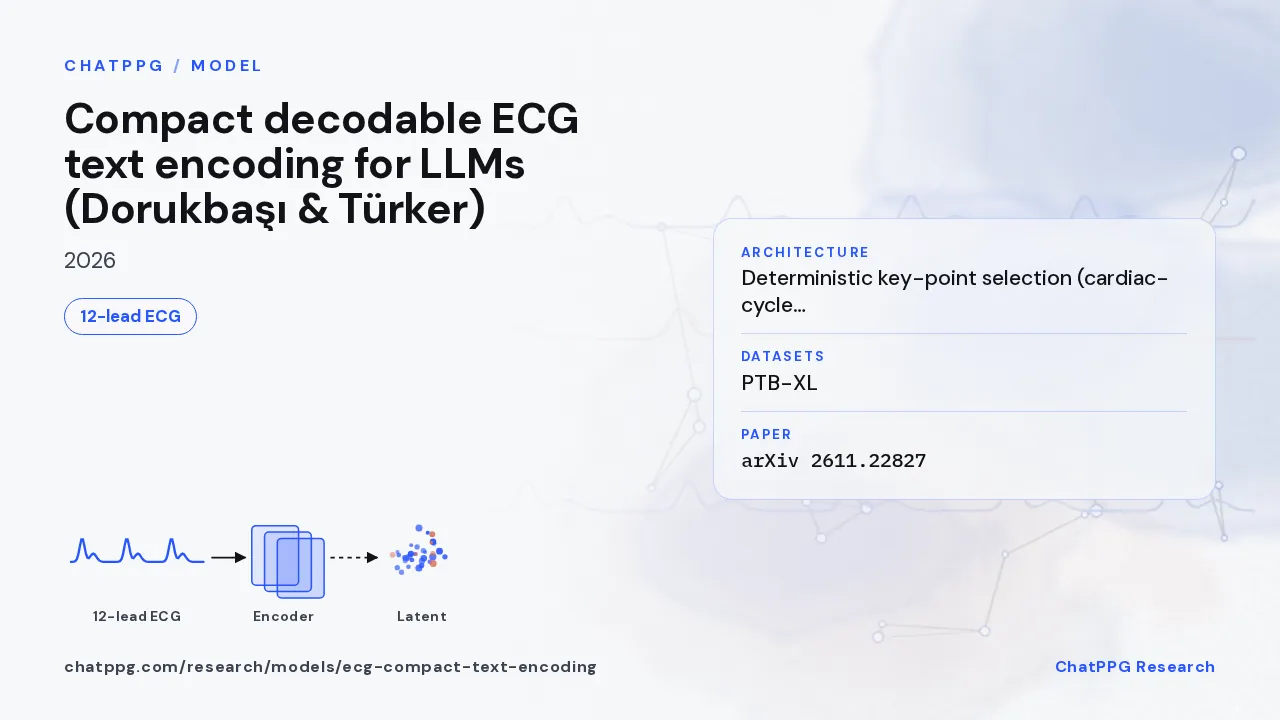
When a twelve-lead electrocardiogram is written as text for a large language model, the number of tokens has to be balanced against the information lost through compression. This paper presents a deterministic encoding that writes eight independent leads as amplitude letters and exact time gaps and recovers the remaining four limb leads algebraically. The key points are selected with a cardiac-cycle-dependent tolerance, the amplitudes are parameterized by a 26-letter logarithmic codebook learned from a training set, and a 10-step tolerance schedule keeps all records within a fixed token budget. The encoding was applied to 21,388 records from the public PTB-XL database and evaluated using an exact decode-and-re-encode round trip, waveform reconstruction error, and a paired comparison of convolutional classifiers trained with 5 different seeds on signals from the original and decoded databases. All records were contained in 4,080 tokens (average: 2,866 tokens, 64.3% fewer than a per-sample transcription), and all stored lead strings were exactly reproduced. The average correlation between the decoded and reference signals was 0.982. The macro-averaged area under the receiver operating characteristic curve was 0.9167 for the reference signals and 0.9157 for the decoded signals (paired difference -0.0010; 95% patient-level bootstrap interval, -0.0028 to 0.0007), within the pre-specified non-inferiority margin of -0.010; this is not a confirmatory result, because the test fold had been used during encoder development. The diagnostic content of a compact text can therefore be preserved, while the language model's ability to read the text is yet another matter.
Verbatim fromarXiv· arXiv metadata (abstracts are released under CC0)
How it works
Datasets linked in the hub; pretraining vs evaluation roles follow the paper.
Cite the publication recorded for this model. Check it against the publisher before submitting.
Dorukbaşı, E., & Türker, İ. (2026). Compact and Decodable Electrocardiogram Text for Large Language Models. arXiv preprint. https://arxiv.org/abs/2611.22827
Dorukbaşı, Elif and İlker Türker. 2026. "Compact and Decodable Electrocardiogram Text for Large Language Models." arXiv preprint. https://arxiv.org/abs/2611.22827.
Dorukbaşı, E. and Türker, İ. (2026) 'Compact and Decodable Electrocardiogram Text for Large Language Models', arXiv preprint. Available at: https://arxiv.org/abs/2611.22827
Dorukbaşı, Elif, and İlker Türker "Compact and Decodable Electrocardiogram Text for Large Language Models." arXiv preprint, 2026. https://arxiv.org/abs/2611.22827.
E. Dorukbaşı and İ. Türker, "Compact and Decodable Electrocardiogram Text for Large Language Models," arXiv preprint, 2026, [Online]. Available: https://arxiv.org/abs/2611.22827.
@misc{dorukbas2026compact,
  title         = {{Compact and Decodable Electrocardiogram Text for Large Language Models}},
  author        = {Dorukbaşı, Elif and Türker, İlker},
  year          = {2026},
  howpublished  = {arXiv preprint},
  eprint        = {2611.22827},
  archivePrefix = {arXiv}
}
History
Added to the ChatPPG research hub
Newsletter
Get new PPG datasets, papers and models
Get alerts when Compact decodable ECG text encoding for LLMs (Dorukbaşı & Türker) is benchmarked on new datasets, plus the weekly digest.
New datasets, papers and models
Practical guides from the hub
Unsubscribe anytime
The waveform is an illustration of a PPG pulse, not a recording.