PPG Wearable Accuracy During Sleep: Heart Rate and HRV Validation
How accurate are wearable PPG devices for sleep heart rate and HRV? Review of validation studies for Oura, Apple Watch, Fitbit, and Garmin during overnight monitoring.
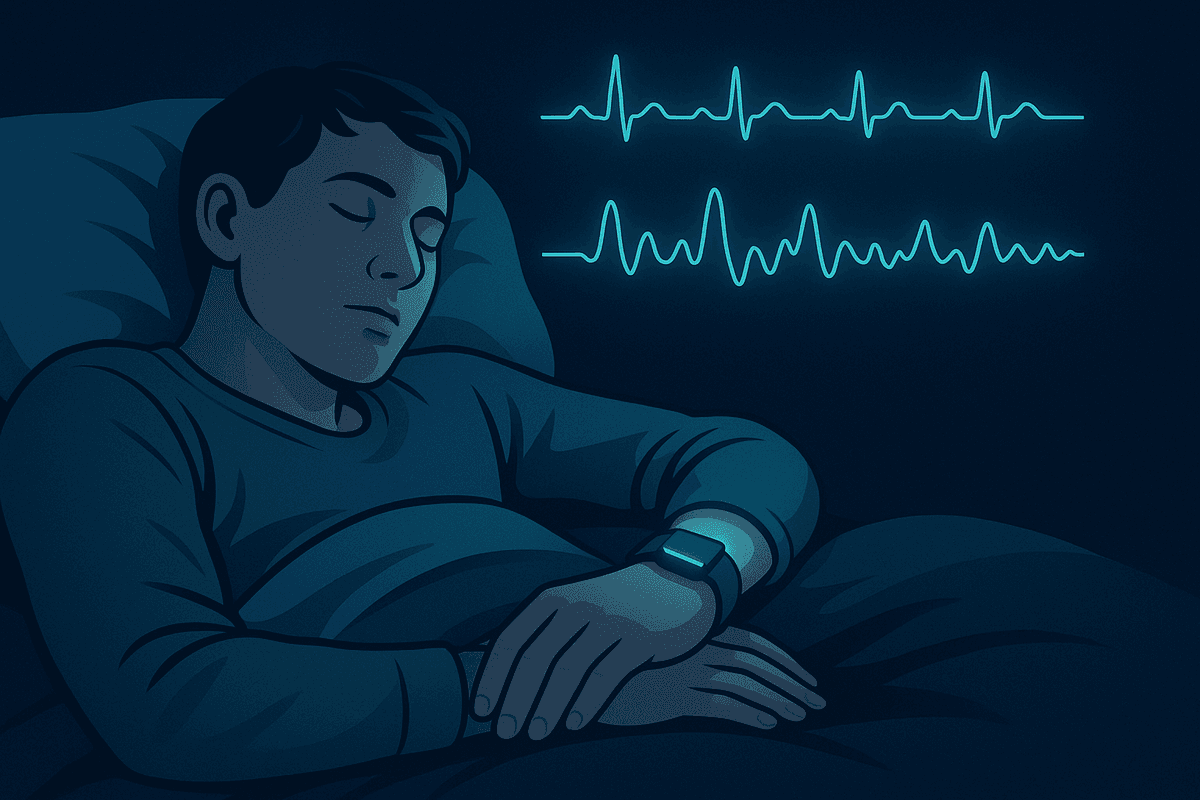
Wearable PPG devices are most accurate during sleep because minimal movement eliminates the main source of error: motion artifacts. Major devices like Oura Ring and Apple Watch show mean errors under 3 BPM for overnight heart rate. HRV metrics, particularly RMSSD, show good correlation with ECG-derived values, though some systematic biases exist across devices.
Why Sleep Is the Optimal Condition for PPG Accuracy
The biggest enemy of optical heart rate accuracy is movement. During sleep, that problem is largely eliminated. The wrist or finger lies still for hours, the sensor maintains consistent contact, and the optical signal is clean and clear.
This is why the accuracy rankings flip somewhat between exercise monitoring and sleep monitoring. Devices optimized for continuous wear and quiet overnight sensing (like Oura Ring) perform especially well during sleep, while the differences between brands narrow considerably compared to their exercise performance gaps.
The PPG signal basics explain why a clean, artifact-free signal is so much easier to process accurately.
Validation Studies: Overnight Heart Rate Accuracy
Multiple independent studies have compared wearable overnight heart rate to ECG obtained during sleep studies (polysomnography or overnight Holter monitors):
Oura Ring: Several studies specifically designed for nighttime use show mean absolute errors of 2.2-3.0 BPM for resting and nocturnal heart rate. A 2021 study in Sensors found Oura Ring Generation 2 showed mean heart rate error of 2.6 BPM during sleep compared to ECG, with better accuracy during NREM versus REM sleep.
Apple Watch: Studies show mean errors of 2-4 BPM during overnight monitoring. Some studies report slightly higher variability than Oura Ring, possibly related to wrist positioning variability. The Apple Watch tends to be more accurate during still sleep periods than during periods with tossing and turning.
Garmin: Similar to Apple Watch for overnight HR accuracy, with mean errors of 2-4 BPM in available studies. Garmin devices have strong battery life, which matters for continuous overnight monitoring.
Fitbit: Fitbit has been validated for sleep monitoring in multiple studies given its long history of sleep tracking. Mean overnight HR errors of 2-4 BPM are typical, with somewhat more variability at very low heart rates (under 50 BPM) like those seen in fit individuals.
Samsung Galaxy Watch: Less published sleep-specific validation data, but available evidence suggests similar overnight accuracy to Garmin and Fitbit.
All of these represent best-case accuracy for these devices. Exercise accuracy is substantially worse.
Heart Rate Variability During Sleep: What Wearables Can Measure
HRV during sleep is one of the most valuable metrics wearables provide. Nocturnal HRV reflects autonomic nervous system balance, recovery state, and overall cardiovascular health.
The key HRV metric for overnight monitoring is RMSSD (Root Mean Square of Successive Differences), which captures short-term vagally mediated variation in inter-beat intervals. RMSSD responds to stress, illness, recovery, and fitness changes, making it a useful longitudinal marker.
For RMSSD measurement accuracy, wearables must accurately detect individual inter-beat intervals (R-R intervals). Small errors in beat timing accumulate into RMSSD measurement error. This is a harder problem than simply measuring heart rate.
Oura Ring HRV validation: Multiple studies have found Oura Ring RMSSD to show good intraclass correlation coefficients (ICC 0.75-0.91) with ECG-derived RMSSD during overnight periods. The ring's consistent fingertip contact helps maintain clean IBI measurement.
Apple Watch HRV: Apple Watch reports RMSSD and makes it available through HealthKit. Studies show moderate to good correlation with ECG-derived RMSSD during overnight monitoring (ICC ~0.70-0.85), though the Apple Watch uses a different sampling and calculation approach than Oura.
Garmin HRV Status: Garmin's overnight HRV tracking uses a similar methodology, with available evidence showing ICC values in the 0.65-0.80 range compared to ECG during sleep studies.
For a deeper look at how HRV is measured and what the metrics mean, see PPG HRV wearable guide.
The Nocturnal Advantage: Why Some Metrics Are More Reliable Than Others
During overnight monitoring, wearables are tracking several physiological signals:
Resting heart rate (most accurate): Body is still, temperature equilibrated, signal stable. This is the most reliable metric from consumer wearables.
RMSSD HRV (accurate with caveats): Good correlation with ECG at rest and during NREM sleep. Less accurate during REM due to more body movement.
LF/HF ratio and frequency-domain HRV (moderate accuracy): These require longer segments of stable signal. Short movement periods during sleep disrupt the analysis. Results are more variable across studies.
Sleep staging (moderate accuracy): Sleep stages (light, deep, REM) are inferred from heart rate patterns, movement, temperature, and respiratory rate. Consumer wearables have moderate agreement with polysomnography for sleep staging, with better accuracy for NREM deep sleep than for light and REM distinction.
The PPG sleep staging algorithms article covers how consumer devices classify sleep stages and what the polysomnography comparison data shows.
Factors That Degrade Overnight Accuracy
Even during sleep, some factors impair wearable accuracy:
Loose fit during sleep: Wrist watches can shift during movement in sleep. The band that felt snug when you went to bed may have loosened. Oura Ring avoids this issue due to the rigid ring structure.
Sleeping on the arm: Compressing the wrist against the mattress for extended periods alters tissue blood flow, distorting the PPG signal. Some Apple Watch users sleep with the watch on the non-dominant arm specifically to reduce this.
Cold environments: Cold causes peripheral vasoconstriction, reducing blood flow to the extremities. This weakens the PPG signal amplitude at the wrist. Studies have found wearable heart rate accuracy slightly lower in cold sleep environments.
Tattoos: Tattooed skin absorbs optical wavelengths differently. If you wear a watch over a wrist tattoo during sleep, accuracy may be affected. See the discussion of optical interference in PPG ambient light interference.
Very low heart rates: Athletes or individuals with bradycardia (resting HR under 45-50 BPM) may show less accurate readings. PPG algorithms are typically optimized for the 50-100 BPM resting range.
Nocturnal Atrial Fibrillation and Wearable Detection
One clinically meaningful application of overnight wearable PPG is detecting nocturnal atrial fibrillation. AFib often occurs during sleep, and many episodes go undetected without long-term monitoring.
Consumer wearables with AFib detection (Apple Watch, Samsung Galaxy Watch, Withings ScanWatch) can detect irregular rhythms during overnight monitoring. Studies have shown reasonable sensitivity and specificity for AFib detection during sleep, though false-positive rates mean that identified irregularities should always be confirmed with clinical ECG.
The can wearables detect AFib article discusses the broader AFib detection evidence in detail.
Practical Implications for Sleep Monitoring Users
For users relying on wearables for sleep health insights:
Resting heart rate trends: Highly reliable as a longitudinal health indicator. Day-to-day variation is real; long-term trends (weeks to months) are the meaningful signal.
HRV tracking for recovery: Useful as a relative metric. Your personal baseline and trend matter more than absolute numbers. A consistent decline in your own overnight RMSSD is meaningful regardless of whether the absolute value matches ECG precisely.
Sleep staging: Use as a rough guide to sleep quality rather than precise staging. Consistently low deep sleep percentages are worth noting; exact minute counts per stage should not be over-interpreted.
Breathing irregularity flags: Devices that flag potential sleep apnea patterns based on SpO2 and heart rate variability provide useful screening information. A positive flag warrants discussion with a physician, not self-diagnosis.
For complete context on how PPG devices contribute to sleep health monitoring, see PPG sleep fragmentation biomarkers and wearable AHI estimation.
References
-
Kinnunen H, et al. "Feasibility of Oura Smart Ring to Capture Sleep Time and Sleep Quality Versus Polysomnography." Sensors 21(4):1278 (2021). doi:10.3390/s21041278
-
Altini M, Kinnunen H. "The Promise of Sleep: A Multi-Sensor Approach for Accurate Sleep Stage Detection Using the Oura Ring." Sensors 21(13):4302 (2021). doi:10.3390/s21134302
-
Dial MB, et al. "Validation of nocturnal resting heart rate and heart rate variability in consumer wearables." Physiological Reports 13:e70527 (2025). doi:10.14814/phy2.70527
-
Dunn J, et al. "Wearable sensors enable personalized predictions of clinical laboratory measurements." Nature Medicine 27(6):1105-1112 (2021). doi:10.1038/s41591-021-01339-0
-
de Zambotti M, et al. "Wearable sleep technology in clinical and research settings." Medicine & Science in Sports & Exercise 51(7):1538-1557 (2019). doi:10.1249/MSS.0000000000001947
Frequently Asked Questions
- How accurate are wearables for heart rate monitoring during sleep?
- Wearable PPG devices are at their most accurate during sleep because the body is still and motion artifacts are minimal. Most major devices (Oura Ring, Apple Watch, Garmin, Fitbit) show mean absolute errors under 3 BPM for overnight heart rate compared to ECG.
- Are sleep HRV readings from wearables accurate?
- Nocturnal HRV from validated wearables correlates well with ECG-derived HRV for RMSSD, the most commonly reported HRV metric. Oura Ring has the strongest validation data for overnight HRV. Apple Watch and Garmin show good correlation at rest and overnight, though some systematic biases exist.
- Which wearable is most accurate for sleep heart rate monitoring?
- Oura Ring and Apple Watch have the most validation data for sleep monitoring and both perform well. Oura Ring's finger placement gives strong signal quality overnight. The choice depends more on sleep staging accuracy and total feature set than heart rate alone.
- Can wearables accurately measure HRV during sleep stages?
- Yes, with limitations. Most validated wearables show good RMSSD correlation during NREM sleep. Accuracy during REM sleep is lower due to more movement. Stage-specific HRV comparisons are less reliable than overnight average HRV.
- Does wearing a wearable affect sleep quality?
- A small percentage of users report the device affecting their sleep through discomfort or orthosomnia (sleep anxiety from monitoring). Studies have not found significant population-level sleep disruption from wearable use, but individual variation exists.
- What causes inaccurate sleep heart rate readings from wearables?
- Loose watch fit (especially if you move and the device slides), sleeping position that compresses the sensor, skin contact issues in cold environments, and ambient light under covers can all affect accuracy. Oura Ring generally avoids the fit issue due to the secure ring form factor.
- How do wearables compare to polysomnography for sleep monitoring?
- Polysomnography (PSG) is the clinical gold standard for sleep study. For pure heart rate during sleep, wearables are reasonably accurate. For sleep staging (light, deep, REM), consumer wearables have moderate accuracy compared to PSG, particularly for REM detection.