Paperdoi:10.1038/s41467-026-72436-2
A self-supervised electrocardiogram foundation model for empowering cardiovascular disease prediction and genetic factor discovery (ECG-LFM)
Nature Communications (2026-04-27)
Licence: CC BY-NC-ND (OpenAlex)
TL;DR
ECG-LFM: pretrained on >10 million 12-lead ECGs from multiple datasets, combining contrastive learning with masked language modelling. Fine-tuned for 8 CVDs, average AUROC 0.930 across datasets. ECG-LFM-derived features (EDFs) map to known CVD biomarkers; GWAS on EDFs found 24 significant SNPs (8 novel); Mendelian randomisation suggests causal links for 2 CVDs and 4 EDFs.
- Form factor: clinical
Abstract
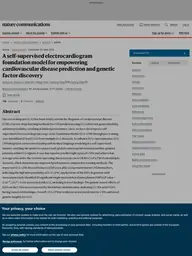
Electrocardiogram (ECG) has been widely used in the diagnosis of cardiovascular disease (CVD). Current deep learning methods for CVD prediction using ECG often lack generalizability and interpretability, resulting in limited performance. Here, we have developed a self-supervised Electrocardiogram Large-scale Foundation Model (ECG-LFM) through pre-training over ten million 12-lead ECGs from multiple ECG datasets. To enhance ECG representation, ECG-LFM integrates contrastive learning with masked language modeling in a self-supervised manner, enabling the model to capture both global contextual information and fine-grained patterns within ECG signals. It was fine-tuned to predict eight types of CVDs and achieved an average area under the receiver operating characteristic curve (AUROC) of 0.930 from multiple datasets, which demonstrates improved performance compared to existing methods. The important ECG-LFM derived features (EDFs) are able to represent known CVD biomarkers, indicating the high interpretability of ECG-LFM. Applications of the EDFs in genome-wide association study identified 24 significant single nucleotide polymorphisms (SNPs) (P-value -8, LD r2 < 0.01) associated with ECG, including 8 novel findings. The genetic causal effects of EDFs on the CVDs were evaluated by Mendelian randomization, indicating 2 CVDs and 4 EDFs having causal relationships. Overall, ECG-LFM provides accurate prediction for CVDs and novel genetic insights for ECG.
Verbatim from Europe PMC (opens in a new tab) · Licence: cc by-nc-nd
Results on ChatPPG leaderboards
All leaderboardsNo results from this paper on ChatPPG leaderboards yet. Browse the leaderboards.
Tasks & signals
Signals
Keywords
How it works
Cite this paper
APA
Lin, S., Li, Z., Wu, Q., Chen, Y., Yang, Y., & Zhao, H. (2026). A self-supervised electrocardiogram foundation model for empowering cardiovascular disease prediction and genetic factor discovery (ECG-LFM). Nature Communications. https://doi.org/10.1038/s41467-026-72436-2
BibTeX
@article{lin2026selfsupervised,
  title         = {{A self-supervised electrocardiogram foundation model for empowering cardiovascular disease prediction and genetic factor discovery (ECG-LFM)}},
  author        = {Lin, Siying and Li, Zhaoqi and Wu, Qifan and Chen, Yifeng and Yang, Yuedong and Zhao, Huiying},
  year          = {2026},
  journal       = {Nature Communications},
  doi           = {10.1038/s41467-026-72436-2}
}
Built from the hub record. Check it against the publisher before submitting.
Added to the ChatPPG research hub