PaperarXiv:2609.13190
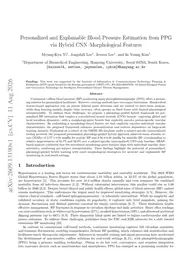
Personalized and Explainable Blood Pressure Estimation from PPG via Hybrid CNN--Morphological Features
arXiv preprint (cs.CV)
 (opens in a new tab)
Yi, Myung-Kyu et al., "Personalized and Explainable Blood Pressure Estimation from PPG via Hybrid CNN--Morphological Features", arXiv:2609.13190, CC BY 4.0
TL;DR
Continuous cuffless blood pressure (BP) monitoring using photoplethysmography (PPG) offers a promising solution for personalized healthcare. However, existing methods have two major limitations. Handcrafted feature-based approaches rely on precise fiducial point detection and are limited to short-term analysis, while deep learning models, despite their accuracy, often operate as black boxes with limited physiological interpretability.
- Form factor: other
Abstract
Continuous cuffless blood pressure (BP) monitoring using photoplethysmography (PPG) offers a promising solution for personalized healthcare. However, existing methods have two major limitations. Handcrafted feature-based approaches rely on precise fiducial point detection and are limited to short-term analysis, while deep learning models, despite their accuracy, often operate as black boxes with limited physiological interpretability. To address these challenges, we propose a physiology-guided hybrid framework for personalized BP estimation that couples a convolutional neural network (CNN) branch capturing global and local waveform dynamics with a morphology-prior branch that explicitly encodes person-specific vascular characteristics. By embedding a morphology-based feature set that explicitly encodes individual vascular characteristics, the proposed framework enhances personalization and reduces dependence on large-scale training datasets. Evaluated on a subset of the MIMIC-III database under a subject-specific (personalized) testing protocol, the proposed personalized physiology-guided hybrid approach achieved mean absolute errors (MAEs) of 3.77 mmHg for systolic BP and 2.36 mmHg for diastolic BP, corresponding to relative improvements of 43.7% and 32.4% over a subject-specific (personalized) CNN-only baseline. SHAP-based analysis confirmed that the introduced morphology-prior features align with individual vascular characteristics, reinforcing per-subject interpretability. These findings highlight the potential of personalized, physiology-guided hybrid learning with novel morphological descriptors for accurate and explainable BP monitoring in real-world settings.
Verbatim from arXiv (opens in a new tab) · arXiv metadata (abstracts are released under CC0)
Results on ChatPPG leaderboards
All leaderboardsNo results from this paper on ChatPPG leaderboards yet. Browse the leaderboards.
Tasks & signals
Tasks
Signals
Keywords
How it works
Cite this paper
APA
Yi, M.-K., Lee, J., Lee, J., & Kim, I. Y. (2026). Personalized and Explainable Blood Pressure Estimation from PPG via Hybrid CNN--Morphological Features. arXiv preprint. https://doi.org/10.1109/ACCESS.2026.3658724
BibTeX
@misc{yi2026personalized,
  title         = {{Personalized and Explainable Blood Pressure Estimation from PPG via Hybrid CNN--Morphological Features}},
  author        = {Yi, Myung-Kyu and Lee, Jongshill and Lee, Jeyeon and Kim, In Young},
  year          = {2026},
  howpublished  = {arXiv preprint},
  doi           = {10.1109/ACCESS.2026.3658724},
  eprint        = {2609.13190},
  archivePrefix = {arXiv}
}
Built from the hub record. Check it against the publisher before submitting.
Added to the ChatPPG research hub