PaperarXiv:2605.18802
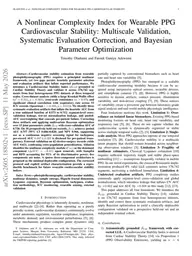
A Nonlinear Complexity Index for Wearable PPG Cardiovascular Stability: Multiscale Validation, Systematic Evaluation Correction, and Bayesian Parameter Optimization
arXiv preprint (eess.SP, cs.AI, cs.LG)
TL;DR
Cardiovascular stability estimation from wearable photoplethysmography (PPG) requires a principled nonlinear framework, yet major gaps persist in heuristic parameter selection and evaluation protocols that inflate reported performance. Cross-dataset analysis demonstrates a large Kruskal-Wallis effect size (eta2 = 0.351, p < 0.001), strong cross-scale consistency (kappa > 0.97), and significant correlation with respiratory rate across 53 ICU records (Spearman r = 0.346, p = 0.011).
- Form factor: wrist
Abstract
Cardiovascular stability estimation from wearable photoplethysmography (PPG) requires a principled nonlinear framework, yet major gaps persist in heuristic parameter selection and evaluation protocols that inflate reported performance. We introduce a Stability-Constrained Cardiovascular Stability Index (SCSI) grounded in Cardiac Stability Theory and validate it across 176,742 segments from four heterogeneous PPG datasets at three temporal scales. Cross-dataset analysis demonstrates a large Kruskal-Wallis effect size (eta2 = 0.351, p 0.97), and significant correlation with respiratory rate across 53 ICU records (Spearman r = 0.346, p = 0.011). We identify three evaluation artifacts that inflate heuristic AUC from a true baseline of 0.573 to 0.752: segment-level cross-validation leakage, test-set normalization leakage, and pooled-AUC overweighting that conceals per-patient failure. Correcting these artifacts and applying Bayesian optimization over 15 joint parameters yields SCSI with cross-validation AUC of 0.720. On 18 held-out records, SCSI achieves pooled AUC of 0.757 (95% CI: 0.686-0.828) and negative predictive value of 0.966 for tachypnea screening, while per-record AUC of 0.497 +/- 0.207 is disclosed for transparency. External validation on 42 elective-surgery records yields AUC of 0.621, confirming cross-population generalization. Ablation analysis identifies the nonlinear complexity module as the dominant component. A sparse three-component architecture is proposed as the minimal deployable configuration. The corrected protocol provides a reproducible benchmark for future wearable cardiovascular stability indices.
Verbatim from arXiv (opens in a new tab) · arXiv metadata (abstracts are released under CC0)
Results on ChatPPG leaderboards
All leaderboardsNo results from this paper on ChatPPG leaderboards yet. Browse the leaderboards.
Tasks & signals
Tasks
Signals
Keywords
How it works
Cite this paper
APA
Oladunni, T., & Adewumi, F. G. (2026). A Nonlinear Complexity Index for Wearable PPG Cardiovascular Stability: Multiscale Validation, Systematic Evaluation Correction, and Bayesian Parameter Optimization. arXiv preprint. https://doi.org/10.48550/arXiv.2605.18802
BibTeX
@misc{oladunni2026nonlinear,
  title         = {{A Nonlinear Complexity Index for Wearable PPG Cardiovascular Stability: Multiscale Validation, Systematic Evaluation Correction, and Bayesian Parameter Optimization}},
  author        = {Oladunni, Timothy and Adewumi, Farouk Ganiyu},
  year          = {2026},
  howpublished  = {arXiv preprint},
  doi           = {10.48550/arXiv.2605.18802},
  eprint        = {2605.18802},
  archivePrefix = {arXiv}
}
Built from the hub record. Check it against the publisher before submitting.
Added to the ChatPPG research hub