PaperarXiv:2603.20442
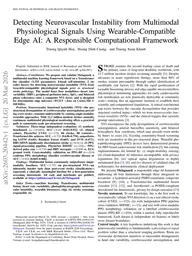
Detecting Neurovascular Instability from Multimodal Physiological Signals Using Wearable-Compatible Edge AI: A Responsible Computational Framework
arXiv preprint (cs.LG, cs.AI) · 11 pages, 8 figures, 6 tables. Submitted to IEEE JBHI. Code: https://github.com/ClevixLab/Melaguard
TL;DR
The model fuses heart rate variability (HRV), peripheral perfusion index, SpO2, and bilateral phase coherence into a composite NVI Score, designed for edge inference (WCET <=4 ms on Cortex-M4). NVI - the pre-structural dysregulation of cerebrovascular autoregulation preceding overt stroke - remains undetectable by existing single-modality wearables. With 12.2 million incident strokes annually, continuous multimodal physiological monitoring offers a practical path to community-scale screening.
- Form factor: other
Abstract
We propose Melaguard, a multimodal ML framework (Transformer-lite, 1.2M parameters, 4-head self-attention) for detecting neurovascular instability (NVI) from wearable-compatible physiological signals prior to structural stroke pathology. The model fuses heart rate variability (HRV), peripheral perfusion index, SpO2, and bilateral phase coherence into a composite NVI Score, designed for edge inference (WCET <=4 ms on Cortex-M4). NVI - the pre-structural dysregulation of cerebrovascular autoregulation preceding overt stroke - remains undetectable by existing single-modality wearables. With 12.2 million incident strokes annually, continuous multimodal physiological monitoring offers a practical path to community-scale screening. Three-stage independent validation: (1) synthetic benchmark (n=10,000), AUC=0.88 [0.83-0.92]; (2) clinical cohort PhysioNet CVES (n=172; 84 stroke, 88 control) - Transformer-lite achieves AUC=0.755 [0.630-0.778], outperforming LSTM (0.643), Random Forest (0.665), SVM (0.472); HRV-SDNN discriminates stroke (p=0.011); (3) PPG pipeline PhysioNet BIDMC (n=53) – pulse rate r=0.748 and HRV surrogate r=0.690 vs. ECG ground truth. Cross-modality validation on PPG-BP (n=219) confirms PPG morphology classifies cerebrovascular disease at AUC=0.923 [0.869-0.968]. Multimodal fusion consistently outperforms single-modality baselines. Code: https://github.com/ClevixLab/Melaguard
Verbatim from arXiv (opens in a new tab) · arXiv metadata (abstracts are released under CC0)
Results on ChatPPG leaderboards
All leaderboardsNo results from this paper on ChatPPG leaderboards yet. Browse the leaderboards.
Tasks & signals
Tasks
Signals
Keywords
How it works
Cite this paper
APA
Hoa, T. Q., Cuong, H. D., & Khanh, T. X. (2026). Detecting Neurovascular Instability from Multimodal Physiological Signals Using Wearable-Compatible Edge AI: A Responsible Computational Framework. arXiv preprint · 11 pages, 8 figures, 6 tables. Submitted to IEEE JBHI. Code: https://github.com/ClevixLab/Melaguard. https://doi.org/10.48550/arXiv.2603.20442
BibTeX
@misc{hoa2026detecting,
  title         = {{Detecting Neurovascular Instability from Multimodal Physiological Signals Using Wearable-Compatible Edge AI: A Responsible Computational Framework}},
  author        = {Hoa, Truong Quynh and Cuong, Hoang Dinh and Khanh, Truong Xuan},
  year          = {2026},
  howpublished  = {arXiv preprint · 11 pages, 8 figures, 6 tables. Submitted to IEEE JBHI. Code: https://github.com/ClevixLab/Melaguard},
  doi           = {10.48550/arXiv.2603.20442},
  eprint        = {2603.20442},
  archivePrefix = {arXiv}
}
Built from the hub record. Check it against the publisher before submitting.
Added to the ChatPPG research hub