PaperarXiv:2609.16248
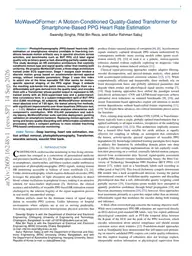
MoWaveQFormer: A Motion-Conditioned Quality-Gated Transformer for Smartphone-Based PPG Heart Rate Estimation
arXiv preprint
 (opens in a new tab)
Singha, Swandip et al., "MoWaveQFormer: A Motion-Conditioned Quality-Gated Transformer for Smartphone-Based PPG Heart Rate Estimation", arXiv:2609.16248, CC BY 4.0
TL;DR
Three-stage ECG-supervised architecture for smartphone PPG HR: (1) discrete motion group from ACC spectral energy; (2) motion-indexed learnable FIR banks for spectral shaping; (3) patch Transformer with quality-aware gating. Motivated by BUT PPG v2.0 binary good/bad labels discarding partially usable windows.
- Form factor: other
Abstract
Photoplethysmography (PPG)-based heart-rate (HR) estimation on smartphones remains unreliable in free-living conditions because motion artifacts vary in spectral structure across activities, and benchmarks such as BUT PPG v2.0 label signal quality only as binary good or bad, discarding partially usable data. This study develops an HR estimation architecture that explicitly conditions motion type and signal quality rather than treating both uniformly. We propose MoWaveQFormer, a three-stage architecture trained under ECG supervision. Stage 1 assigns each window a discrete motion group based on accelerometer-derived spectral energy, without trainable parameters. Stage 2 uses this index to select one of the three learnable FIR filter banks for motion-specific spectral shaping of the PPG signal. Stage 3 embeds the resulting sub-bands into patch tokens, re-weights them via a differentiable soft gate derived from the quality label, and encodes them with a Transformer whose pooled output is regressed to HR, trained jointly with an ECG-supervised loss and a pulse-transit-time consistency term. In a subject-independent split of BUT PPG v2.0 (3,888 recordings, 50 subjects), MoWaveQFormer achieved a mean absolute error of 7.85 bpm, the lowest among five methods, with significant improvements over three baselines (Wilcoxon test, p<0.05). Ablation and Bland-Altman analyses characterize each component's contribution. With 816,445 parameters and sub-3-ms latency, MoWaveQFormer suits real-time deployment, pending validation on smartphone hardware. Replacing motion-agnostic filtering and binary quality discarding with differentiable conditioned processing offers a compact pathway to more reliable free-living PPG-based cardiovascular monitoring.
Verbatim from arXiv (opens in a new tab) · arXiv metadata (abstracts are released under CC0)
Results on ChatPPG leaderboards
All leaderboardsNo results from this paper on ChatPPG leaderboards yet. Browse the leaderboards.
Tasks & signals
Tasks
Signals
Keywords
How it works
Cite this paper
APA
Singha, S., Bin Reza, R., & Sabuj, S. R. (2026). MoWaveQFormer: A Motion-Conditioned Quality-Gated Transformer for Smartphone-Based PPG Heart Rate Estimation. arXiv preprint. https://arxiv.org/abs/2609.16248
BibTeX
@misc{singha2026mowaveqformer,
  title         = {{MoWaveQFormer: A Motion-Conditioned Quality-Gated Transformer for Smartphone-Based PPG Heart Rate Estimation}},
  author        = {Singha, Swandip and Bin Reza, Rifat and Sabuj, Saifur Rahman},
  year          = {2026},
  howpublished  = {arXiv preprint},
  eprint        = {2609.16248},
  archivePrefix = {arXiv}
}
Built from the hub record. Check it against the publisher before submitting.
Added to the ChatPPG research hub