PaperarXiv:2502.17486
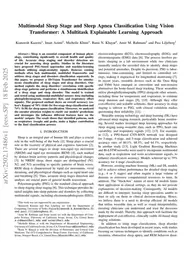
Multimodal Sleep Stage and Sleep Apnea Classification Using Vision Transformer: A Multitask Explainable Learning Approach
arXiv preprint (eess.SP, cs.LG)
 (opens in a new tab)
Kazemi, Kianoosh et al., "Multimodal Sleep Stage and Sleep Apnea Classification Using Vision Transformer: A Multitask Explainable Learning Approach", arXiv:2502.17486, CC BY 4.0
TL;DR
1D-Vision Transformer multitask model jointly classifying sleep stages and sleep apnea from multimodal PPG + respiratory flow + respiratory effort. Reported overall 5-stage accuracy 78% (κ 0.66) and apnea classification accuracy 74% (κ 0.58); attention-weight analysis highlights respiratory troughs/peaks. Included because it jointly does staging (not apnea-only) with PPG as a primary multimodal channel.
- Form factor: other
Abstract
Sleep is an essential component of human physiology, contributing significantly to overall health and quality of life. Accurate sleep staging and disorder detection are crucial for assessing sleep quality. Studies in the literature have proposed PSG-based approaches and machine-learning methods utilizing single-modality signals. However, existing methods often lack multimodal, multilabel frameworks and address sleep stages and disorders classification separately. In this paper, we propose a 1D-Vision Transformer for simultaneous classification of sleep stages and sleep disorders. Our method exploits the sleep disorders' correlation with specific sleep stage patterns and performs a simultaneous identification of a sleep stage and sleep disorder. The model is trained and tested using multimodal-multilabel sensory data (including photoplethysmogram, respiratory flow, and respiratory effort signals). The proposed method shows an overall accuracy (cohen's Kappa) of 78% (0.66) for five-stage sleep classification and 74% (0.58) for sleep apnea classification. Moreover, we analyzed the encoder attention weights to clarify our models' predictions and investigate the influence different features have on the models' outputs. The result shows that identified patterns, such as respiratory troughs and peaks, make a higher contribution to the final classification process.
Verbatim from arXiv (opens in a new tab) · arXiv metadata (abstracts are released under CC0)
Results on ChatPPG leaderboards
All leaderboardsNo results from this paper on ChatPPG leaderboards yet. Browse the leaderboards.
Tasks & signals
Tasks
Signals
Keywords
How it works
Cite this paper
APA
Kazemi, K., Azimi, I., Khine, M., Khayat, R. N., Rahmani, A. M., & Liljeberg, P. (2025). Multimodal Sleep Stage and Sleep Apnea Classification Using Vision Transformer: A Multitask Explainable Learning Approach. arXiv preprint. https://doi.org/10.48550/arXiv.2502.17486
BibTeX
@misc{kazemi2025multimodal,
  title         = {{Multimodal Sleep Stage and Sleep Apnea Classification Using Vision Transformer: A Multitask Explainable Learning Approach}},
  author        = {Kazemi, Kianoosh and Azimi, Iman and Khine, Michelle and Khayat, Rami N. and Rahmani, Amir M. and Liljeberg, Pasi},
  year          = {2025},
  howpublished  = {arXiv preprint},
  doi           = {10.48550/arXiv.2502.17486},
  eprint        = {2502.17486},
  archivePrefix = {arXiv}
}
Built from the hub record. Check it against the publisher before submitting.
Added to the ChatPPG research hub